BEING ERNEST: The Untold Story Of Ottawa’s Korean War Ace

ernest

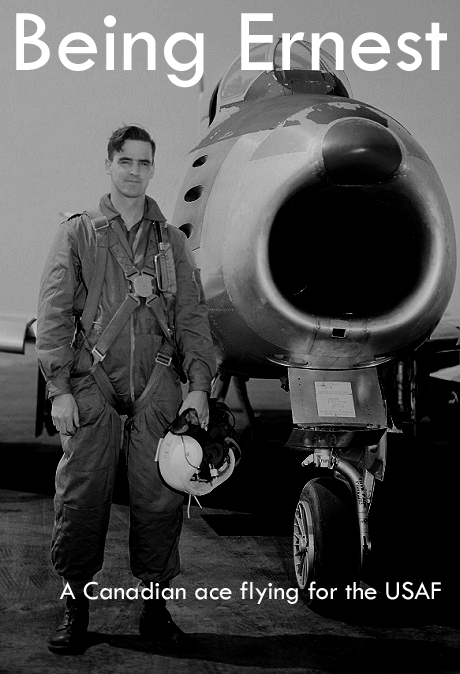
Ernie Glover, an Ottawa based pilot flying American Sabre jets during the Korean War.

As another Remembrance Day approaches we reflect on those that served our country and sacrifices made throughout history’s conflicts. Yet often quietly and unintentionally overlooked are those that served in what has been dubbed The Forgotten War. A ghastly war that raged in the cold mountains of Korea from 1950 to 1953, it involved United Nations forces led by the United States against Communist forces of China and the Soviet Union. Almost 26,000 Canadians participated in the Korean War under UN command in both ground and naval combat roles with air combat limited to transport and supply missions. Well, sort of. It turns out that some Canadian fighter pilots with the Royal Canadian Air Force volunteered their services to the United States Air Force flying Canadian made Sabre jets against Soviet MIGs. One of these pilots was an Ottawa based fellow by the name of Ernest Glover, a man with a fascinating life story that I think needs to be told, a story that unfolds like a Hollywood film.

BEING ERNEST.

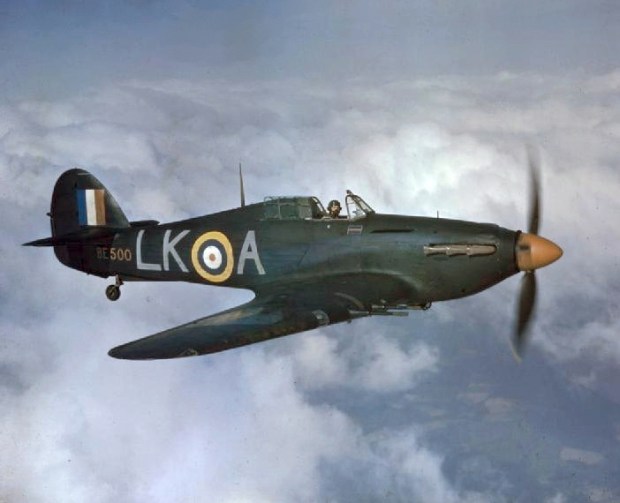
Ernest Arthur Glover grew up in Toronto and in 1940 at the age of 18 enlisted in the RCAF to serve his country during World War II, training near Hamilton to become a pilot. Ernie soon got a taste of the war beingshipped to England where he was strapped into Hawker Hurricanes for night fighter missions.

Ernie Glover entered air combat during World War II flying night fighter missions in a Hawker Hurricane.

Ernie Glover entered air combat during World War II flying night fighter missions in a Hawker Hurricane. (Photo: Wikipedia)

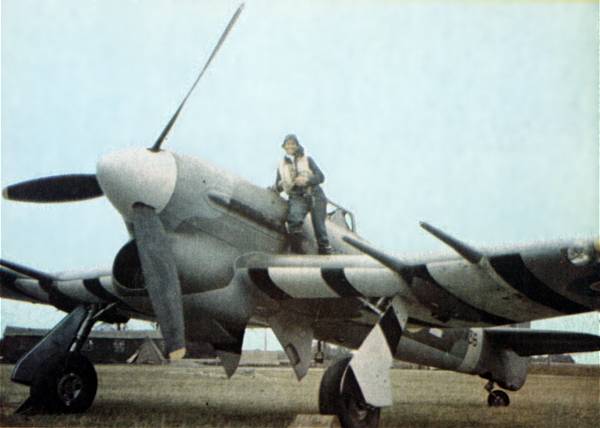
Gaining valuable combat experience in Hurricanes, Ernie soon moved into the more powerful and formidable Hawker Typhoon, flying fighter missions into occupied Europe. On one such mission in 1943 over France, Ernie was blasted by German flak that downed his Typhoon forcing him into the hands of the Germans and a Prisoner Of War.

Ernie Glover then moved into the more formidable Hawker Typhoon, but was peter shot down over France.

Ernie Glover advanced into the more formidable Hawker Typhoon, but in 1943 was shot down over France and became a PoW.

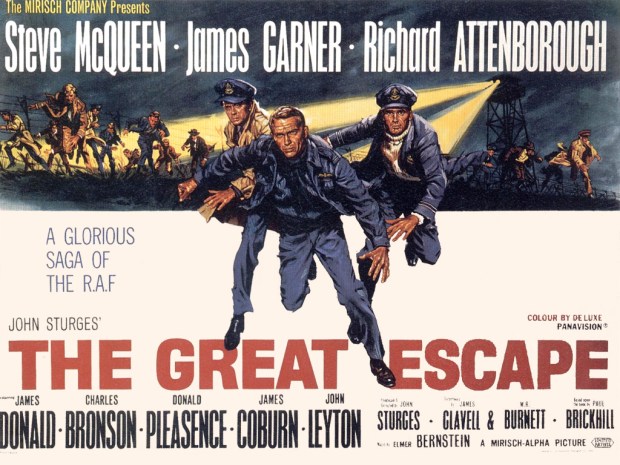
Ernie found himself a PoW at a place called Stalag Luft III. This German PoW camp is better known as the site of The Great Escape and contained captured Allied airmen who worked tirelessly to tunnel their way out of the prison camp. Their exploits were made into a 1963 film starring Steve McQueen, “The Great Escape”. Ernie was present during the Great Escape but remained confined at Stalag Luft III until the end of the war.

Glover was a prisoner at Stalag Luft III, the prison camp that was the scene of the Great Escape, later made into a Hollywood film.

Glover was a prisoner at Stalag Luft III, the prison camp that was the scene of the Great Escape, later made into a Hollywood film.

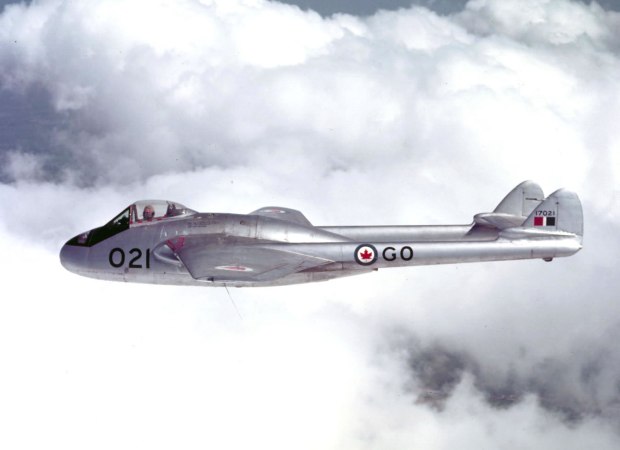
After being liberated from Stalag Luft III Ernie returned to Canada where he worked for Dominion Bridge in Montreal. Ernie could not seem to keep his feet on the ground and in 1948 re-enlisted back into the RCAF and in 1951 came to Ottawa to fly the new Vampire jets stationed at Ottawa’s Uplands Air Force Base.

Upon being freed from prison camp in Germany, Ernie returned to Canada and in 1951 flew Vampire jets in Ottawa.

Upon being freed from prison camp in Germany, Ernie returned to Canada and in 1951 flew Vampire jets in Ottawa.

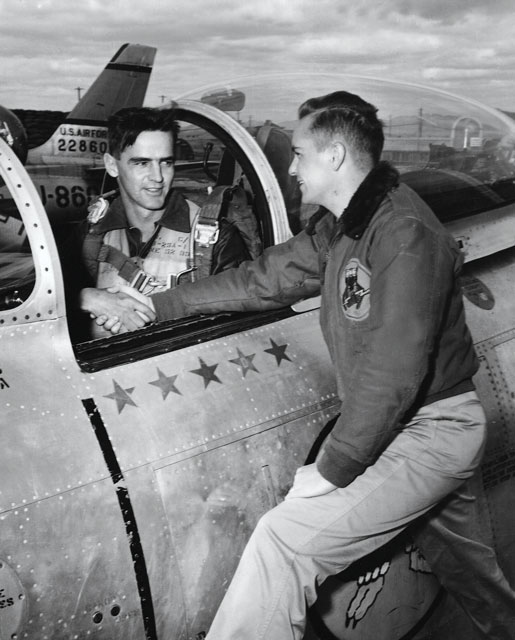
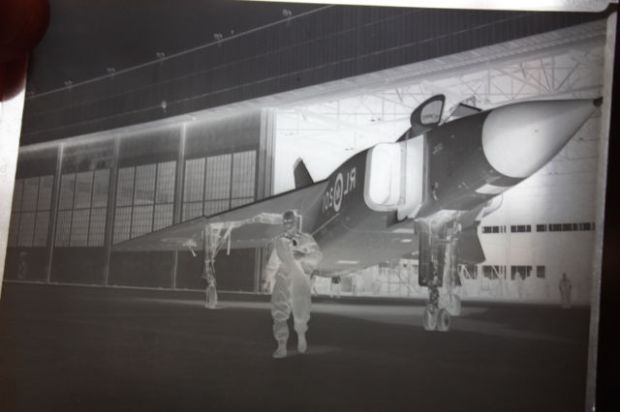
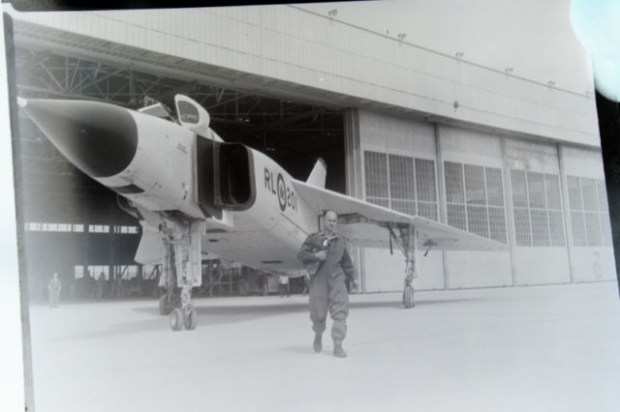
Mastering these new jet engined fighter craft, Ernie volunteered with 22 other RCAF pilots to join the Americans fighting in the skies above Korea. You see, the best fighter jet in the world at the time was the F-86 Sabre, and Canada was producing their own variant called the Canadair CF-86 built in Montreal, of which many were being sent to Korea for service with the USAF. RCAF pilots were unable to join the air battles over Korea in their own Canadian Sabres, but in 1952 as volunteers fighting under the American flag these 22 Canadian pilots got their wish to experience the mighty Sabre in combat. Ernie Glover was one of these eager pilots, and he joined the USAF 334th Fighter Squadron in Korea.

Ernie Glover in the cockpit of a Sabre jet in Korea flying for the USAF. (photo:Legion Magazine)

Ernie Glover (left) in the cockpit of a Sabre jet in Korea flying for the USAF. (photo:Legion Magazine)

Now in the Sabre, Ernie soon engaged Soviet made MIG fighters on an almost daily basis under treacherous flying conditions. Dog fighting in “MIG Alley”, a dangerous zone of air combat where the Sabres and MiGs would battle it out in what was to be the first large scale jet to jet aerial combat scenario, RCAF pilots in USAF marked Sabres flew over 900 combat missions with 9 confirmed MIG kills. Ernie happened to down 3 of those nine MIGs, the highest score of any RCAF pilot in Korea making him a distinguished combat pilot.

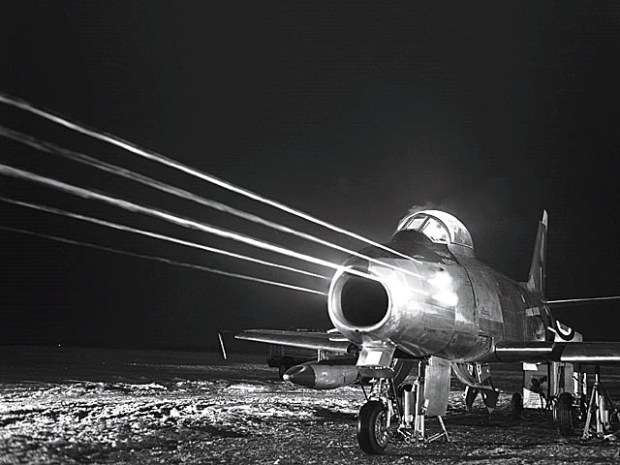
F-86 Sabre jet of the 334th Squadron in Korea of which Glover flew 58 combat missions.

F-86 Sabre jet of the USAF 334th Squadron in Korea of which Glover flew 58 combat missions.

Ernie flew a total of 58 combat missions and the Americans recognized Ernie’s air combat skills in the Sabre and awarded him the American Distinguished Flying Cross, a medal reserved for those with “the Air Corps of the Army of the United States, who distinguishes himself, or herself by heroism or extraordinary achievement while participating in an aerial flight.” Ernie shared his American DFC with the likes of Jimmy Doolittle, Amelia Earhart, Buzz Aldrin, and John Glenn. Ernie was also awarded the Commonwealth Distinguished Flying Cross, the very last RCAF pilot to do so for his service in the skies over Korea.

ERnie Glover shot down 3 MiG fighters and was awarded the Distingusihed Flying Cross by the Americans for his service in Korea.

Ernie Glover shot down 3 MiG fighters and was awarded the Distingusihed Flying Cross by the Americans for his service in Korea.

After completing his 58 missions in the American Sabres, Ernie returned to Ottawa to fly Canadian Sabres now outfitted to 422 Fighter Squadron at Uplands RCAF Air Base south of the city.

A Canadair CF-86 Sabre at Uplands Air Base in Ottawa.

A Canadair CF-86 Sabre at Uplands Air Base in Ottawa.

Returning to the familiar cockpit of the Sabre in Ottawa, and almost 20 years after he was last there, Ernie re-visted the skies over Europe with the RCAF in Germany.  Also flying other aircraft, Ernie was later stationed in Trenton, On where he finally retired from the RCAF in 1970 after 30 years of service.

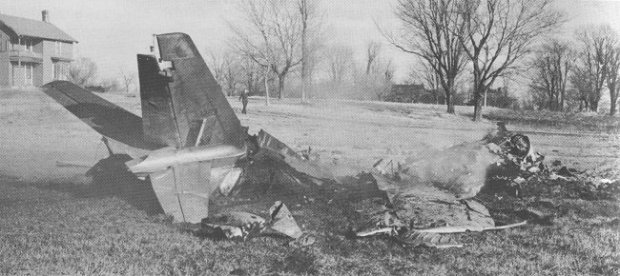
A crashed CF-86 Sabre from Uplands that exploded after hitting the ground near Manotick.

A crashed CF-86 Sabre from Uplands that exploded after hitting the ground near Manotick.

Ernie left fighter jets to take on small town life in Frankford just north of Trenton. Having been a fighter pilot in World War II, shot down in Europe, a PoW in the Great Escape prison camp and a decorated Canadian Korean War air ace flying with the Americans, Ernie seemed almost invincible. Almost. Having survived all these battles, Ernest had one last battle to fight but was later admitted to hospital in 1991. Ernie Glover, the little known Ottawa ace, made a final flight to other skies on September 9th in a Belleville Hospital. His life’s journey was most definitely an earnest one.

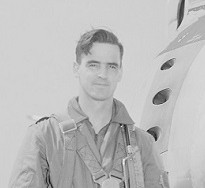
Ernie Glover, the air ace from Ottawa.

Ernie Glover, the air ace from Ottawa.

SOURCES

Air Crew Remembered

Canada’s Veterans Hall Of Honour

Canadian Warplanes, 2009, Harold Skaarup

Legion Magazine

Wikipedia: “Korean War”, “Distinguished Flying Cross”


Stone Tower Could Be Ontario’s Oldest Remaining Windmill

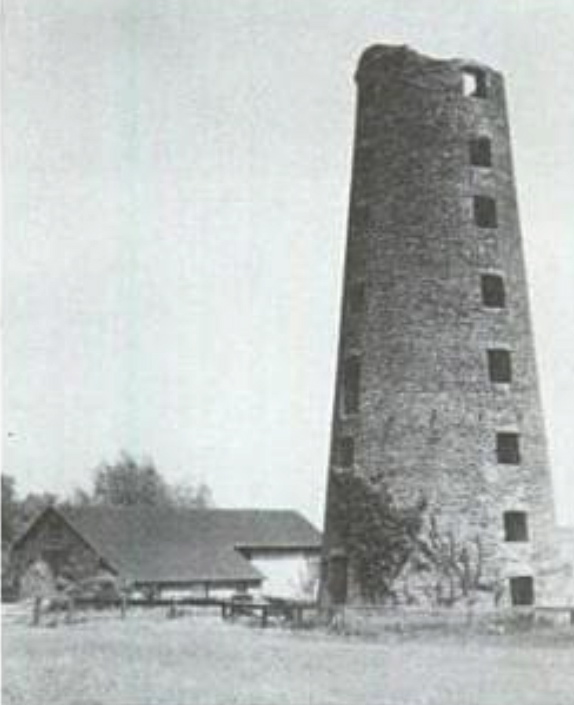
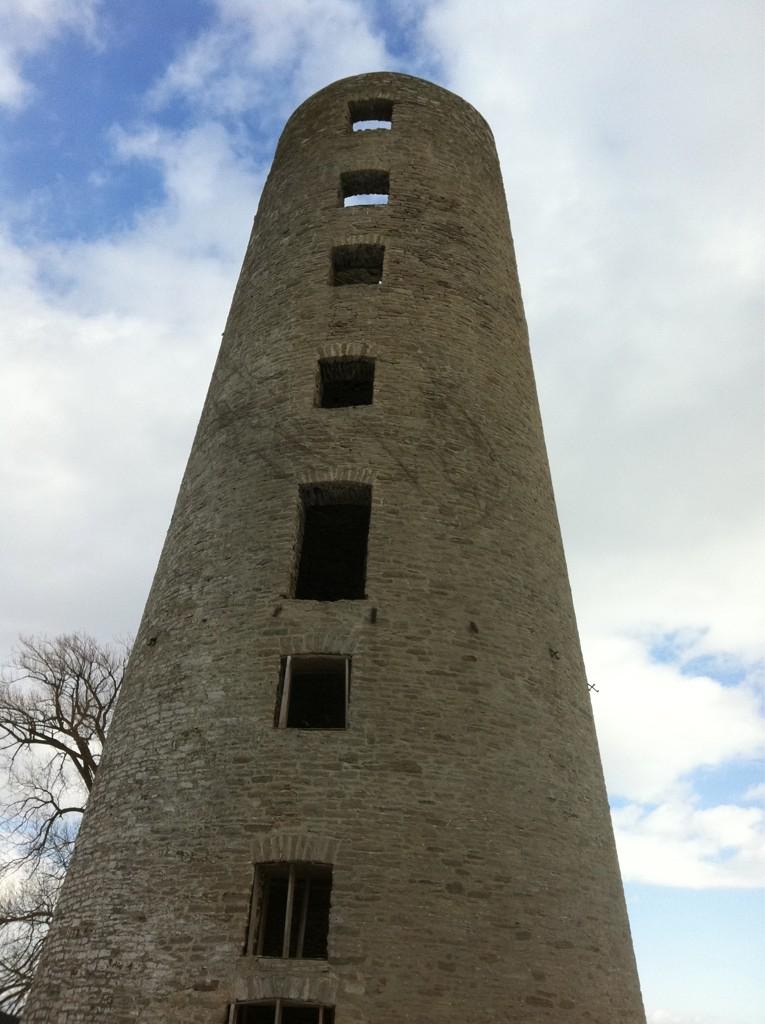
This old stone tower near Maitland, Ont. could very well be the ruins of Ontario's Oldest Windmill.

This old stone tower near Maitland, Ont. could very well be the ruins of Ontario’s Oldest Windmill. (Source: Google Maps)

One of the nicest drives in the region has to be the scenic cruise along Highway 2 that parallels the mighty St. Lawrence River between Gananoque and Prescott. The meandering old highway follows the shores of the St. Lawrence and along with panoramic views you are also treated to a ride through time. For thousands of years the St. Lawrence has been an important waterway and during the early days of European exploration and settlement it was a crucial area for industry, trade, and strategic military importance. While driving along this highway of history one day I spotted an unusual stone tower at the side of the road near the river. Resembling a lookout tower from some old abandoned medieval castle, I noted its position and snapped a few pics for future research. Upon further investigation it seems this was no medieval lookout tower but rather the ruins of what could be the oldest standing windmill in Ontario.

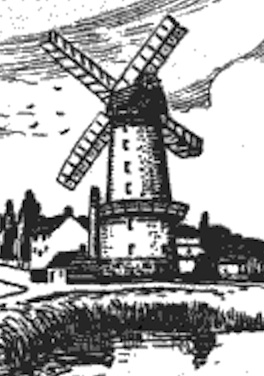
An sketch of an early 1800s windmill that would have been almost identical to the stone tower on Highway2.

An sketch of an early 1800s windmill that would have been almost identical to the stone tower on Highway2.

The first windmill in Upper Canada was a cylindrical tower of stone built in the 1790s near Prince Edward County on the shores of Lake Ontario to pump water from the lake to a Loyalist homestead, but nothing remains of this structure after it was abandoned and demolished in 1877. There’s the old stone windmill that is a National Historic Site near Prescott that was constructed in 1832 and was later converted into a lighthouse after it served as a fort during a failed rebellion attack from the United States. This stone tower has been restored and cared for by Parks Canada which lies about 20 minutes east of our forgotten tower of wind.

An early 20th century photo of the tower. It was abandoned in

An early 20th century photo of the tower. It was abandoned as a windmill in 1837.

Originally built in 1827 by George Longley who arrived in the town of Maitland a year earlier, this structure predates the Prescott mill by 5 years and towers 80 feet to the top with a base circumference of 34 feet. A wooden cap was added to the tower with wooden sails that measured almost 100ft long from tip to tip. These were made of cloth spread over a lattice that could be adjusted to regulate the speed and rate of rotation. A wooden balcony at the 30ft high mark surrounded the tower, of which you can still see the remains of iron brackets from where it was attached.

The iron brackets used to fasten the wooden balcony that surrounded the tower can clearly be seen.

The iron brackets used to fasten the wooden balcony that surrounded the tower can clearly be seen.

I’m not sure if this windmill was to mill wheat or to pump water up from the river like the one near Prince Edward County. It seems Mr.Longley only operated the windmill for about ten years when rotation of its massive sails were ceased and it was converted into a grain silo. A steam powered mill was built alongside it to grind flour and oats. Longley died in 1842 and soon the whole place closed down in 1854. Sitting vacant until 1863, the new owners of the property decided it would be a great place to build a distillery, of which they did, and the Halladay Family made over 275,000 gallons of whisky a year. It was shut down for some “irregularities” in 1865.

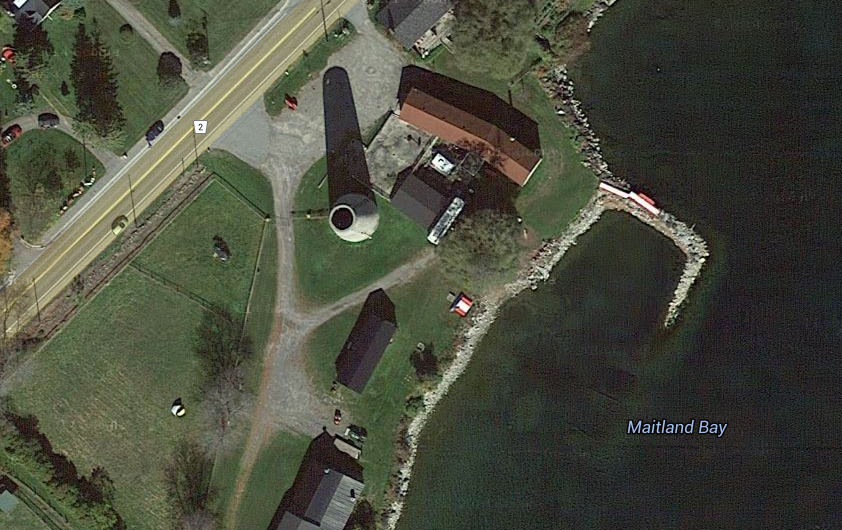
Google Maps Satellite image of the stone tower ruins.

Google Maps Satellite image of the stone tower ruins.

At the beginning of the 20th century, the old windmill still remained, and almost a hundred years after it was built, the new property owner, Peter Webster took an interest in saving the stone tower and repaired it for Canada’s Centennial. In 1936 Webster and his partner formed “Maitland Charts” that produced rolled nautical charts and sonar paper for the Royal Navy. In 1973, the chart company business literally went off the charts and the company moved to a bigger space leaving the tower to stand alone where it still stands today.

The current owners of the tower seem to have taken a keen interest in keeping it standing as best they can, maintaining this forgotten sentinel of the St. Lawrence. If this really is Ontario’s oldest standing windmill sitting at he side of the road it might be worth the 45minute drive from Ottawa to take a look at the old tower of power, a lost relic from a time when wind and sail ruled the land and sea.

SOURCES

“Maitland: A Very Neat Village Indeed” by Stephen Otto, Richard Dumbrille, 1985

Google Maps

Wikipedia “List Of Windmills in Canada”


TRACKING CHAMPLAIN: Plotting the explorer’s epic journey on the 400th anniversary

400 years ago this week one of the world’s most renowned explorers set out on an epic journey…This autumn marks the Quadricentennial of Samuel de Champlain’s adventurous voyage through Central-Eastern Ontario along its many waterways and through its forests. With a team of Huron warriors on a mission to defeat the Iroquois in what is now Upper New York state, Champlain walked and paddled through our own backyard. Using current mapping technology and Champlain’s very own detailed journal entries we can plot the famous explorer’s 400 year old expedition…

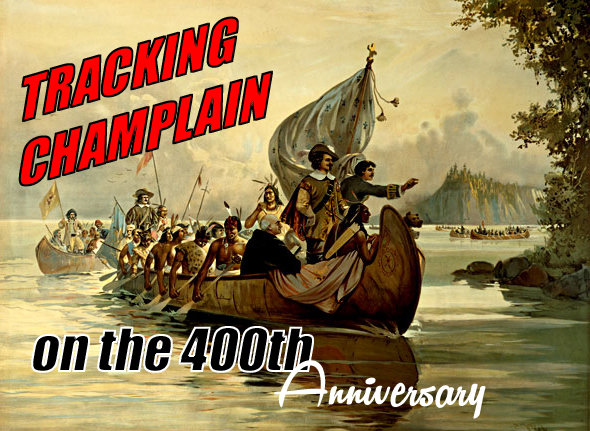
CHAMP-title card

In 1615 on another exploration of the new frontier, Champlain made his way down the St. Lawrence River and was greeted by a large contingent from the Huron and Algonquin nations. The explorer met these aboriginal nations before on one of his earlier journeys, and now they asked Champlain to help them defeat the Onondaga and Oneida nations to the south in what is now Upper New York state. Champlain knew these opposition tribes to the south posed a great threat to the French fur trade routes along the upper St. Lawrence and Ottawa rivers. He realized that by allying with the Hurons and Algonquins, they may be able to defeat this threat to the south and clear the way for French trade on Lake Ontario, Ottawa River and St. Lawrence River.

In an agreement to help his allies, Champlain returned to Quebec to plan an attack and make the necessary equipment preparations for the journey that would take him and his native companions deep into enemy territory. That summer of 1615 his French contingent traveled by a flotilla of canoes along the Ottawa River to Morrison Island then along the Mattawa River and through Lake Nipissing. Working to promote strong alliances with the French between the aboriginal people he met en route, Champlain and company made their way along the French River into Lake Huron across Georgian Bay to a site near what is now Penetanguishene. He arrived in “Huronia” in August of 1615 and began to sit down with members of the Huron nation to plan their attack of the Iroquois at their large fortification across Lake Ontario in New York State. With the necessary preparations having been made, Champalin embarked in September 1615 with a massive war party outfitted with canoes laden with tribal warriors, armed Frenchmen, and the supplies needed to make the bold journey to defeat the powerful Iroquois to the south.

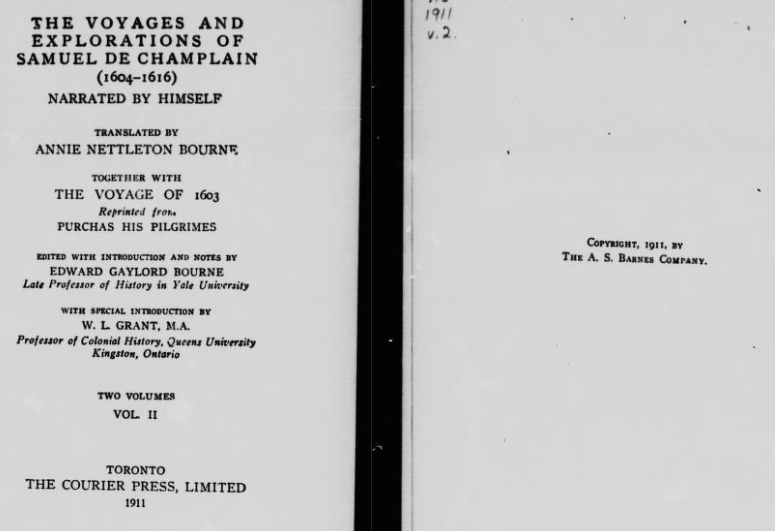
Thankfully for history’s sake, Champlain made a very detailed journal of this adventure, and in 1907, “Champlain’s Voyages et Descouvertures” was translated and printed by the American Historical Association  into a book titled “VOYAGES and Explorations of Samuel De Champlain narrated by himself”

A translated copy of Champlain's journal used to plot out his 1615 adventure.

A translated copy of Champlain’s journal used to plot out his 1615 adventure.

Obtaining a scanned version of a Canadian 1911 version of the journal and isolating the journey Champlain made through Central-Eastern Ontario in 1615 we can re-create the trip. His entries are detailed, and the translation helps pinpoint exact locations that I was able to match to current existing landmarks. Having grown up in the same area in my teenage years and having sailed some of the exact same waters traversed by Champlain, I believe I was able to map out this epic journey as it happened 400 years ago.

MEASURING CHAMPLAIN’S DISTANCES

Before we begin we must first start deciphering this 400 year old  adventure with an analysis of the original journal and how it translates into present day terms. The first mention Champlain makes about the start his journey is on Page 76 where he mentions they gathered two canoes with 12 of the strongest “savages”, continuing his way towards the enemy. Champlain then  uses the term “lieue”or “league” to measure distance on his journey. But what is a league, how far is that in today’s modern measurement of distance? This of course is crucial to tracking Champlain properly and is a key element to matching his distances on today’s maps for an accurate plotting of his route.

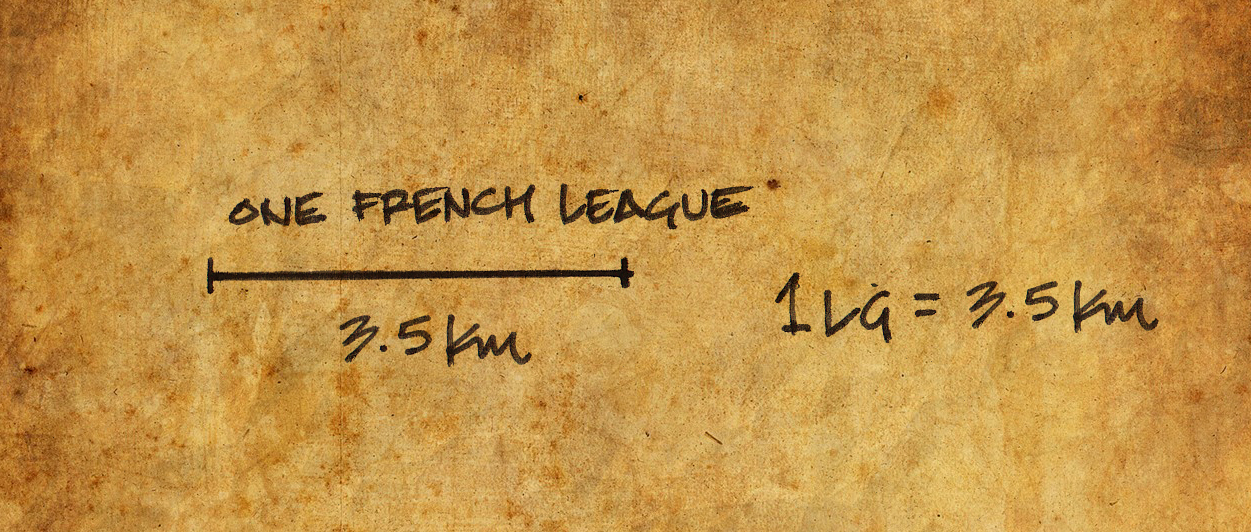
A conversion of a French league to modern kilometres was necessary to accurately plot his journey.

A conversion of a 1600’s French league to our modern kilometres was necessary to accurately plot his journey.

The “old French league” was a measurement used by the French up until 1674 and was defined as 10,000ft. With Champlain traveling in 1615 and his journal of his exploits being published soon after, this falls into the right unit of measurement for that time. 10,000 feet converts into a modern metric measurement of 3.25km. The French League however differed with Champlain depending on what type of surface he was traveling on. A French Land League ranged between 3.25km-4.68km, (an average of 4km). Champlain used a different measure of league at different points of his adventures, on the open sea and St. Lawrence River he used a league that was 4.0-4.5km compared to the approximate 3.4km league he used for inland travel. Because Champlain was traveling over both land and water on this 1615 journey which makes it almost impossible to pinpoint an EXACT measurement of his mentioned league. So I will be using the average of 3.5km=one Champlain league.

THE JOURNEY

After leaving Huronia on September 1 1615, Champlain travels across Lake Simcoe and entered what is now the Trent-Severn Waterway where his journal mentions travelling south and entering Sturgeon Lake. From Sturgeon lake Champlain mentions:

“From it flows a river that empties into the great lake of the Entouhonorons”

The “Lake of the Entouhonorons” is Lake Ontario. Champlain describes the journey down the Otanabee and Trent rivers which empty into Lake Ontario from Sturgeon Lake as being “about 64 leagues-that is to the entrance to of this lake of the Entouhonorons”

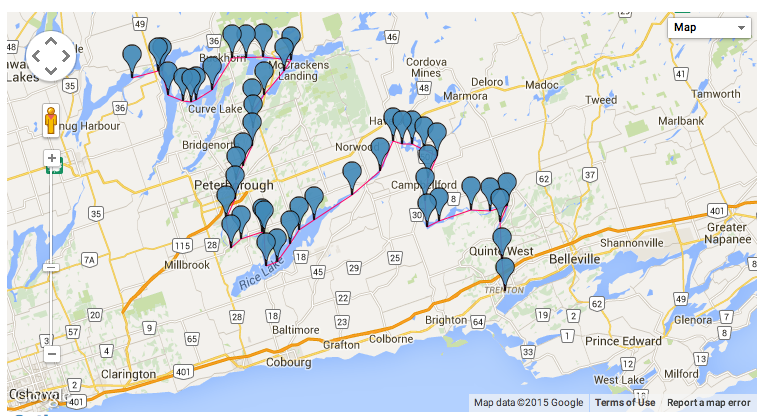
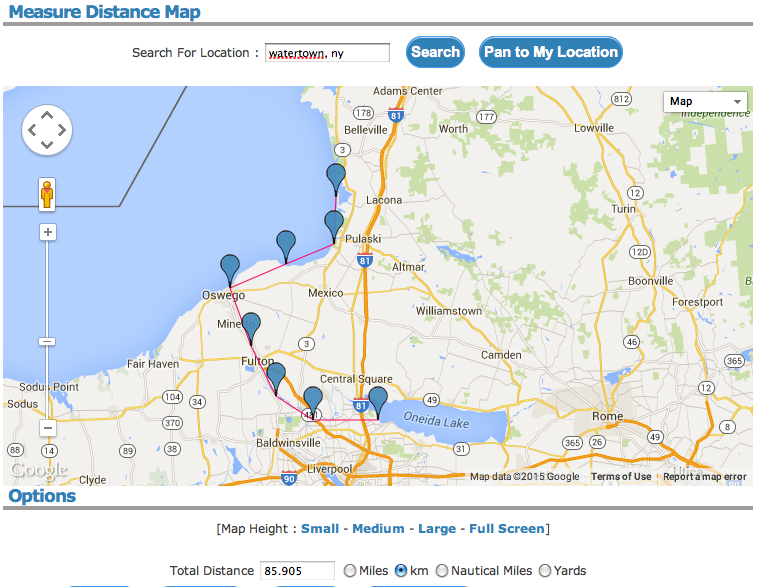
Now we can utilize our measurement of a league (3.5km) which calculates 64leagues x 3.5km=224km. This distance mapped out on a current map where the Trent flows from Sturgeon Lake to Lake Ontario at Trenton is almost a perfect match.

Using a mapping program we are able to track the '64 leagues" Champlain mentions it took to go from Sturgeon Lake to where the Trent River empties into Lake Ontario at Trenton.

Using a mapping program we are able to track the “64 leagues” or 224Km Champlain mentions it took to go from Sturgeon Lake to where the Trent River empties into Lake Ontario at Trenton.


Our journey begins on at Sturgeon Lake where Champlain passed through in September 400 years ago.

Our journey begins on at Sturgeon Lake where Champlain passed through in September 400 years ago. (GoogleMaps)

Champlain also mentions passing 5 rapids and smaller lakes along the way. The matches the pre-Trent canal rapids at Bobcaygeon, Buckhorn, Peterborough, and the many other falls and rapids they would have encountered along the Otanabee and Trent rivers.

Otanabee River Champlain and his Huron warriors travelled along.

Otanabee River Champlain and his Huron warriors travelled along. (Google Maps)

Champlain mentions how beautiful the river area is and that it seemed eerily abandoned of people. It is noteworthy to mention that some think Champlain is speaking of Prince Edward County at this point, but the journal and mapping do not make this possible.

Some of the rapids Champlain mentions in his journal on the Trent River.

Some of the rapids Champlain mentions in his journal on the Trent River.

CHAMPLAIN’S WEAPON

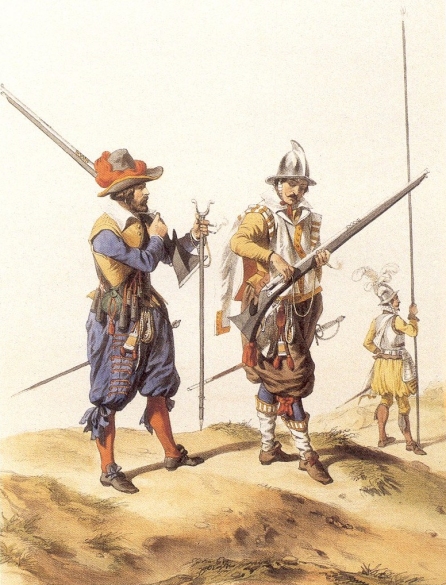
Along the Otanabee and Trent, Champlain watches his native companions hunt with spears and one of them is injured when one of Champlain’s men tries to also hunt with their own weapon, an “arquebus” which is a type of matchlock musket used by Champlain and his French companions. A heavy weapon between 30 and 50 inches in length, Champlain’s arquebus fired 1 ounce lead balls through a straight barrel, capable of felling large game and men. This was Champlain’s weapon of choice on his adventure 400 years ago.

Champlain used an "arquebus" similar to this as his weapon of choice on the adventure.

Champlain used an “arquebus” similar to this as his weapon of choice on the adventure.

matchlock7

After Champlain and team empty into Lake Ontario (what Champlain calls Entouhonorons) at Trenton, they entered what is now the Bay Of Quinte and Prince Edward County. Passing along through the Bay Of Quinte past Deseronto, Picton and finally into the main body of Lake Ontario near Adolphustown, Champlain and company head east along the northern shore.

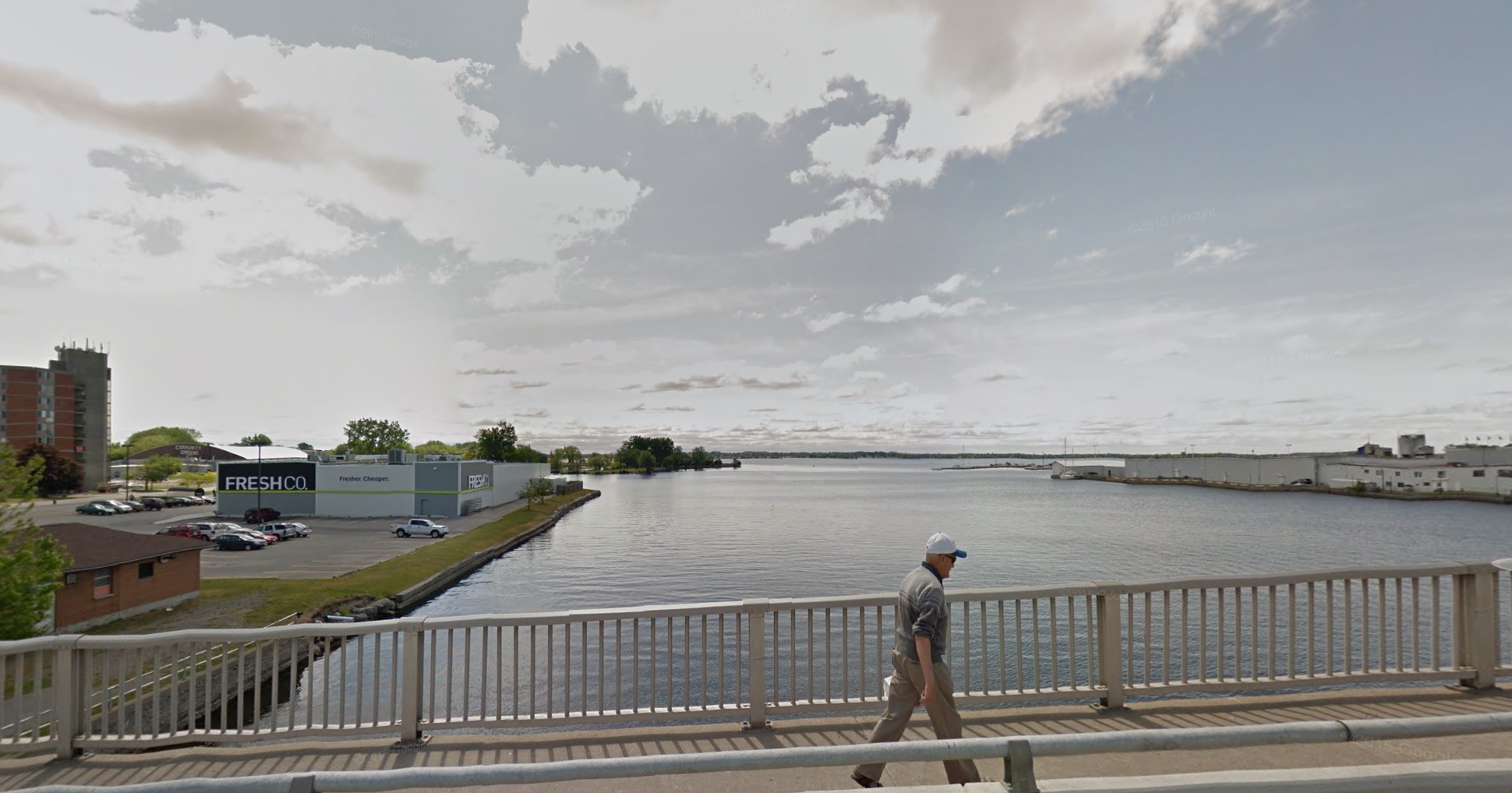
This is where Champlain would have exited from the river into "lake of the Entouhonorons" or as we now call it, Lake Ontario.

This is where Champlain would have exited from the river into “Lake of the Entouhonorons”, or as we now call it, Trenton on Lake Ontario.(GoogleMaps)

They would have passed Bath, Millhaven, Amherstview and Kingston. It is here that I firmly believe that scholars and the history books are incorrect in their assumption that Champlain cut down into the lake on the eastern end of Prince Edward County towards the Main Duck islands.

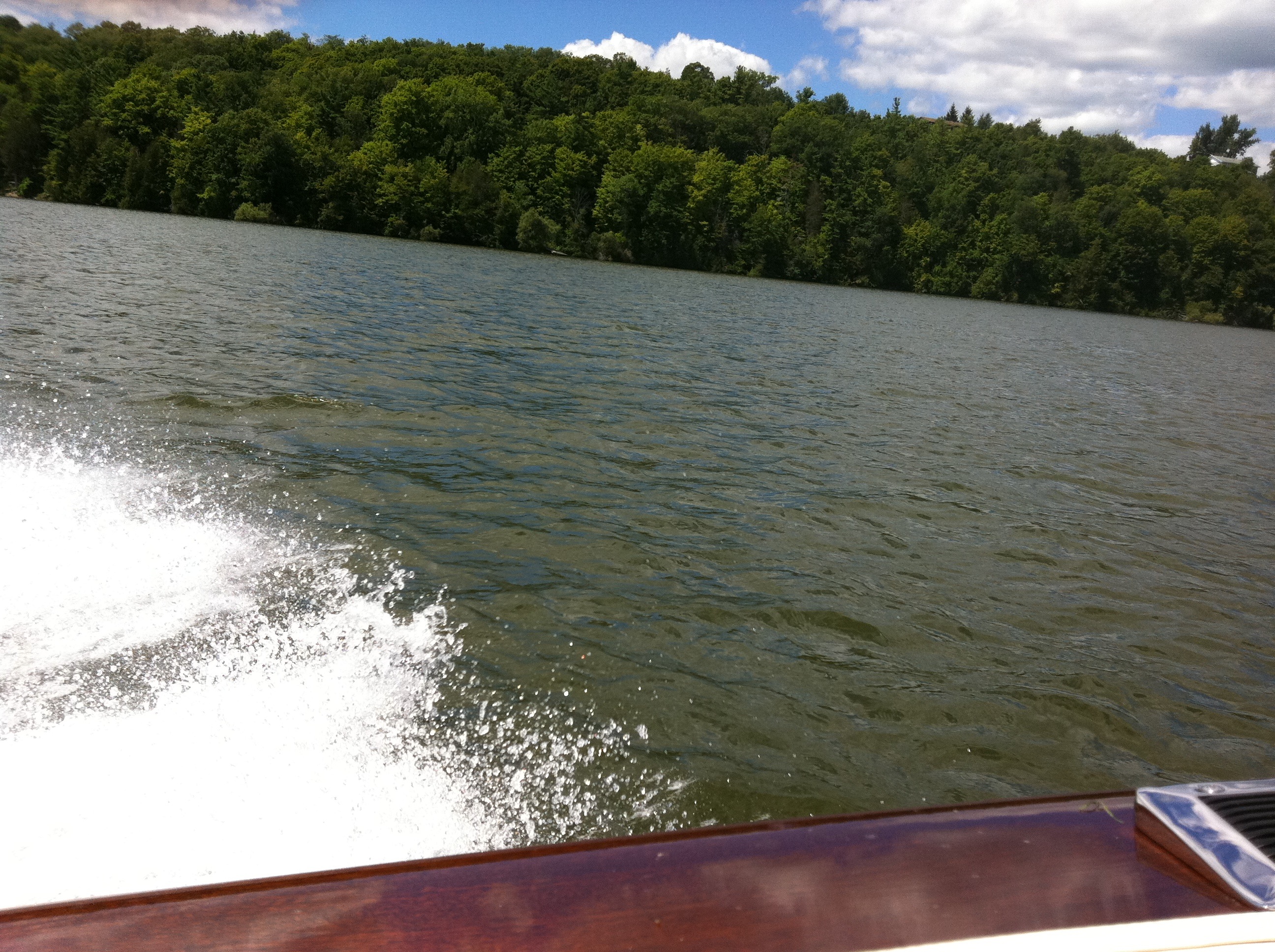
Cruising along the Bay of Quinte in the same waters Champlain traversed 400 years ago.

Cruising along the Bay of Quinte in the same waters Champlain traversed 400 years ago.

routemarked

The route I believe Champlain took on his 1615 journey.

Champlain's actual map he drew of the land he explored drawn in 1632. I marked his route that he took in red.

Champlain’s actual map he drew of the land he explored drawn in 1632. I marked his route in red.


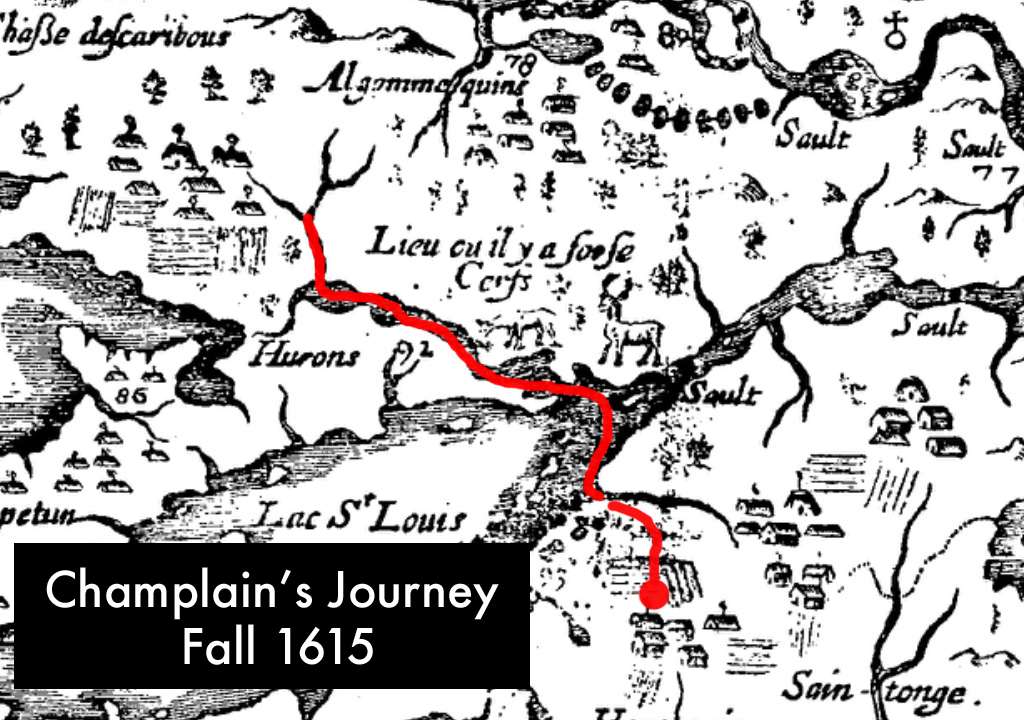
Another map of Champlain's with his route marked in red.

Another map of Champlain’s with his route marked in red.

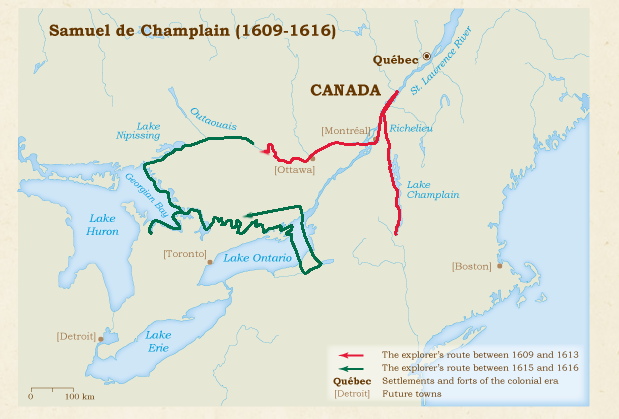
The accepted route Champlain supposedly took but I think is incorrect.

The accepted route Champlain supposedly took but I think it is incorrect.

Champlain mentions in the journal:

“we went across at the eastern end, which is the entrance to the great River St. Lawrence at latitude 43 degrees where there are some beautiful and very large islands in this passage” 

This description tells me Champlain travelled along the northern shore of Lake Ontrio to Kingston, where the St. Lawrence begins as he mentions. It is here that there are also the “VERY beautiful and LARGE ISLANDS” he mentions would have been Amherst Island, Wolfe Island, Grenadier ISland and Galoo Island. Having sailed these exact waters, I know that this would make the most logical location to traverse Lake Ontario as it is more sheltered than the open lake of the accepted Main Duck Island route.

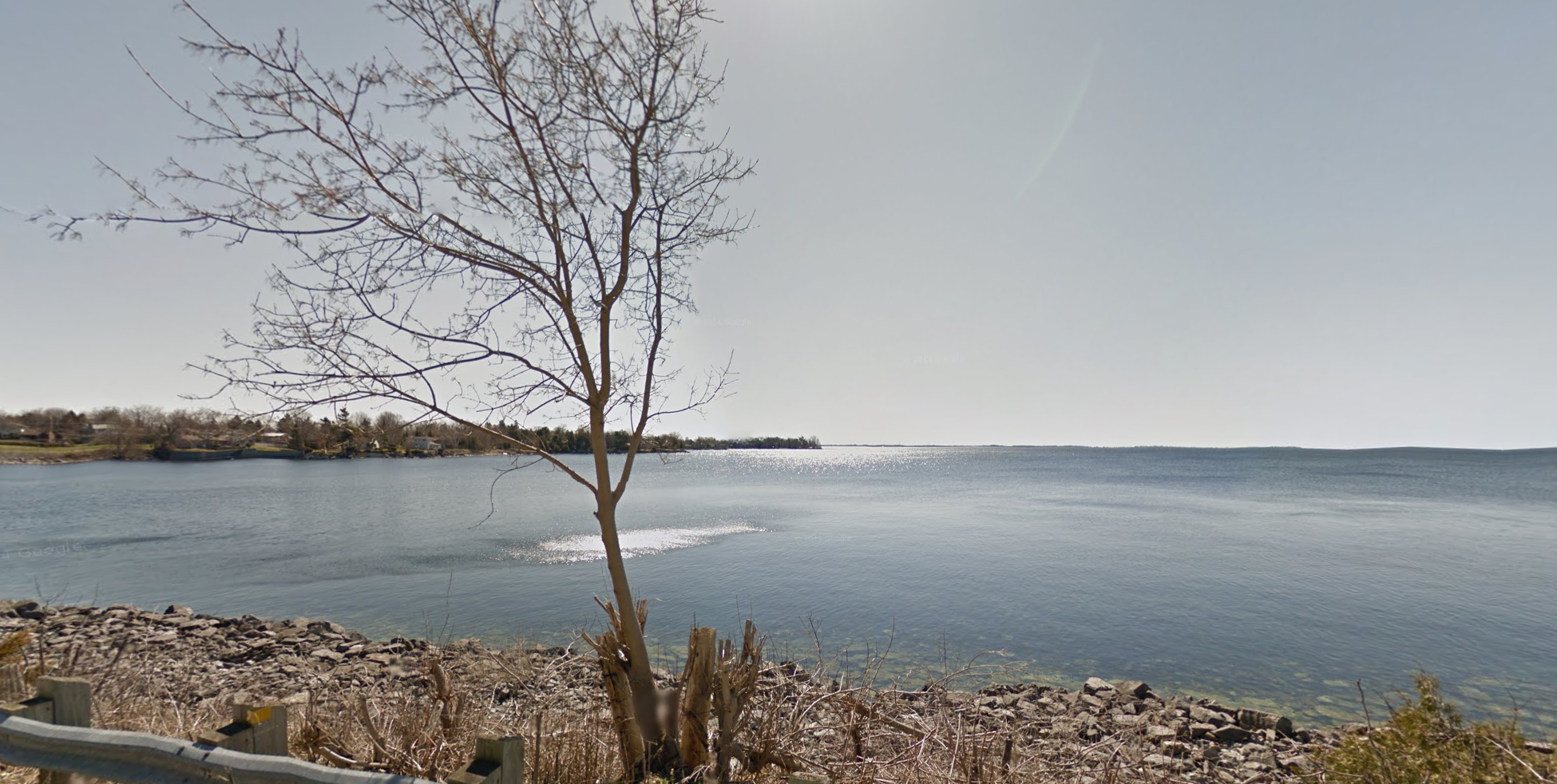
The gap where I think Champlain went through to go across Lake Ontario.

The gap where I think Champlain went through to go across Lake Ontario.

The "large beautiful islands" Champlain makes note of oin his journal as he crossed the eastern end of the lake were lost likely Wolfe Islands, Galoo and Stony Islands to name a few.

The “large beautiful islands” Champlain makes note of in his journal as he crossed the eastern end of the lake were lost likely Wolfe Islands, Galoo and Stony Islands to name a few.

Champlain’s native companions would have known this and also being in river canoes, have most likely traversed at the far eastern end of the lake around the shelter of the islands he mentions instead of going across the open waters of the lake with its treacherous autumn winds. Also, the latitude of 43 degrees he mentions puts Champlain in the Wolfe Island/Grenadier/Galoo Island area.

Using that area as his crossing point, the journal then mentions he traversed across “about 14 leagues to get to the other side of the lake in a southerly direction” . The distance of 14 leagues x 3.5km gives us a distance of about 50km they travelled across the lake. It is here, in late September 1615 that Champlain hit the shores of present New York state. The following journal details and description allow us to now pinpoint where this was, which I believe to be El Dorado Beach, NY.

landing beach

Where Champlain likely landed in New York state in late September 1615.

ENTERING NEW YORK STATE

Champlain explains that once they reached the shore of the enemy and hid their canoes in the woods,

“we went about 4 leagues by land along a sandy beach , where I observed a very agreeable and beautiful country crossed by several little brooks and two small rivers which empty into this lake; and a great many lands and meadows..”

Champlain’s description and clues reveal:

  • a sandy beach
  • several little brooks
  • two small rivers

These clues all point to Champlain landing at what is now EL DORADO BEACH Preserve, just southwest of what is now Henderson, NY. NOT Hernderson Harbour as others believe. I think El Dorado Beach is where Champlain and his warriors first landed because it is a beach area that stretches south for exactly 14km that he mentions walking along (4 leagues x 3.5km=14km).

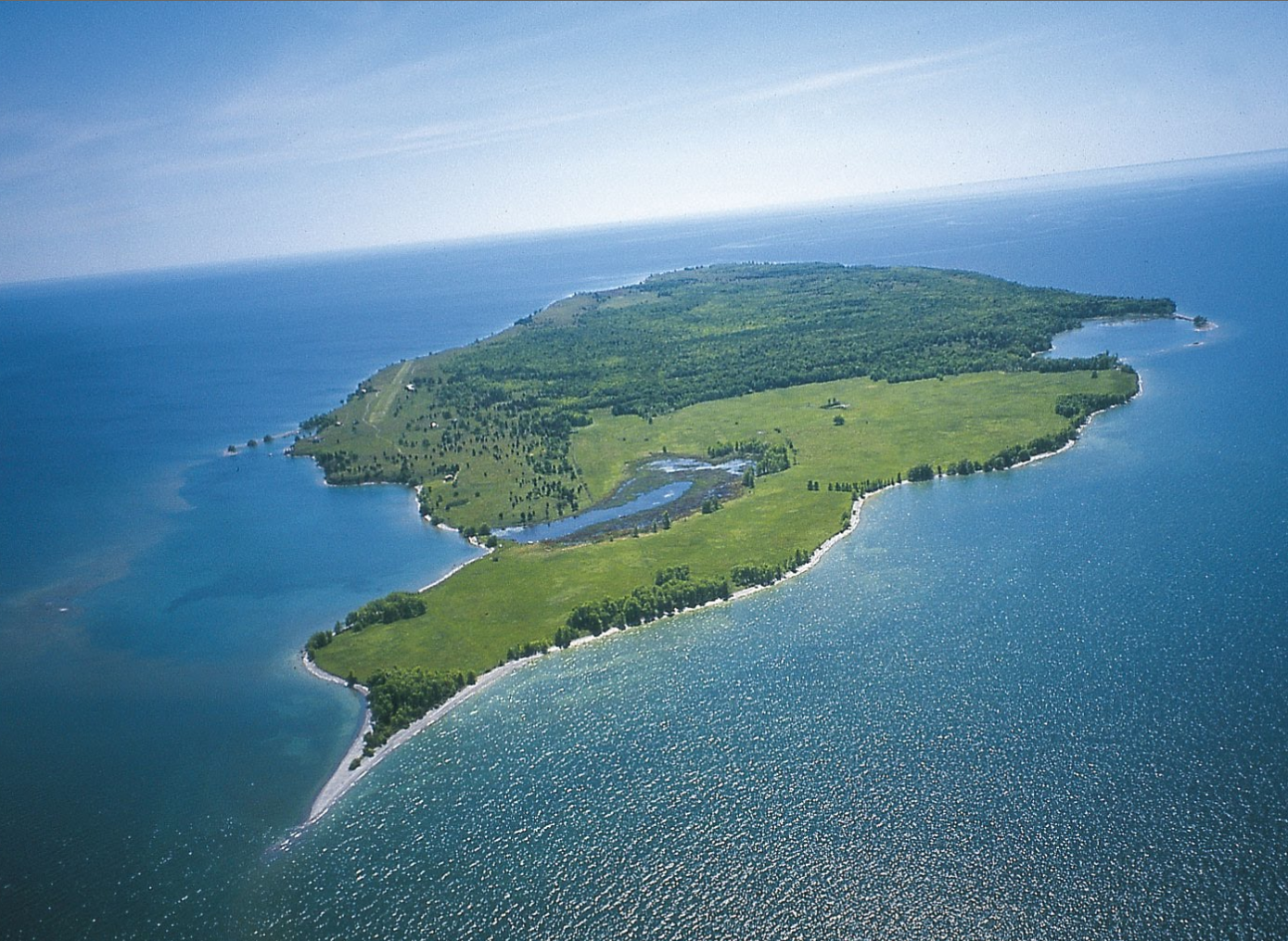
Aerial view of Champlain's landing point.

Aerial view of Champlain’s landing point.

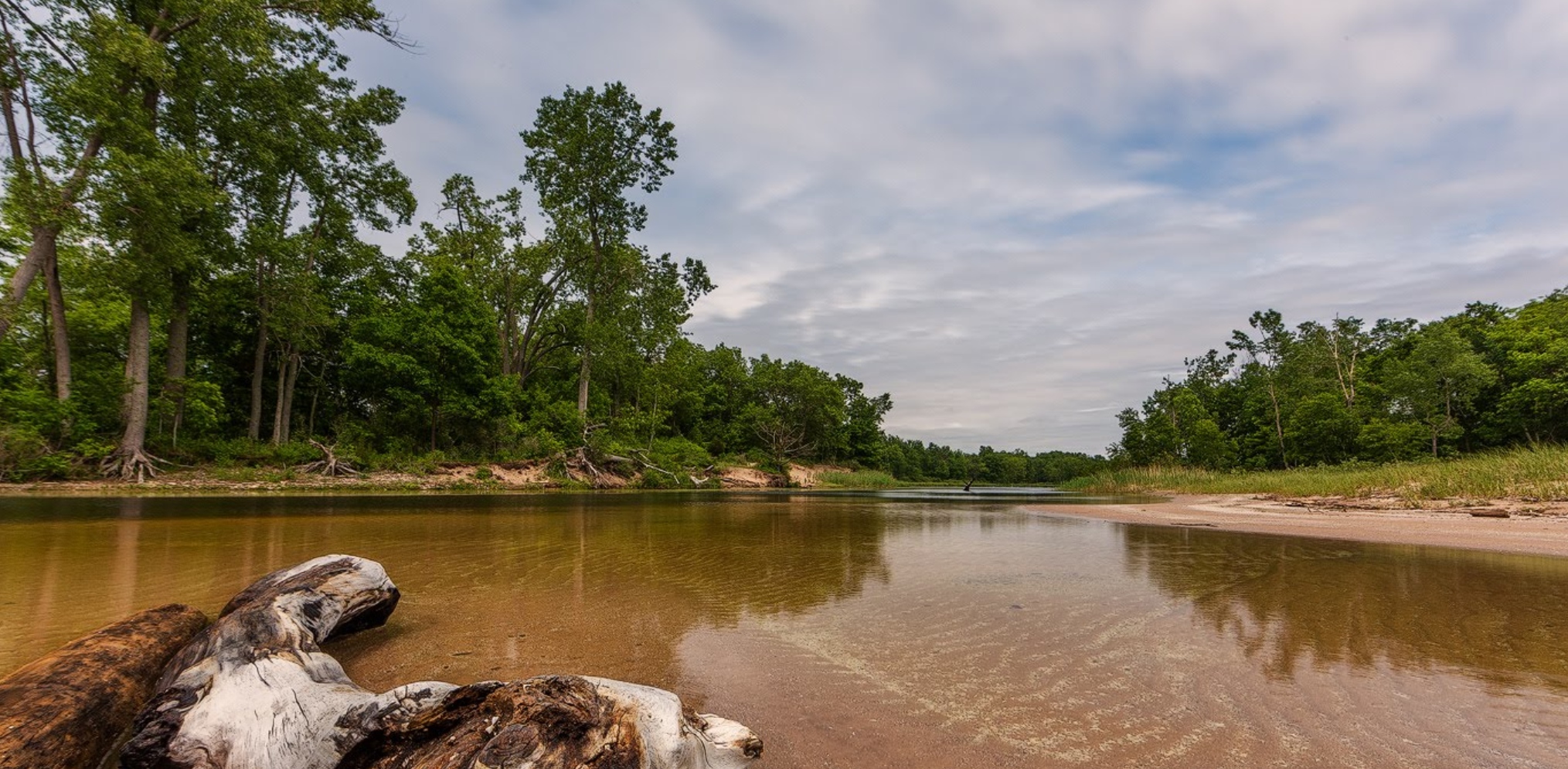
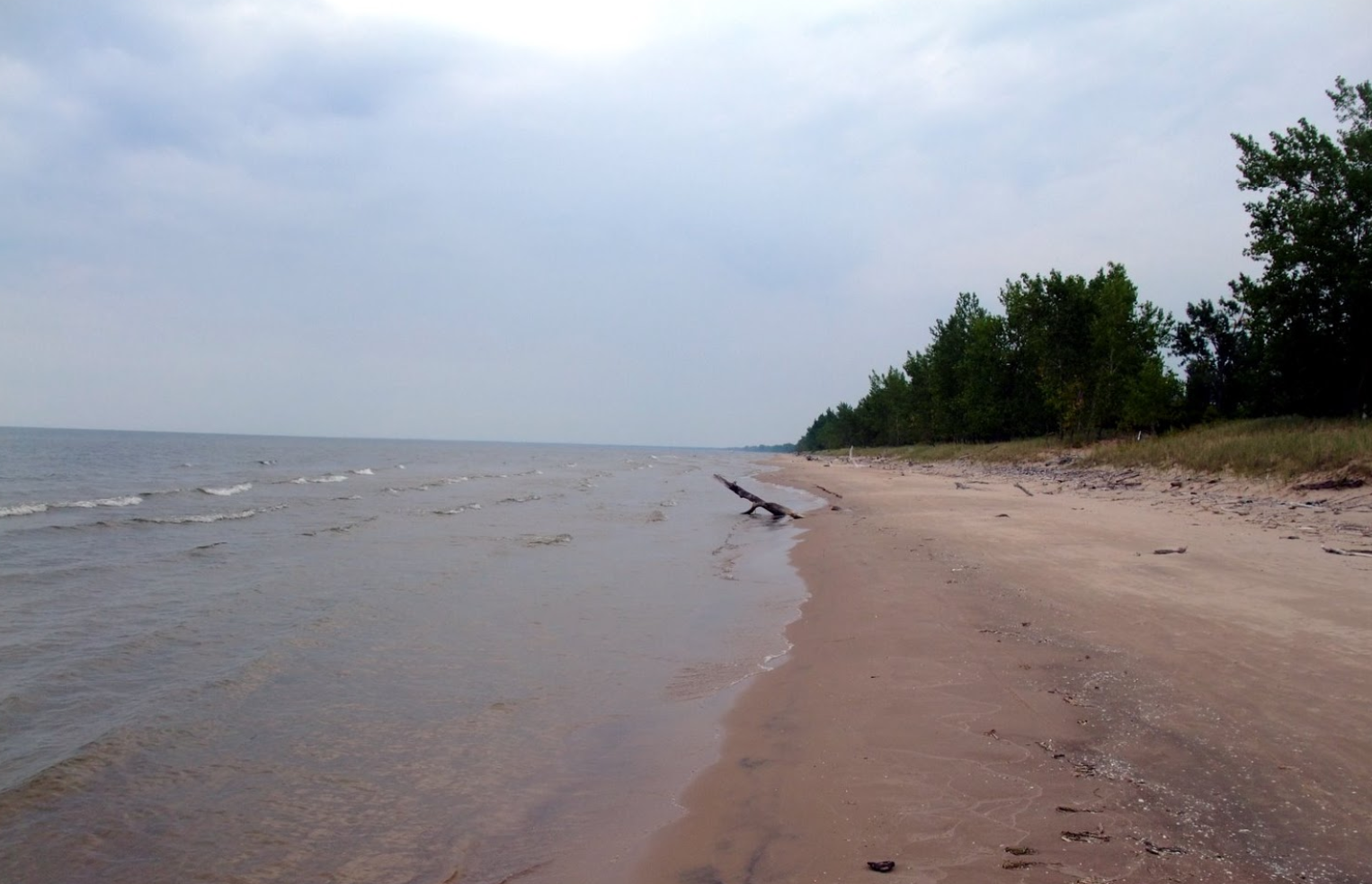
The beach Champlain walked along with his invading war party.

The beach Champlain walked along with his invading war party.

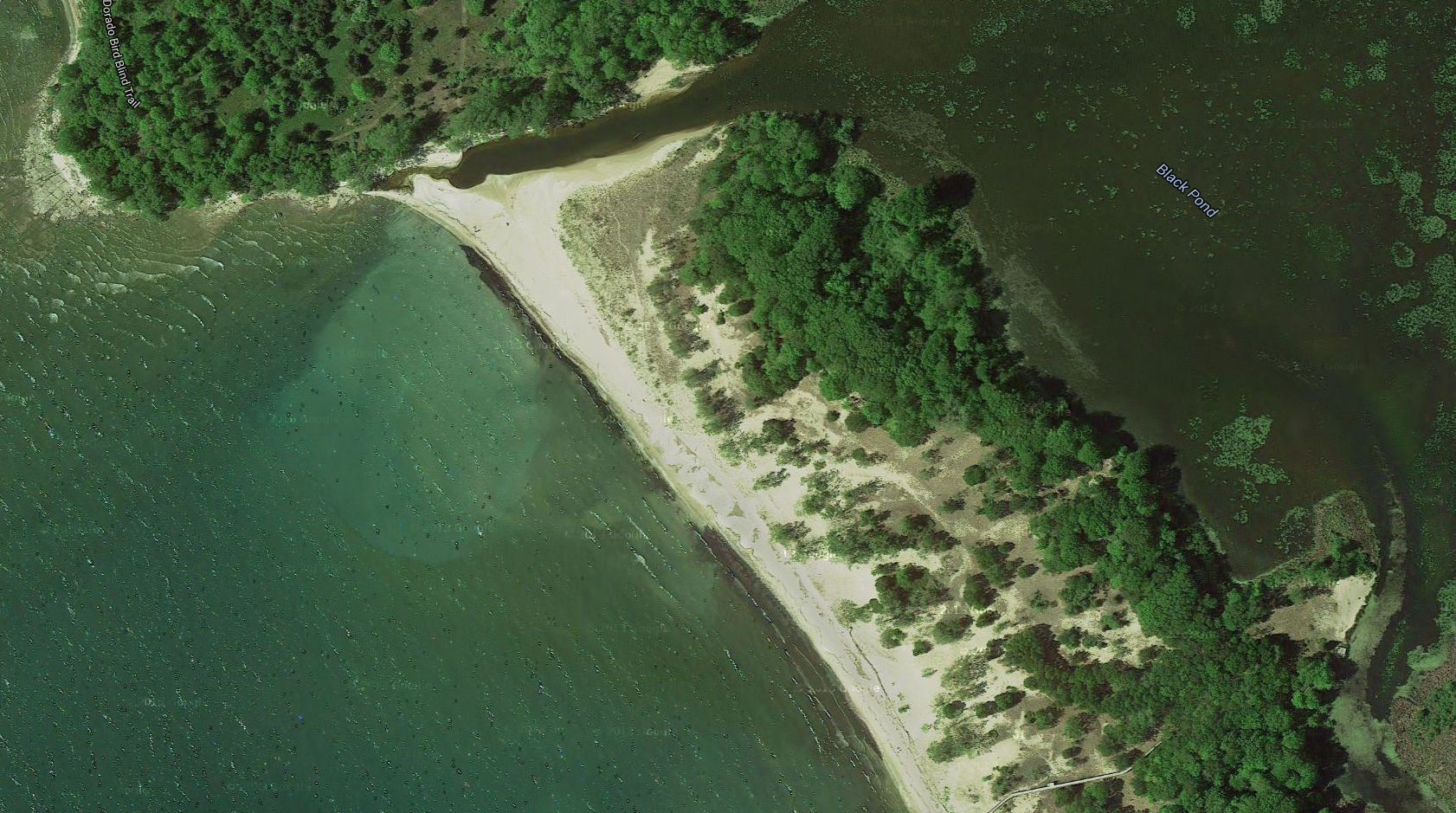
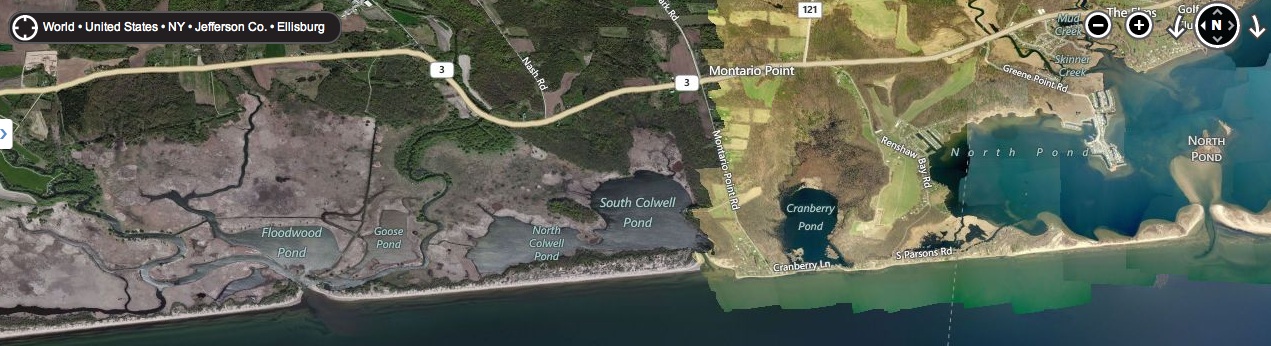
The two small rivers he mentions would be Sandy Creek and the Salmon River. The “several little brooks” would be the various creeks that dissipate in from the beach. Next Champlain mentions in his journal “a great many ponds and meadows where there were an unlimited amount of game”.

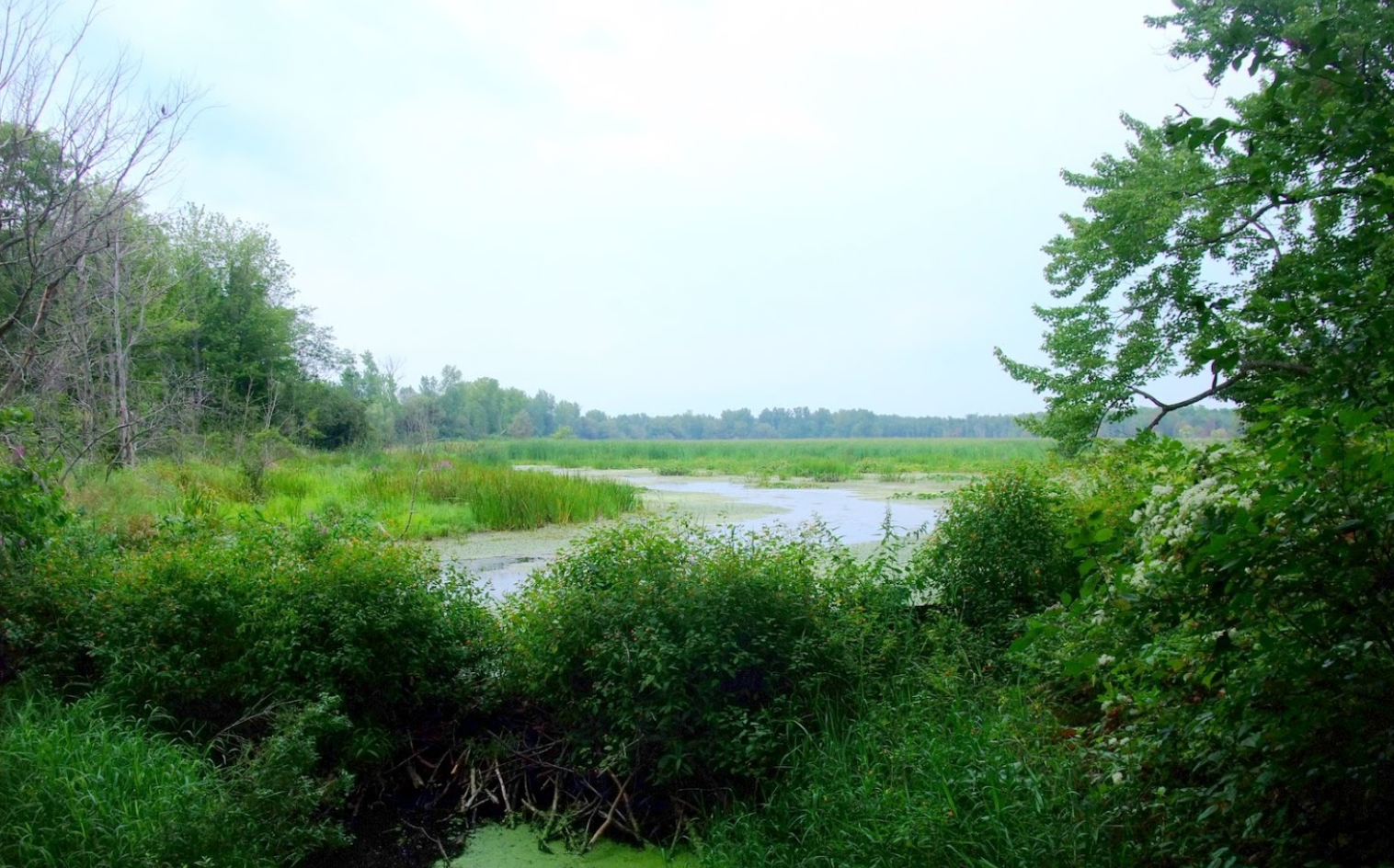
The marshes Champlain mentions with lots of game.

The marshes Champlain mentions with lots of game.

These ponds would likely be the Lakeview Pond, North Sandy Pond and many other ponds that lie behind the beach, now called Southwick Beach in New York state that he walked south along around Oct.1 1615. I am not sure if there has ever been a proper archeological investigation into this 14km stretch of beach area where Champlain landed and traversed, but I’m sure a number of artefacts lie buried in the sand from this 400 year old expedition, waiting to be discovered.


Beach Champlain walked along.

Beach Champlain walked along.

It is from this beach in NY state that Champlain continued down into Upper New York state for four days on foot through Oswego and Onondaga Counties to the Oneida River.

After walking along the coast of Lake Ontario, Champlain enters the Oswego River and follows its shores inland.

After walking along the coast of Lake Ontario, Champlain enters the Oswego River and follows its shores inland. (Google Maps)


Champlain followed the river inland to Lake Oneida that he mentions in his journal.

Champlain followed the river inland to Lake Oneida that he mentions in his journal. (Google Maps)

The inland journey Champlain would have taken.

The inland journey Champlain would have taken.

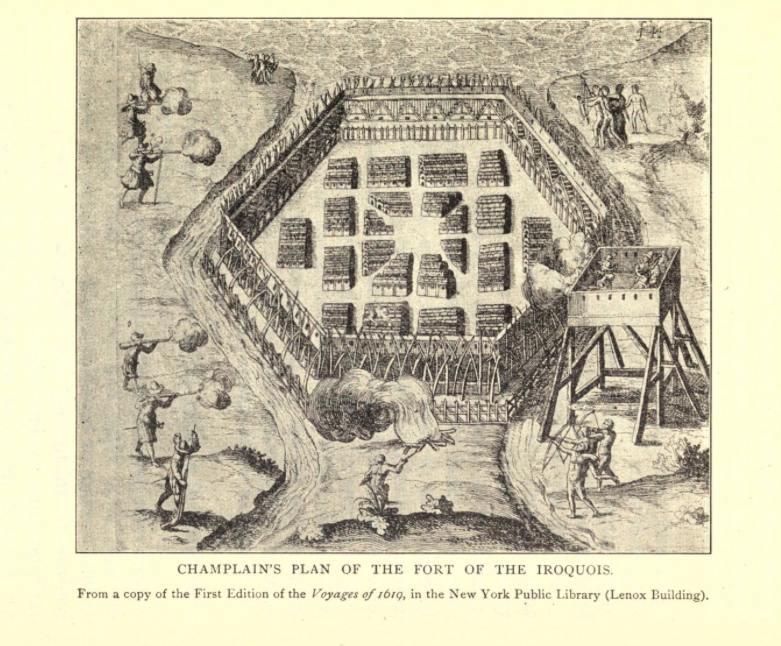
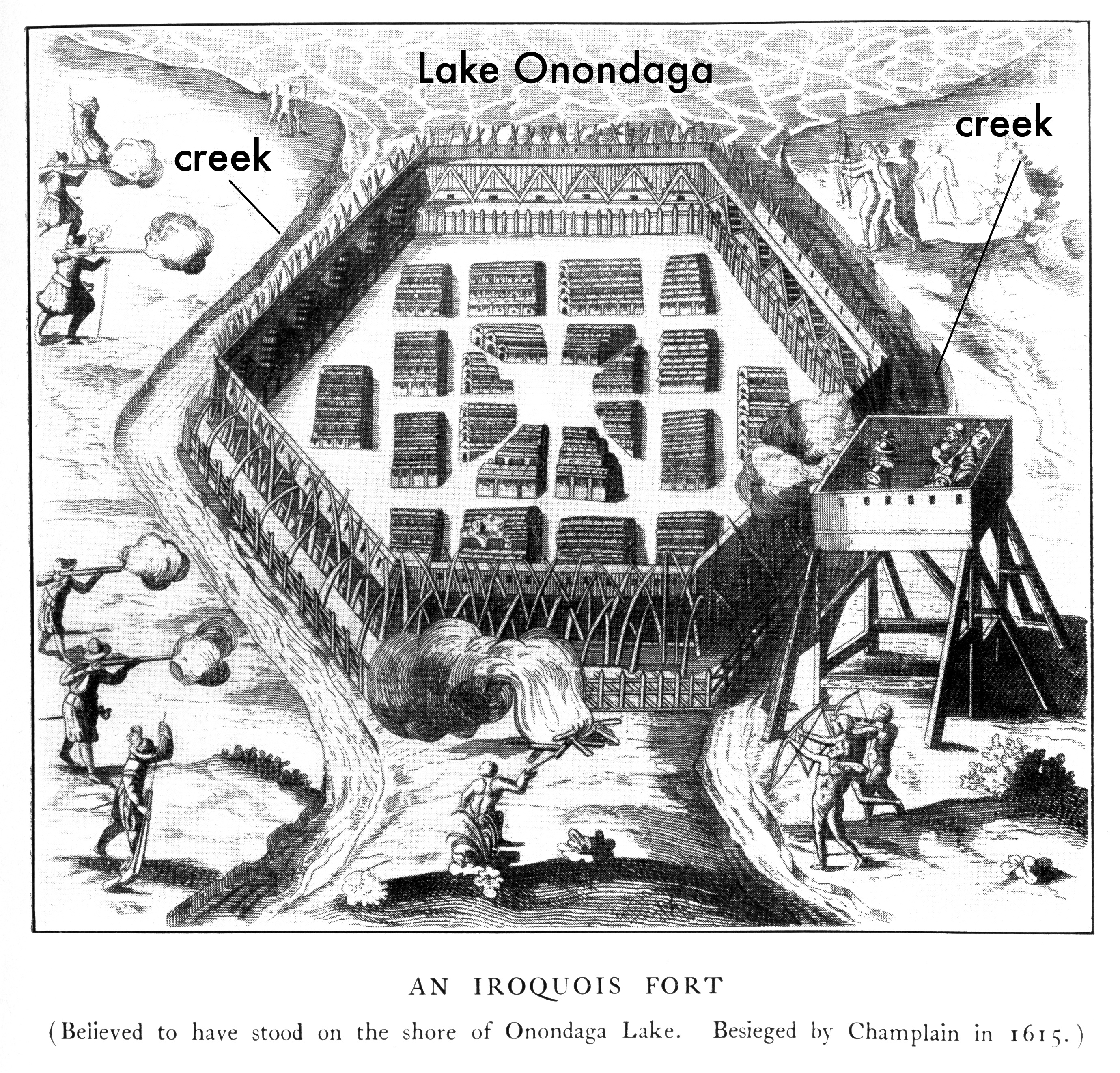
On October 9 Champlain encountered enemy Iroqouis while on scouting mission that they took prisoner. On October 10 1615, Champlain and his band of native warriors reached their destination: the immense palisaded fortress of the Iroquois.

Champlain's own sketch of the Iroquois fortress he attacked on Oct.10 1615. Note the two rivers either side.

Champlain’s own sketch of the Iroquois fortress he attacked on Oct.10 1615. Note the two rivers either side and Lake Onondaga at top.

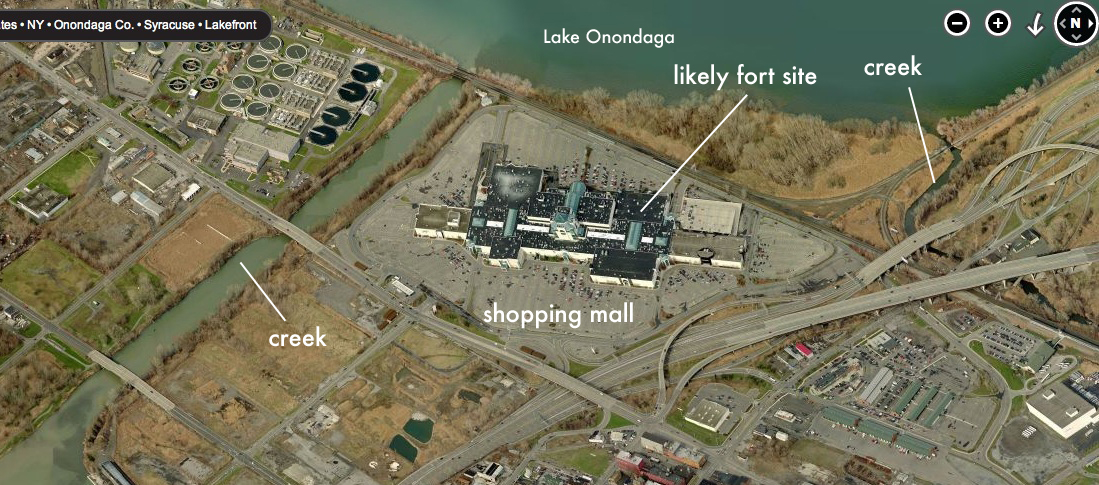
This was an Iroquois stronghold whose exact location has been the subject of much controversy due to Champlain’s scant details on getting there. Other than simply saying it was located “between two streams” there are few details that help locate where this fort would have been. In his 2009 book “Champlain’s Dream” author David Fischer speculates historians have been incorrect in their assumption the Iroquois fortress was in Fenner, NY within Madison County. Fischer postulates that the fort was probably in between two streams at the south end of Lake Onandaga in Syracuse NY where the present day Carousel Shopping Mall resides.

Where the fortress was it is now a shopping mall. Note two rivers either side.

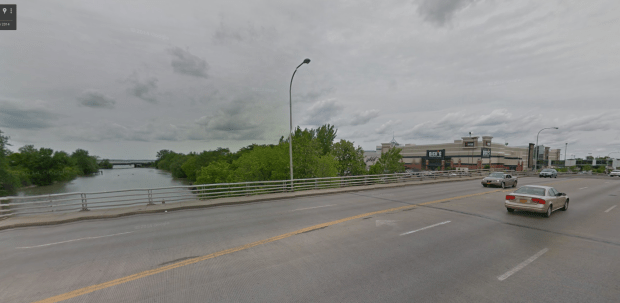
Where the fortress was it is now a shopping mall. Note two rivers either side.


iroquoisfortress

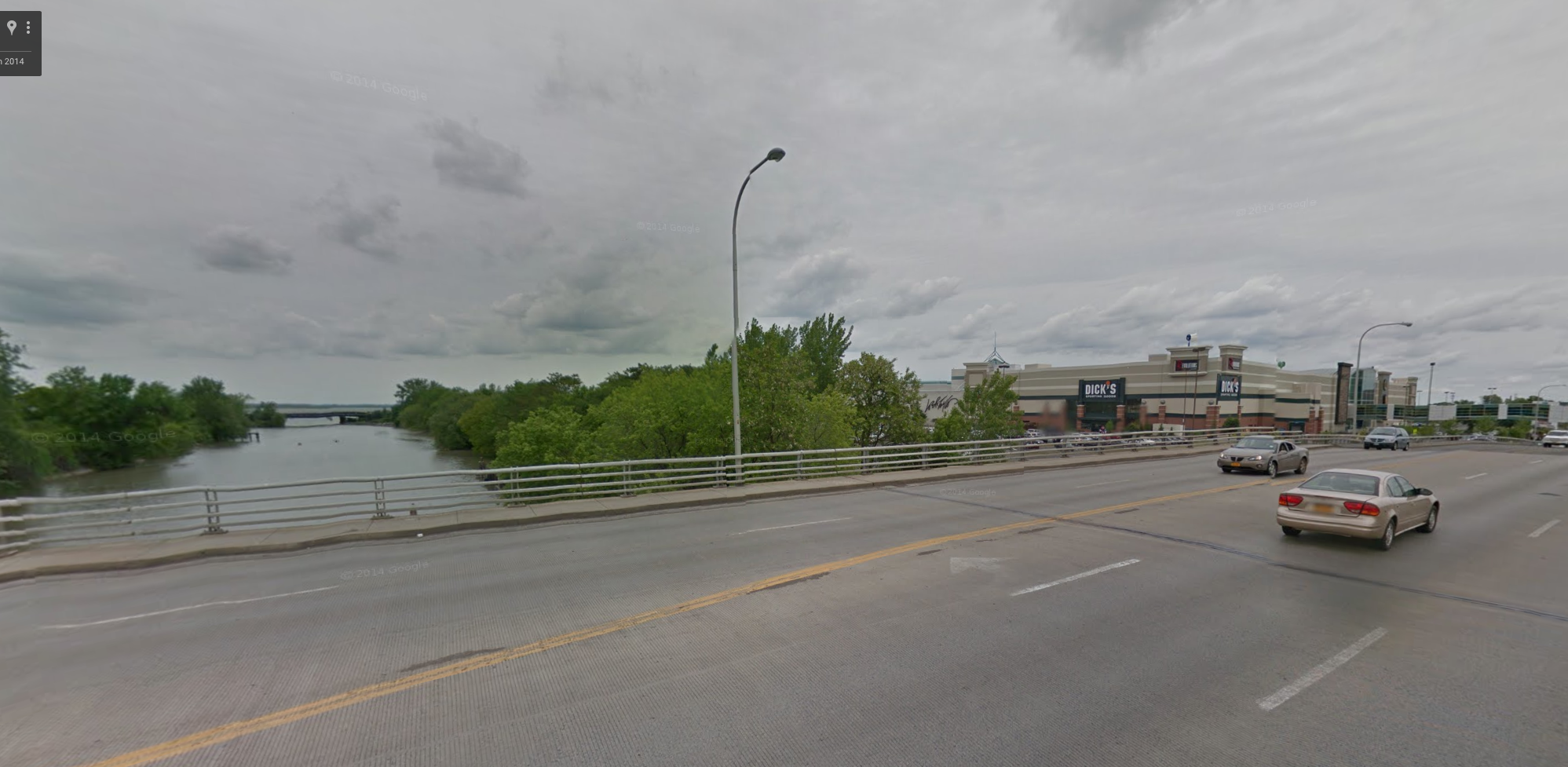
Streetview of where the fort likely stood. Now a Syracuse shopping mall.

Streetview of where the fort likely stood. Now a Syracuse shopping mall.

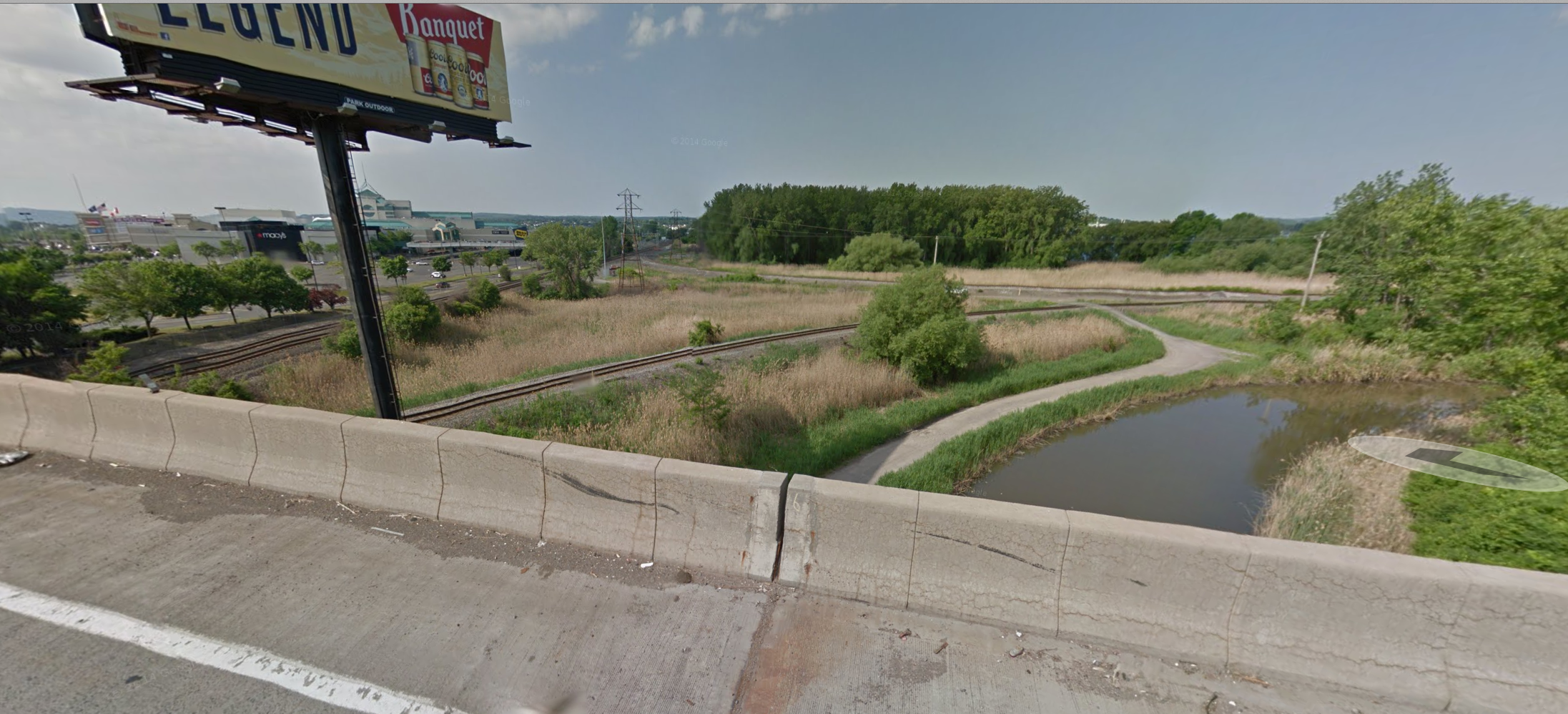
Other side showing the other river that surrounded it.

Other side showing the other river that surrounded it.

On October 10 Champlain began his assault of the enemy fortress, firing his arquebus at the enemy who retreated in shock of having never seen or heard such a weapon. An ensuing battle brought causalities and injuries to Champlain’s native companions who soon retreated in the woods surrounding the fort. The Iroquois fort was a hexagonal shaped wooden fortress made with high walls of sharpened log palisades. Champlain gave orders to burn the walls down and build a series of devices to penetrate the walled fort. Counting on being joined by 500 hundred other warriors from the north, Champlain set to work on a full on offensive attack of the Iroquois fort with disastrous results. The accompanying warriors did not take any orders from Champlain who was trying to rally his troops into some kind of sensible attack formation. Champlain recounts how the native warriors ran around in disarray without a proper plan of attack which frustrated him greatly, but Champlain “excused” them for their behaviour.

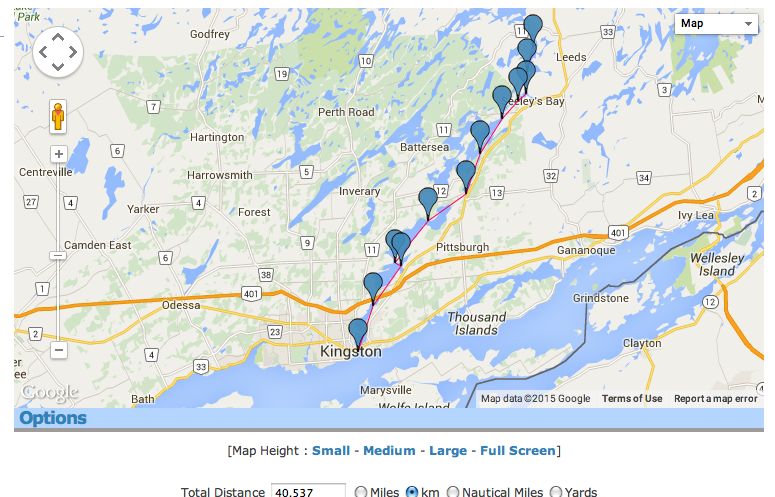
The complete route I believe Champlain took in 1615.

The complete route I believe Champlain took in 1615.

With his troops in disarray and two native chiefs injured in the failed attack, Champlain retreated to his own hastily made wooden fort with having sustained two enemy arrows lodged into his leg. The arrows had pierced his knee and leg which required attention and caused the explorer great pain. Camping out in their fort and enduring a number of further skirmishes until October 16th, Champlain joined his companions on a full scale retreat. With the enemy following Champlain’s team for about a couple of kilometres before retiring back to their fortress, on October 18th Champlain reached the beach of Lake Ontario from where they originally landed. Fighting snow, hail and cold winds, Champlain found their concealed canoes still near the beach and loaded up for a return across Lake Ontario to Kingston. Champlain pleaded to be returned to his settlement. Constructing a camp on the beach area near Henderson, NY, the team packed up on October 28th and as Champlain recounts:

“after crossing from the island, the end of the lake, we entered a river some 12 leagues in length”. This I believe to be Cataraqui River, now part of the Rideau canal system.

Cataraqui River Champlain I think ventured up on his return journey.

Cataraqui River Champlain I think ventured up on his return journey.

This entry most likely refers to crossing “from the island” which would be Wolfe Island, over to Kingston, On and into the Cataraqui River. When we apply Champlain’s “12 leagues in length” it calculates to be 42km up the Cataraqui River, placing Champlain up near Seeley’s Bay, ON. and Whitefish Lake. Another possibility that works is that they took Millhaven Creek across from Amherst Island and up the 42km distance to Sydenham Lake. However, I strongly believe it was the former route mentioned since I have travelled down both, and Millhaven Creek is more of a trickle of a stream that would make canoe travel near impossible. This leaves the Cataraqui River as the most likely option and matches the “marshy” description in his journal.

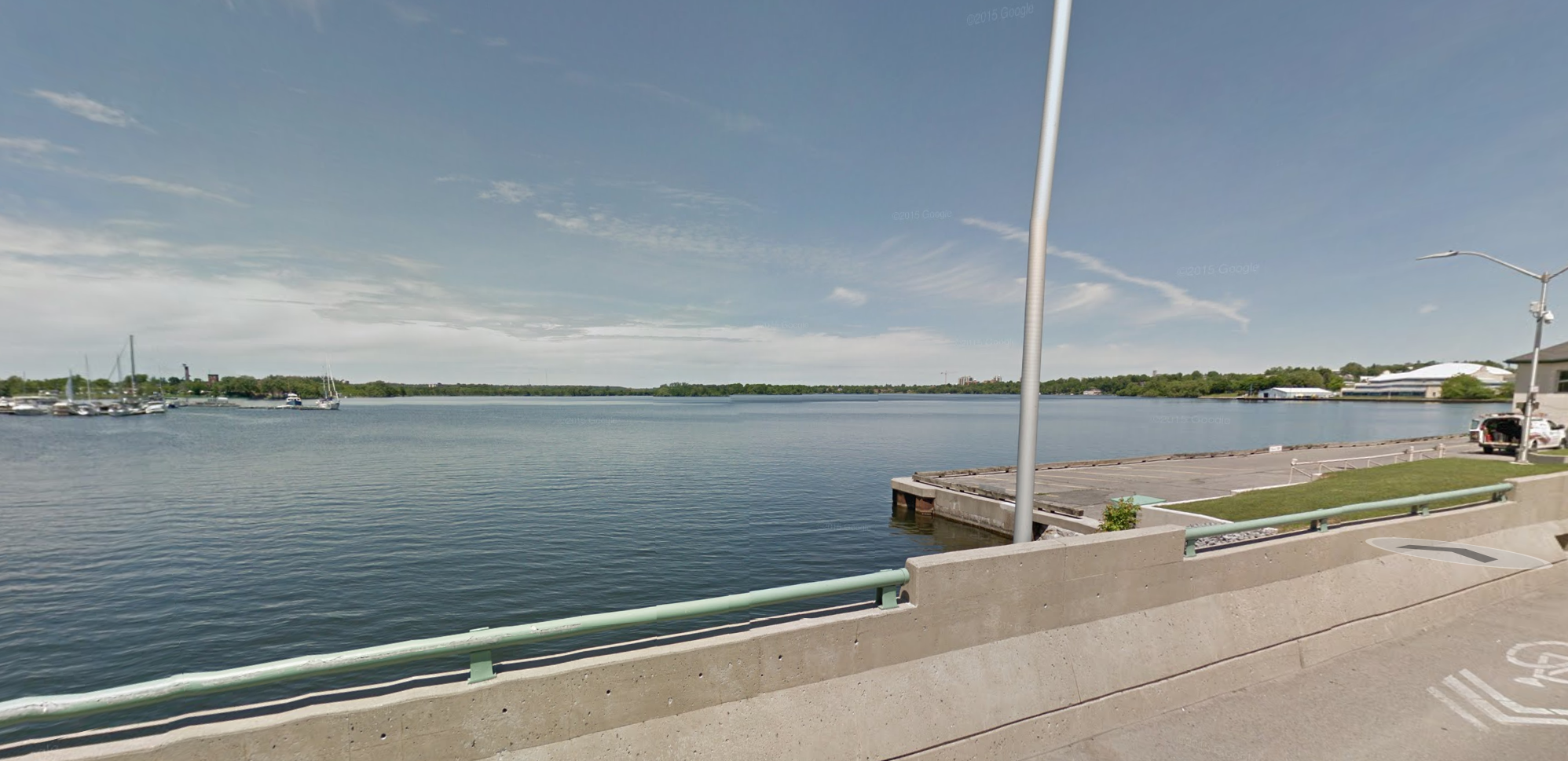
View of the entrance to the Catarqui River from Lake Ontario.

View of the entrance to the Catarqui River from Lake Ontario.

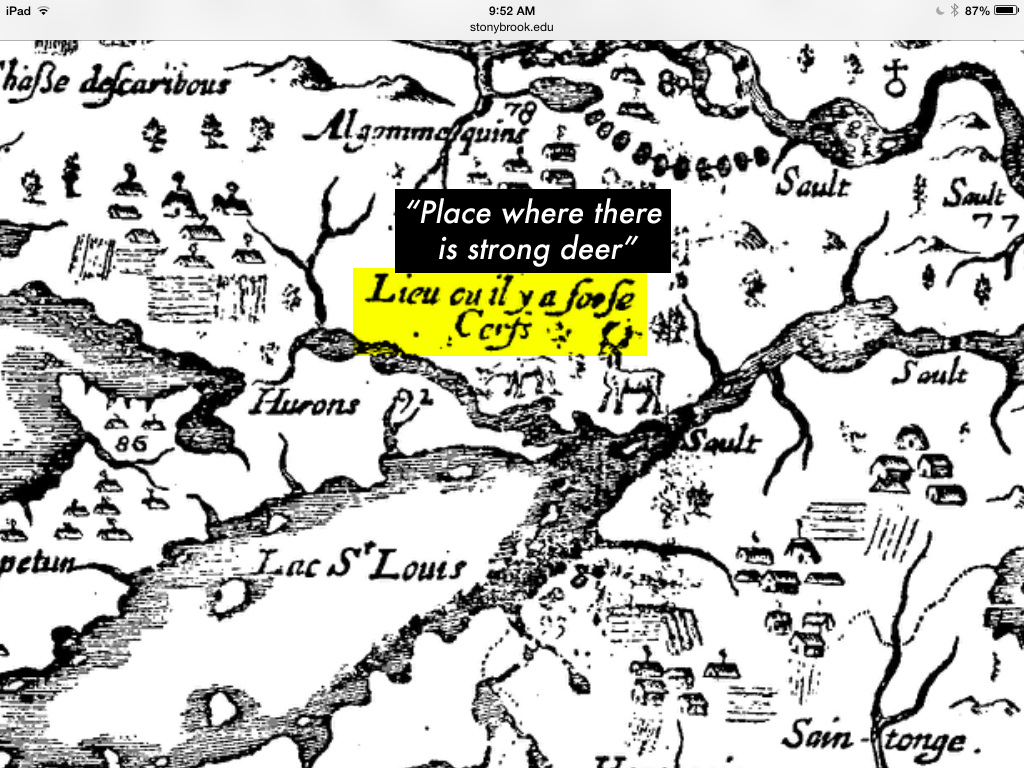
Champlain’s group built two or three log cabins most likely on the shores of Whitefish Lake, where a great deer hunt was established using native hunting methods of building traps and deer capture enclosures. This “great deer hunt area” is marked on a map made by Champlain in 1632 that is marked “Lieu Ou il y a Forte Cerfs” which when translated means “place where there is strong deer”. Having grown up in this area I can attest to the fact that even to this day there is a an abundance of deer in the surrounding woods.

Champlain's map mentions the site of a great deer hunt he participated in. This matches to the area north of Kingston.

Champlain’s map mentions the site of a great deer hunt he participated in. This matches to the area north of Kingston.

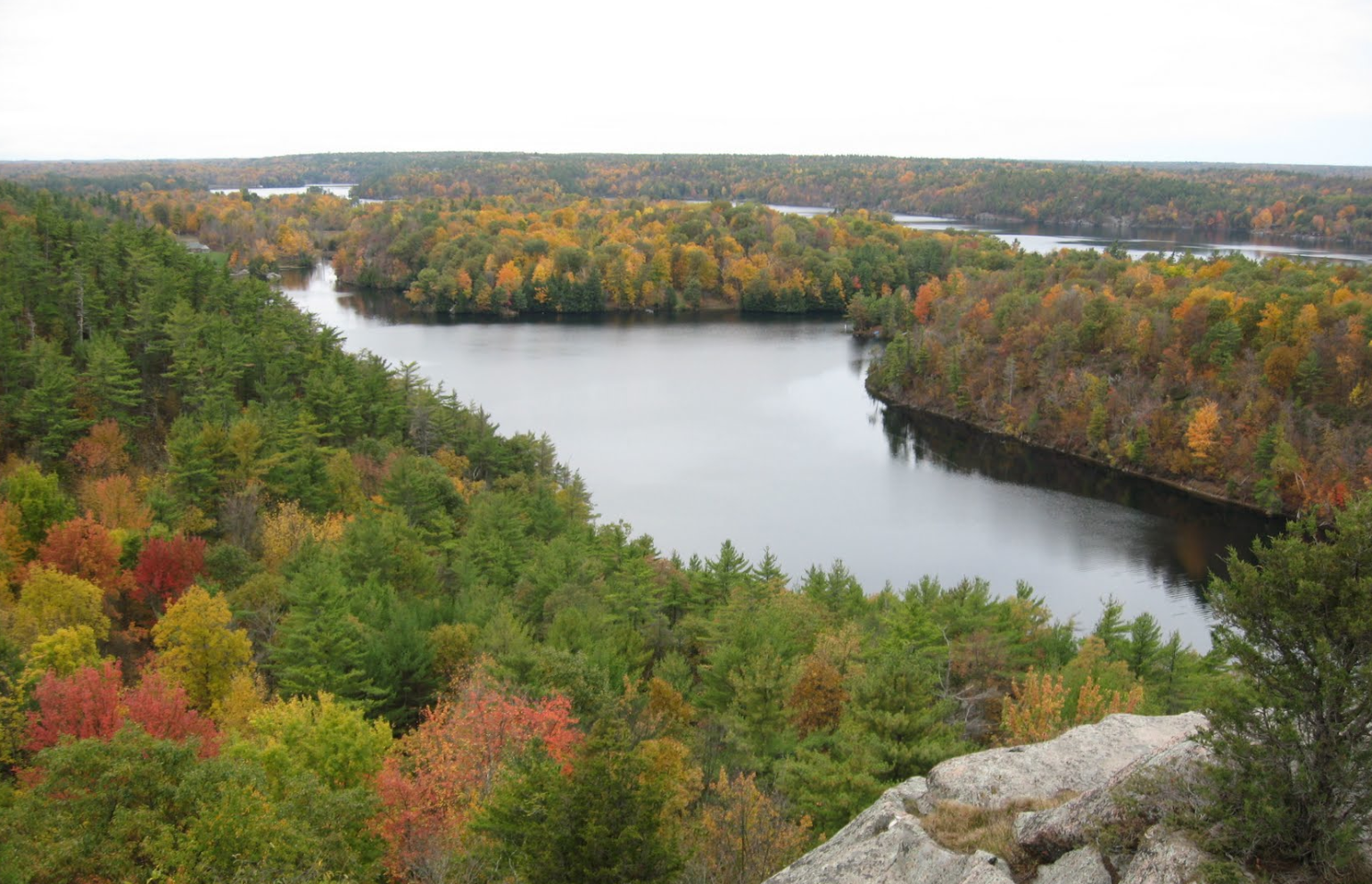
Champlain at this point on his adventure gets lost in the woods of which he transcribes into his journal in detail. Having wandered off trying to capture an unusual bird he had spotted, Champlain was separated from his native companions and was lost in the woods North of Kingston for days. Spending the first night at the foot of a massive tree, Champlain trudged on and came to a pond where he killed some birds of which he ate to survive. In what he describes as being about 5-6 days lost and wandering the woods north of Kingston, probably in the vicinity of Jones Falls where he came across a stream that he followed to a small lake about 4km in length which could very well have been on Whitefish Lake before the building of Rideau Canal in 1830 had flooded the land. Champlain mentions hearing a great waterfall and being surrounded by mountains, of which were probably Jones Falls and the mighty and nearby Rock Dunder mountain area respectively. There are no large mountains per say anywhere west of the Frontenac Axis geographical formation of which his terrain descriptions match.

Whitefish lake as viewed from a mountain Champlain mentions in his journal.

Whitefish lake as viewed from a mountain Champlain possibly mentions in his journal, Rock Dunder.

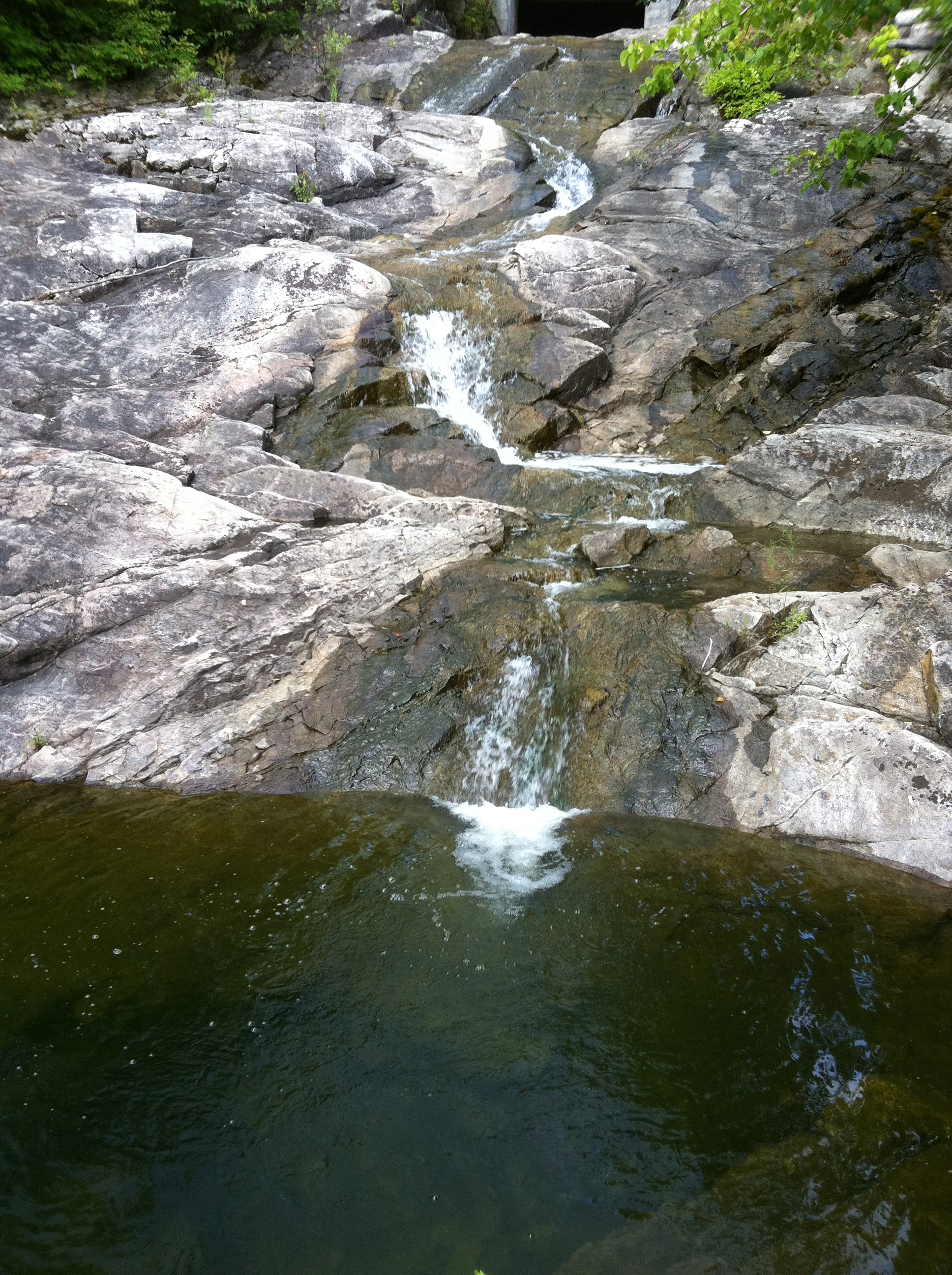
Chmaplain mentions the sound of a waterfall in his journal, which was likely the sound of the mighty Jones Falls before it was dammed up for the Rideau canal.

Champlain mentions the sound of a waterfall in his journal, which was likely the sound of the mighty Jones Falls before it was dammed up for the Rideau canal.

Following the river Champlain was finally re-united with his worried native companions who told Champlain that if had not returned, they would never again meet with the French in fear that they would think they had killed Champlain. It is something to contemplate that history could have been much different if Champlain remained lost in the woods and perished north of Kingston.

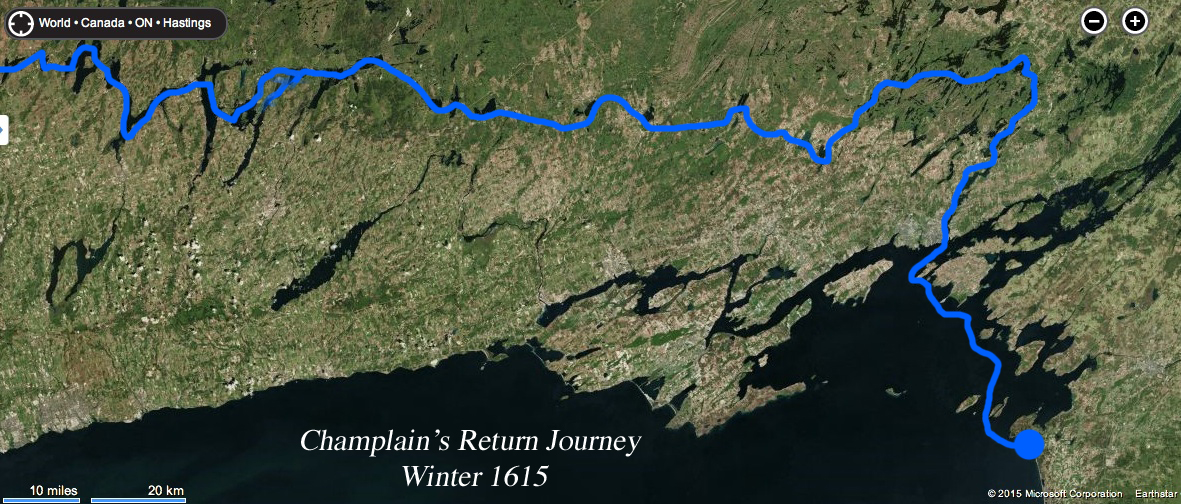
The return journey Champlain took in the late fall early winter of 1615.

The possible return journey Champlain took in the late fall early winter of 1615.

rock dunder2

A mountain Champlain mentions, could be Rock Dunder near Morton, ON, the highest point in Eastern Ontario.

From here, after spending about a month in the area north of Kingston, Champlain departed on December 4th and headed north west across frozen ponds and rivers, most likely traversing the areas of Tweed, Madoc, and the Kawarthas to arrive at their originating native village on December 20th. It is here where Champlain’s adventure concludes and spends the winter among the natives before returning to Quebec and later France.

Wooded area north of Kingston Champlain traversed in the winter of 1615 on his return to Huronia

Wooded area north of Kingston Champlain traversed in the winter of 1615 on his return to Huronia

CONCLUSION

Using Champlain’s journal and its descriptive details of landmarks and terrain, along with his units of league measurement we can put together a fairly accurate recreation of his journey four centuries ago. Of course it has a margin of error and speculation, but as previously mentioned, I have traveled these exact same areas and found many elements to match his journal descriptions.  With this year marking the 400th anniversary of this epic journey it might be worth considering archeological teams from both Canada and the United States search the areas of this route for possible remnants of Champlain’s epic adventure 400 years ago into what was then, the unknown.


MYSTERY OF THE STONE CAIRN

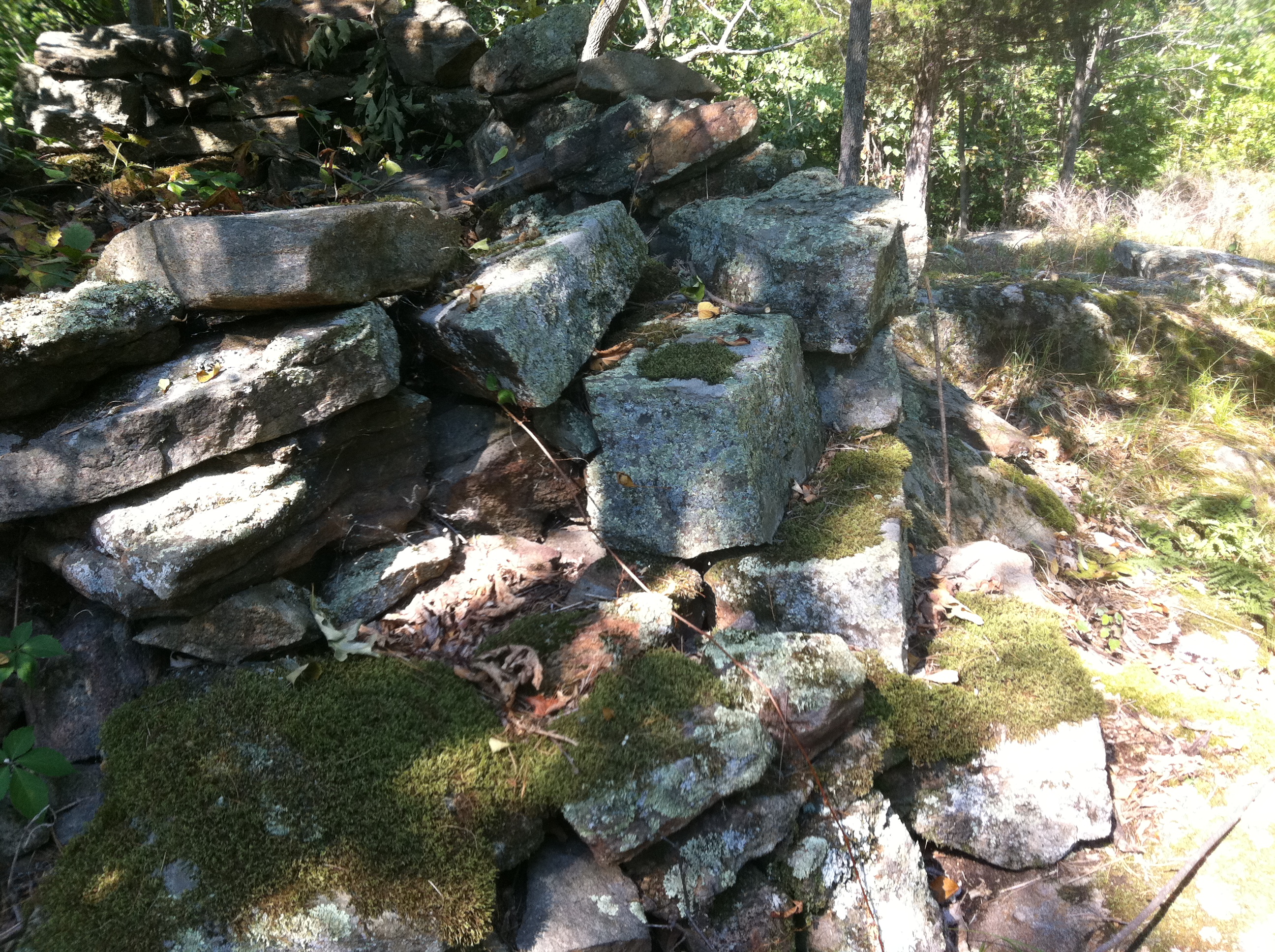
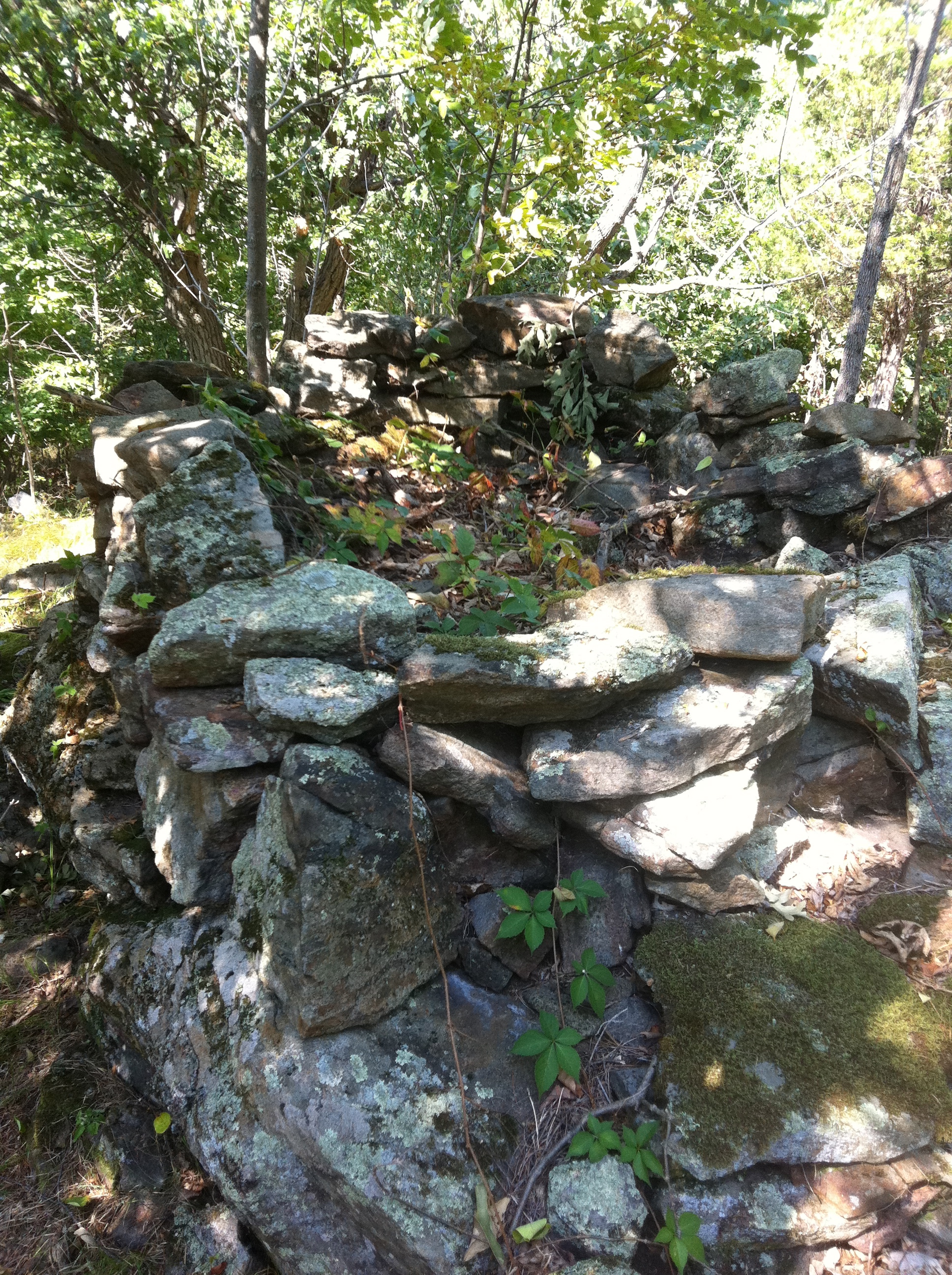
A mysterious stone structure stumbled upon in the woods high atop a geological formation.

A mysterious stone structure stumbled upon in the woods high atop a geological formation.

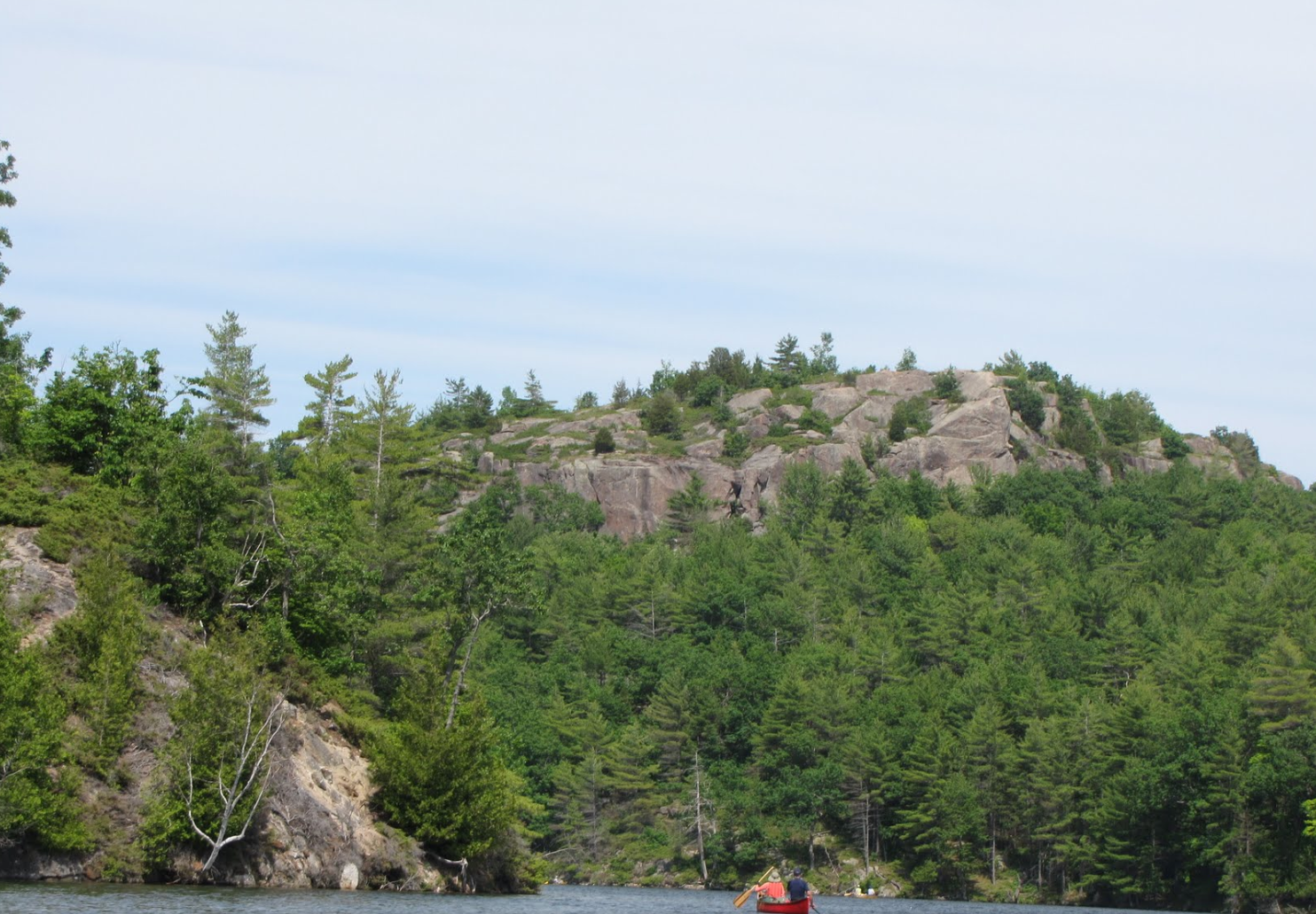
During a recent camping trip along the Rideau Waterway I went for a brief hike into the woods near our campsite at Davis Locks and stumbled upon an interesting geological formation. This extensive outcropping of unusual rocks on Lake Opinicon had me take a closer look which led me to a rugged cliff like area. A collection of strewn stones and odd formations were visible that looked curiously man made. Of course wanting to investigate further, I climbed these rocks for about 20 minutes to the summit where tucked beneath a stand of trees I came across an unusual stone cairn. It’s purpose unknown, the structure was compiled of rocks piled into a rectangular formation with purposely placed stone steps leading into it. The stones of the structure were placed atop an existing boulder protruding from the ground, as well as a split rock also situated in the ground. It looked like a kid’s fort built on the top of a cliff. Yet it seems like a lot of effort the kids went to  in building the structure, but perhaps kids years ago were more resourceful than kids today. I inspected the structure for other details that may reveal its purpose, but still the answer was not clear. I photographed it and proceeded to descend the cliff back to camp. Eventually I wanted to ask others what they thought it was to see if we could solve the MYSTERY OF THE STONE CAIRN.

Situated on the top of the cliff, the structure looks like it has been undisturbed for years.

Situated on the top of the cliff, the structure looks like it has been undisturbed for years.

Returning to Ottawa I emailed some photos of the mystery structure to experts in the field of archaeology to see if they could give their opinion as to what it was. A response soon came back that it was some sort of old mining operation structure, a flagpole base or a lime kiln. I personally don’t think it could be a mining operation since I have come across these before and there is no indication the area had any active mining. With the canal lock in close proximity a flag pole base could be an option, but the size of the structure measured about 8 feet by 6 feet and about 4 feet tall, which makes it seem like an unusual candidate for a flag pole base. A kiln is a possibility, but it seemed so crudely put together that it seems unlikely it would be used for heating/kiln purposes.

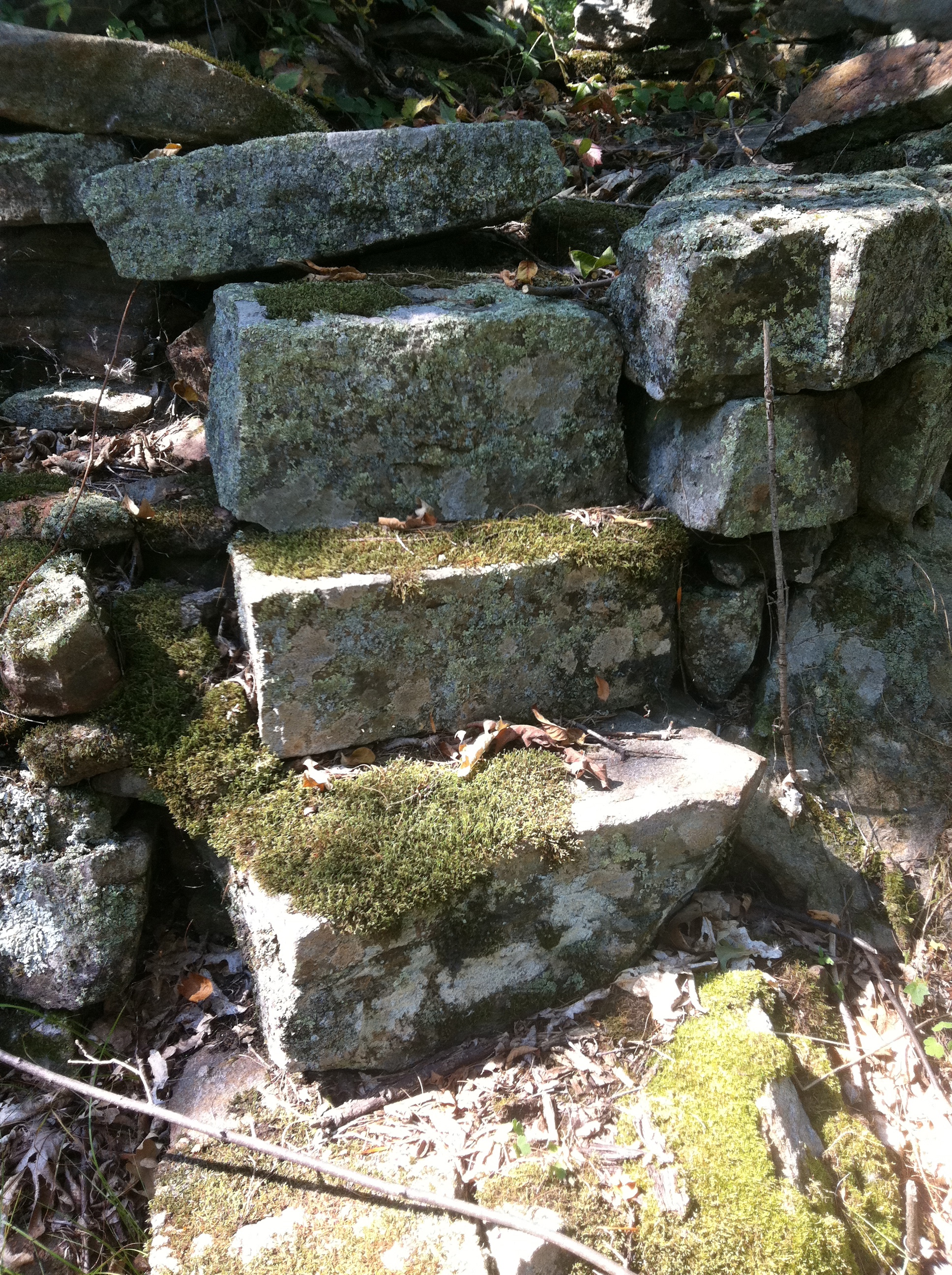
Stones had been placed in an obvious

Stones had been placed in an obvious “staircase” formation that leads into the cairn.

Purposely placed cut stones that form stairs into the stone structure.

Purposely placed cut stones that form stairs into the stone structure.

Doing my own research into what it could be, a looked into the previous history of the land where it rests. Research shows the parcel of land was first owned in 1797 by a Loyalist by the name of Walter Davis from Connecticut , of which the lock is named after. A former member of the American Rangers, Davis moved to South Crosby Township where he set up new life for himself as a Loyalist, building a home and mill on the site of rapids that once connected Lake Opinicon to Indian Lake. This would later be taken over by Col.John By during the construction of the canal system in 1826 when the locks were constructed and the rapids diverted and channelled elsewhere.

The structure measures about 6 by 8 feet and is about 4 feet tall. The interior is filled with unknown material.

The structure measures about 6 by 8 feet and is about 4 feet tall. The interior is filled with unknown material.

Did Davis build a stone lookout atop the cliff overlooking his property? The structure is situated on the highest point of land that overlooks both lakes and commands an impressive view where you would be able to see anyone approaching for miles. As a former American Ranger, perhaps Davis knew to take the strategic high ground to build a mini stone fort lookout. However, why was this not destroyed in the almost 200 years it could have been sitting there by the various other people that came into the area?

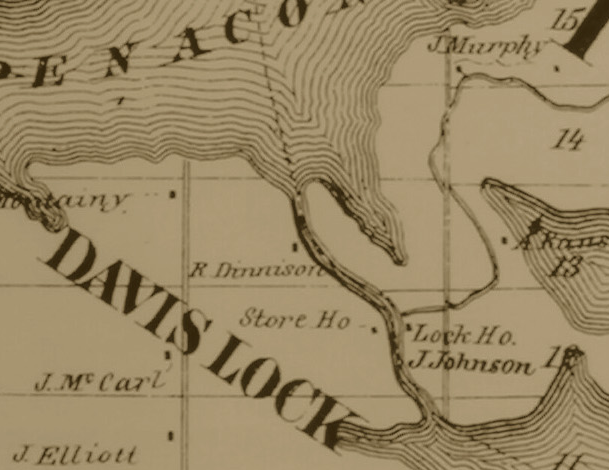
A map from 1880 shows the area and a

A map from 1880 shows the area and a “Store Ho.” is marked in the vicinity. Is this the storehouse made of stones?

I contacted another source who may have answers, a historian who specializes in the history of the Rideau canal. Upon receiving the photos of the structure he was also mystified as to its purpose and given the GPS coordinates, went to investigate for himself and inspect it for clues that may reveal its purpose. Upon closer inspection he concluded it is just a “children’s fort” and which could date it to almost any period (1800s or even early 20th century).

Rocks are piled neatly on top of existing ground boulders.

Rocks are piled neatly on top of existing ground boulders.

This conclusion is in part because he could not can’t see any other purpose for it. He quotes from his investigation it is “Sloppily built (so not an official structure) and uses local field stones. The few squared stones actually appear natural or minimally worked (I can’t see any obvious tool marks) and they clearly form steps into the structure.” However, he still thinks it is open to other theories and says his analysis is “just a guess on my part, I’m not an expert, so still open for interpretation. However I don’t see it as anything Walter Davis Jr. would have done, there’s no reason for it.”

Tucked out of sight the structure is on the highest point in the area.

Tucked out of sight the structure is on the highest point in the area.

Looking further into the land owner Walter Davis who is from Connecticut, I attempted to see if there was a connection to the state he came from. Perhaps there was a typical North Eastern United States stone building technique that was common to that area Davis brought with him to Canada. A quick Google search revealed that Connecticut, New Hampshire and Vermont all have an incredibly high number of these mystery stone cairns as well. Is there a connection to some kind of Eastern US farming practice? Maybe they used these stone cairns to burn brush or store garbage.

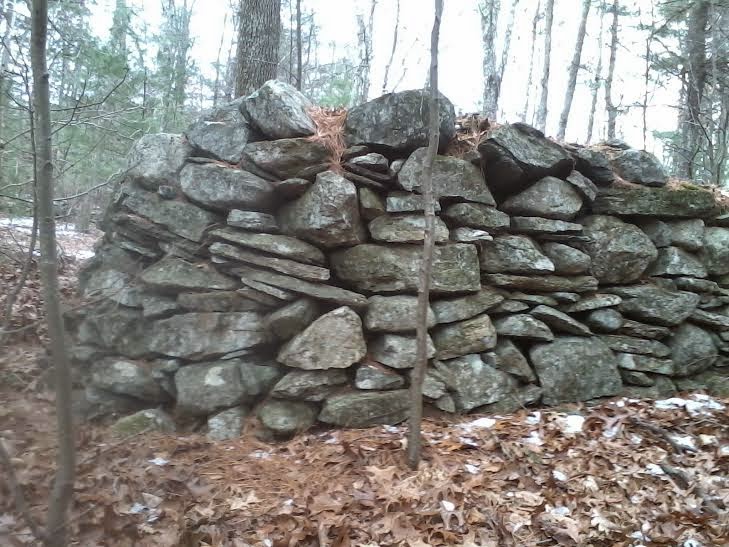
A similar stone structure in Connecticut.

A similar stone structure in Connecticut. (photo: StoneStructures.org)

Another theory put forward by a historian is that these mystery stone cairns are based on aboriginal spiritual practices built by the indigenous people of the area. “Stone Structures of the NorthEastern United States” is a website dedicated to the study of these mystery stone structures found in the woods and forest regions of the NorthEastern United States. They refer to these structures as a “cairns” which are “an intentionally constructed pile of stones. It is built one stone at a time. Cairns have been used by humans in the northeastern United States as far back in time as 5,000 years ago and continue to be used today. Cairns were built by both Native American Indians and white settlers. They were used by the Native Americans for ceremonial purposes and by white settlers for utilitarian purposes.”

Another North Eastern United States Stone Cairn structure.

Another North Eastern United States Stone Cairn structure that is similar. (photo:StoneSturctures.org)

Comparisons of the Opinicon stone structure and the ones presented at Stone Structures.org are almost identical. They give an example of a cairn that uses a “base stone” the same as the Opinicon cairn. The base stone cairn is built upon an above ground boulder, below ground boulder with exposed top, above ground bedrock called an outcrop, or surface level exposed bedrock. Base stone ranges from ground level up to three to four feet high.” The use of a split stone in the base, also like the Opinicon Cairn “exhibits a total split or crack in the base stone. Split stone cairn sites are said to be a spirit portal to the Underworld, utilized by Native Peoples during a “Spirit Quest”. In his book “Vision Quest” author Steven Foster recounts how the piling of stones to form a structure is an ancient practice of “communication” between the living and the dead, where you would enter the structure and connect with loved ones passed and the spirits of nature. Foster says they are usually constructed at a “beautiful. prominent place, where it could be found easily.”

An unsolved stone mystery lies quietly beneath the trees of Lake Opinicon.

An unsolved stone mystery lies quietly beneath the trees of Lake Opinicon.

So, there you have it. A mysterious stone structure sitting in the woods south of Ottawa overlooking Lake Opinicon. To conclude, here is what was said it could be:

-a flag pole base

-a lime kiln

-a mining structure

-a kids fort

-an aboriginal spirit cairn

My thoughts lean towards it being some kind of lookout post our Loyalist friend Davis built when he arrived from Connecticut to the area in 1799. Yet the location is most serene, surrounded by rocks of unusual shapes and geological compounds. Situated high above two gorgeous lakes at rapids that once connected the two in a tranquil forest also lends itself to the plausible theory it was an ancient spiritual structure that has remained as such to this day.

If anyone else has other ideas or theories, please pass them on and perhaps we may eventually solve the MYSTERY OF THE STONE CAIRN.

UPDATE!

Since this post was published it was brought to my attention that the stone structure is actually a British Ordinance watchtower post from the 1800s. If this is the correct answer, then the structure I think should be studied in further detail and an archaeological analysis and/or preservation of the site should be undertaken to preserve this unique piece of early Rideau Canal history. The answer submitted is copied and pasted below:

“If you were camped at Davis and went up the trail to the high ground on the opposite side from the lock office there was a British ordinance watch tower that looked off across to Opinicon lake and this is what remains of the base .Cliffe Pennock the turn of the19 century Opinicon barber/photographer took different shots of the lake from this vantage point and they ended up with other Post card publishers of the day like Valentines of Montreal.”

SOURCES

http://www.uelac.org/Loyalist-Info/detail.php?letter=d&line=60

https://books.google.ca/books?id=_DuPuV5hzyEC&pg=PA47&lpg=PA47&dq=stone+cairn+spirit+quest&source=bl&ots=h8J25Abs8M&sig=dEvBBj3JDKRlemqURao6ochrREw&hl=en&sa=X&redir_esc=y#v=onepage&q=stone%20cairn%20spirit%20quest&f=false

http://www.nativestones.com/cairns.htm

http://digital.library.mcgill.ca/countyatlas/searchmapframes.php

http://www.stonestructures.org

The Mystery Of The Sparks Street Smile

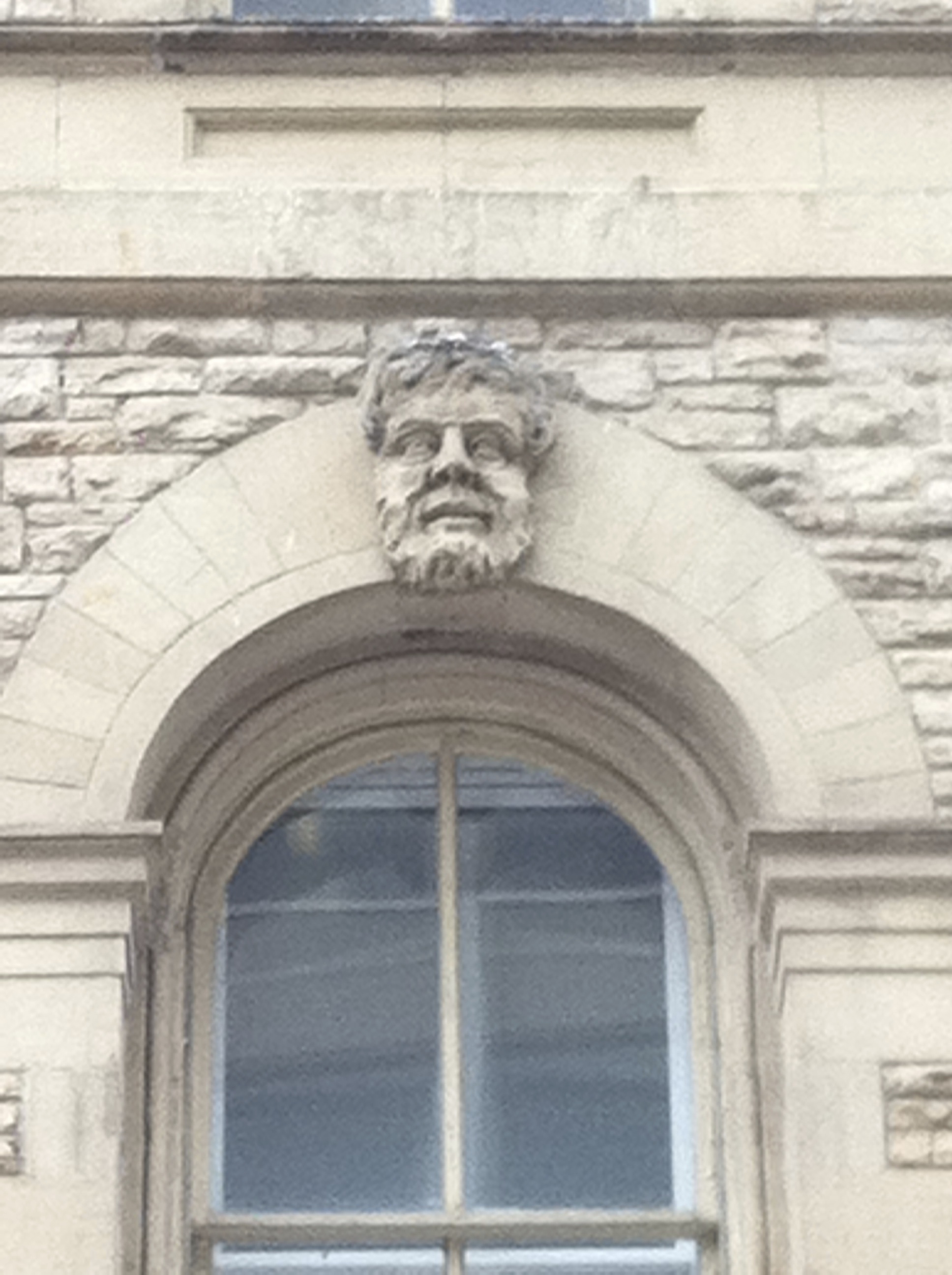
At 93 Sparks St. in Ottawa 11 scowling heads adorn a historic building. However, one of the heads is oddly smiling.

At 93 Sparks St. in Ottawa 11 scowling heads adorn a historic building. However, one of the heads is oddly smiling.

Once a bustling avenue of shops, restaurants, hotels and theatres, Sparks Street today is a mere shadow of its former self, a once glorious past swallowed by the Federal Government and the National Capital Commission who expropriated most of the buildings on the downtown Ottawa street. With a good portion of its past life-force depleted, a stroll down Sparks Street can still provide an interesting look back at some of Ottawa’s finest preserved architecture. A look upwards on a walk down this historic street reveals fascinating details that may be overlooked when walking with eyes straight ahead at street level. One such architectural detail up above provides a curious mystery and may reveal Ottawa’s own version of the DaVinci Code.

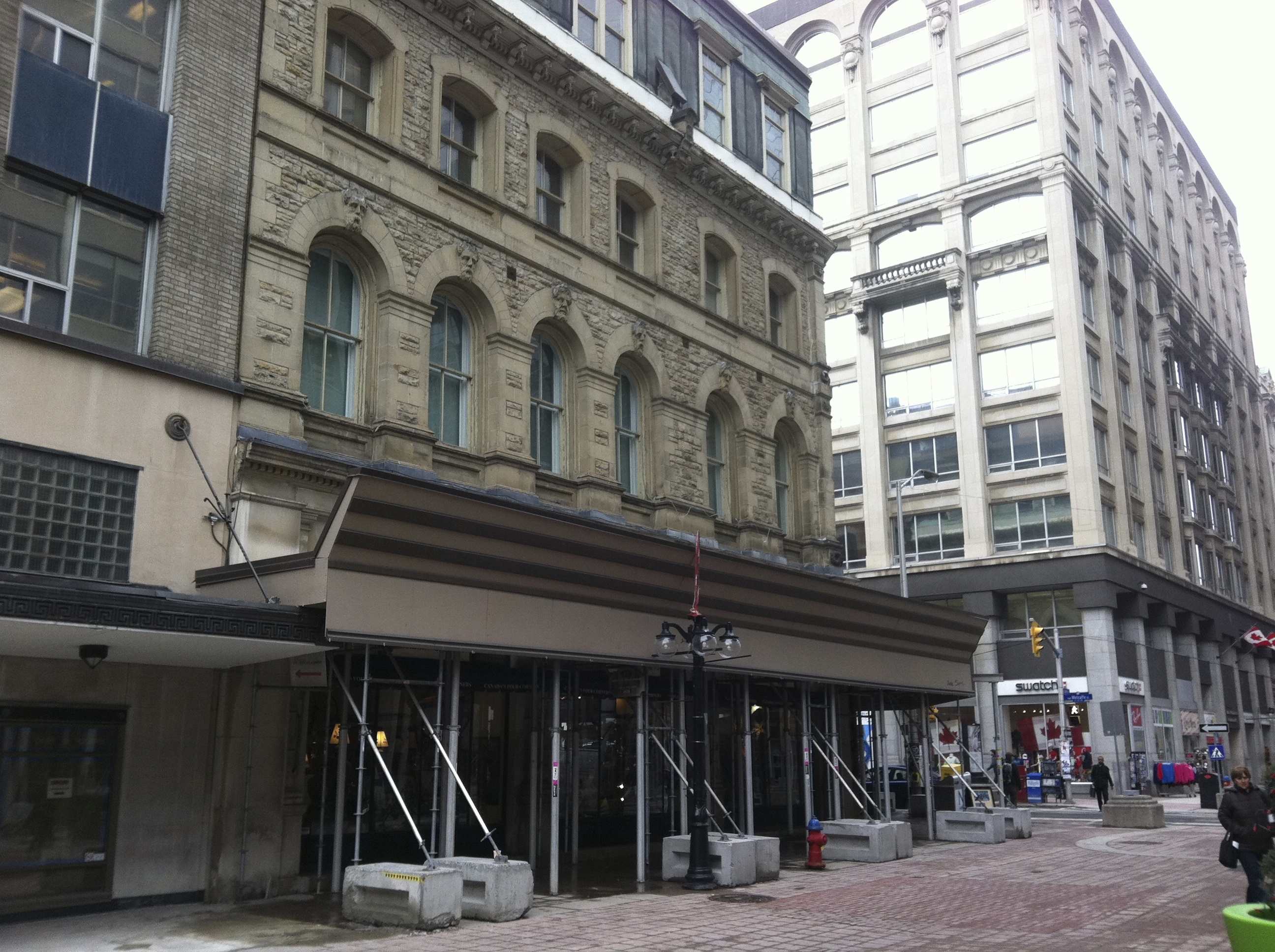
Dubbed "Canada's Four Corners Building", the structure has been covered with scaffolding for years.

Dubbed “Canada’s Four Corners Building”, the structure has been covered with scaffolding for years.

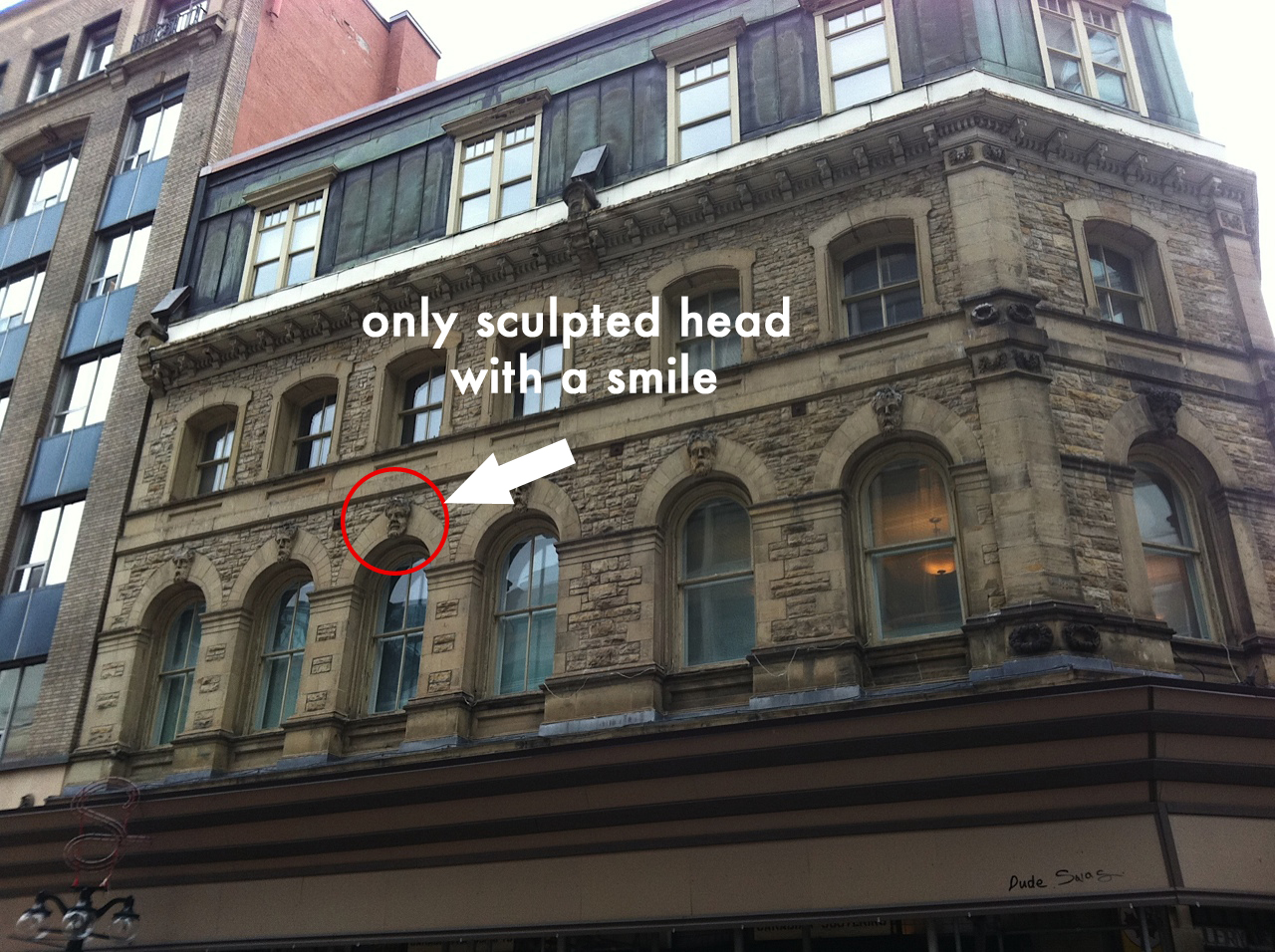
Located at 93 Sparks Street, at the corner of Metcalfe, there is a building dubbed “Canada’s Four Corners”. For as long as I can remember, this building has been the home to the longest operating souvenir shop in Ottawa, its impressive architecture filled with various pieces of Canadiana being offered to the throngs of tourists that pass it each day on their way to Parliament Hill. Also for as long as I can remember, the old building has been unfortunately encased in what seems to be a perpetual scaffolding facade that hides its ground level grandeur. Above the scaffolding there are details of sculpted heads that adorn the keystones of each second level window. These scowling bearded faces all look identical, except for one…one head is mysteriously smiling. Different than the others, this smiling face for some reason is the only head that is not scowling. Why is it smiling? To solve this mystery of expression, let’s go back and check out the history of this old building….

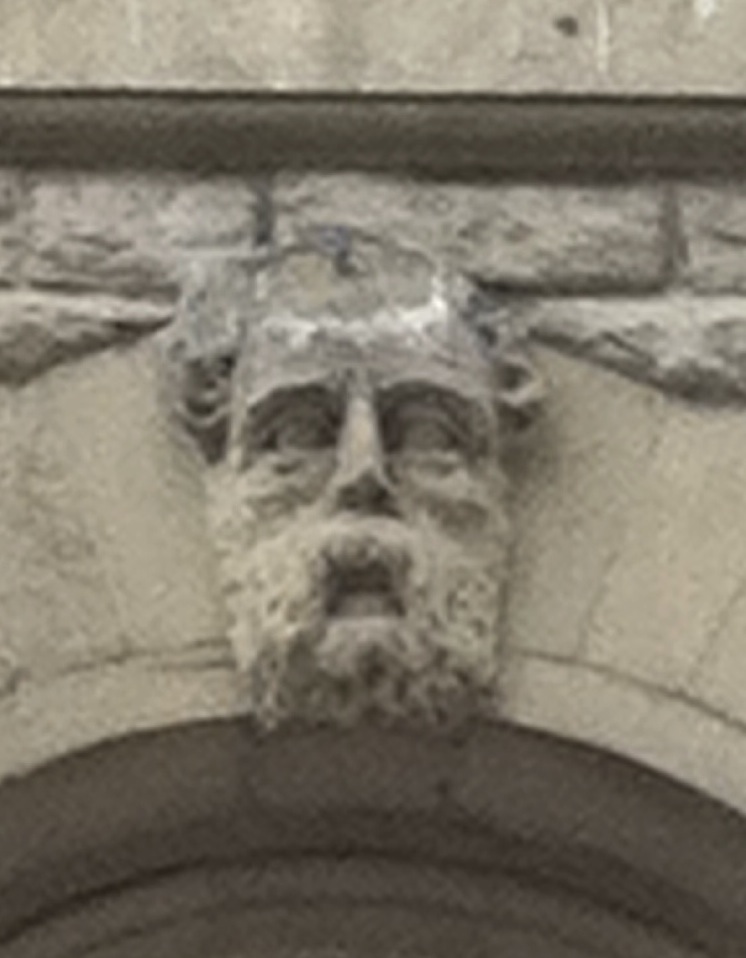
The only one of the eleven carved heads on the building that has a grin.

The only one of the eleven carved heads on the building that has a grin.

HISTORY

Built in 1870 by John Kelly, the structure was designed by Ottawa architect King Arnoldi, who also designed many churches and other notable buildings throughout the Ottawa Valley. Built as a rental property, it was first called “The Montreal Telegraph Building”, whose first tenant was the Merchant Bank Of Canada, a very influential bank that was part of the financial empire of prominent Montreal entrepreneur, Sir Hugh Allan.  Sir Hugh Allan was the richest man in Canada when he died in 1882, and a study of this man may reveal clues as to why there are bearded sculpted heads on his building.

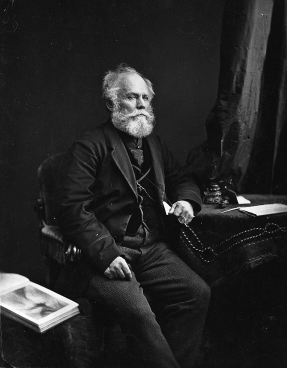
Sir Hugh Allan. Shipping magnate and the richest man in Canada.

Sir Hugh Allan. Shipping magnate and the richest man in Canada.

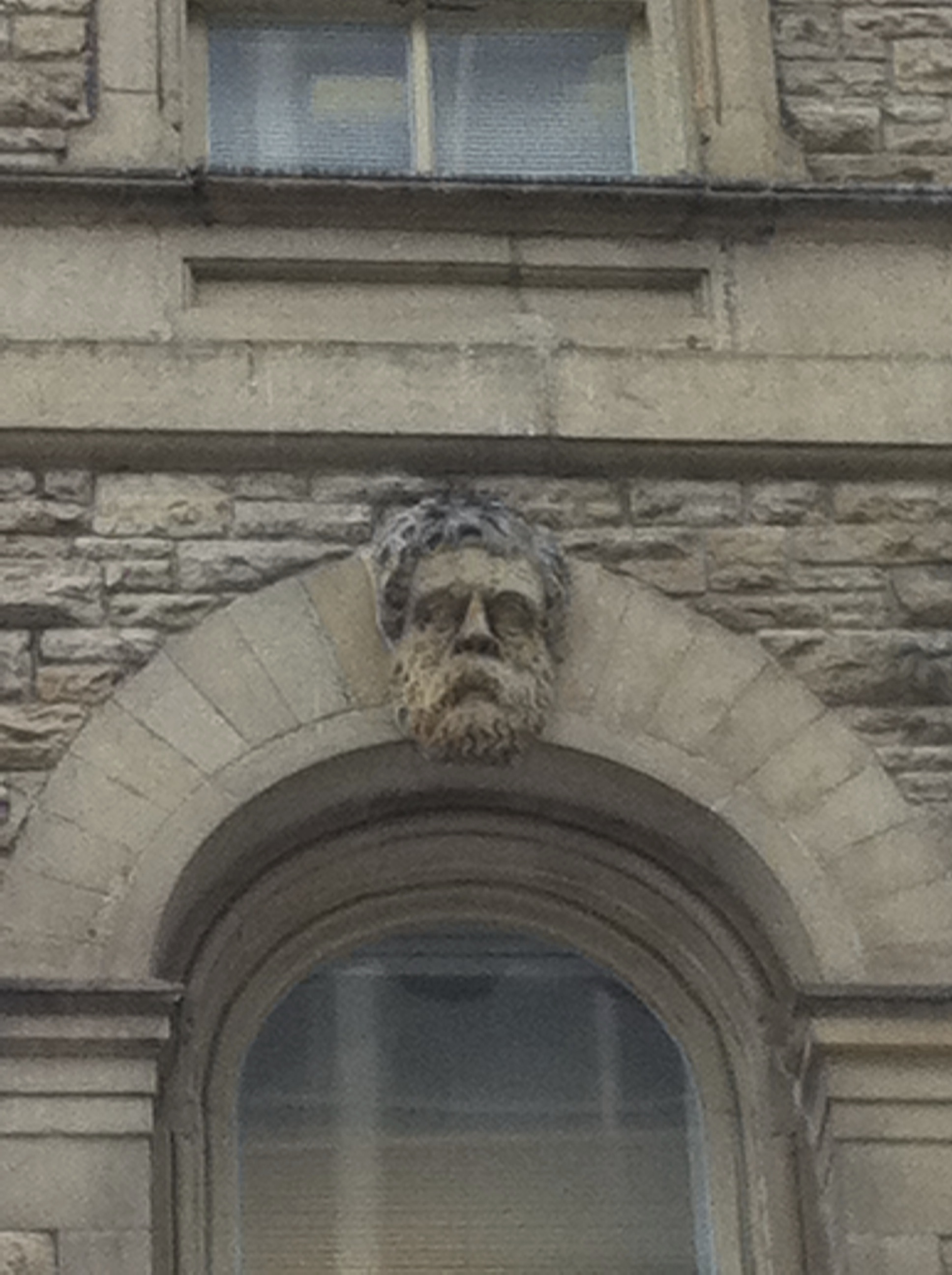
All ten of the eleven keystone heads are similar in appearance.

All ten of the eleven keystone heads are similar in appearance.

Hugh Allan was a Scotsman who made his vast fortune as a shipping magnate, owning the largest privately owned shipping empire in the world. Based in Montreal, Allan’s riches grew after he became the director of the Bank Of Montreal while still in his thirties. Allan formed the Merchant Bank of Canada in 1864 and because of his association with the bank he garnered further wealth in his other profitable ventures. Allan invested in communications technology, manufacturing, and mining. In 1852, he became president of the Montreal Telegraph Company, and rented out the new Sparks Street building to his own bank, the Merchant Bank of Canada that operated in the building until 1954 when it was sold to the Canadian National Railway.

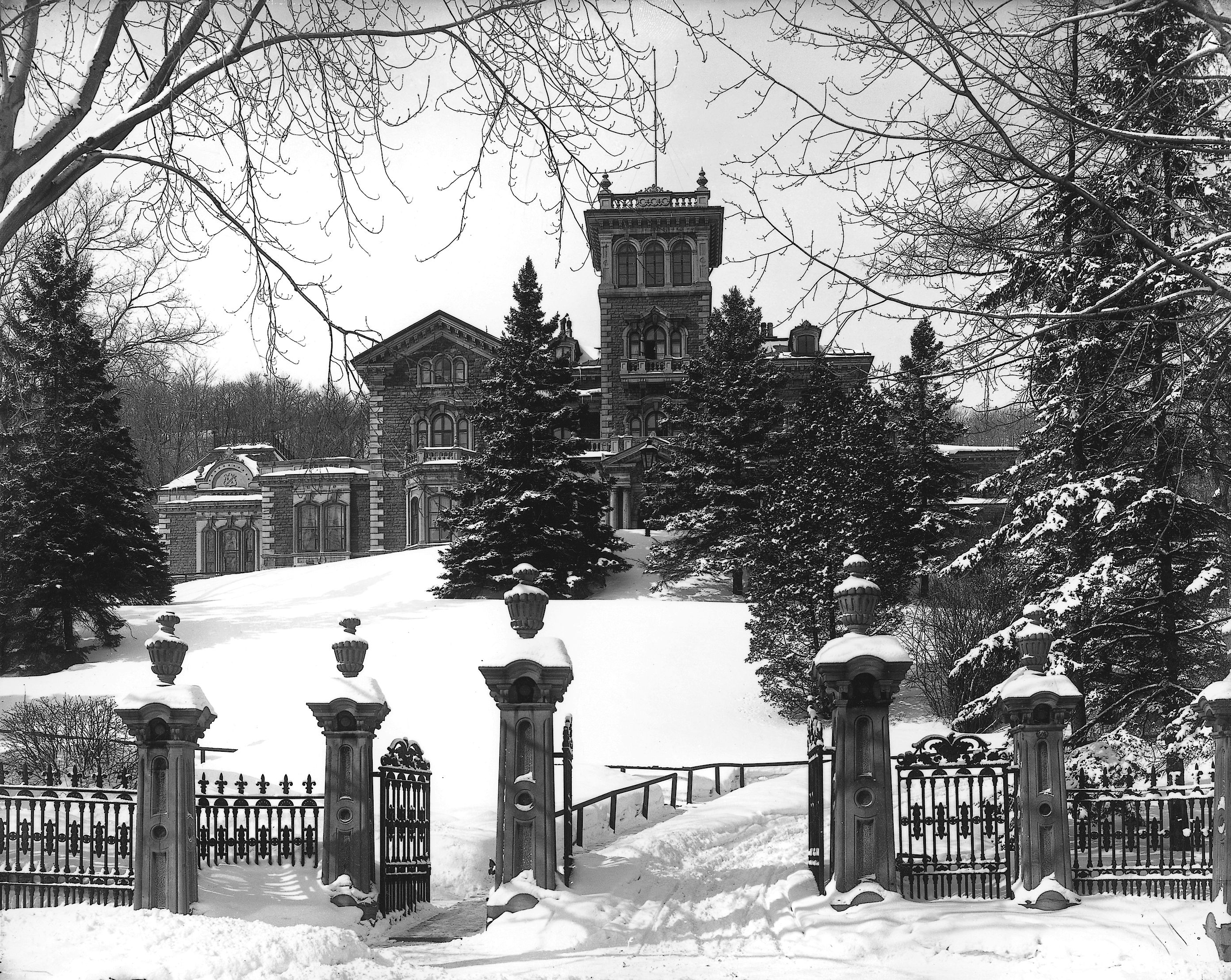
Sir Hugh Allan's castle mansion on Mount Royal filled with mythological symbols. He named "Ravenscrag" after his favourite childhood castle ruins in Scotland.

Sir Hugh Allan’s castle mansion on Mount Royal filled with mythological symbols. He named “Ravenscrag” after his favourite childhood castle ruins in Scotland.

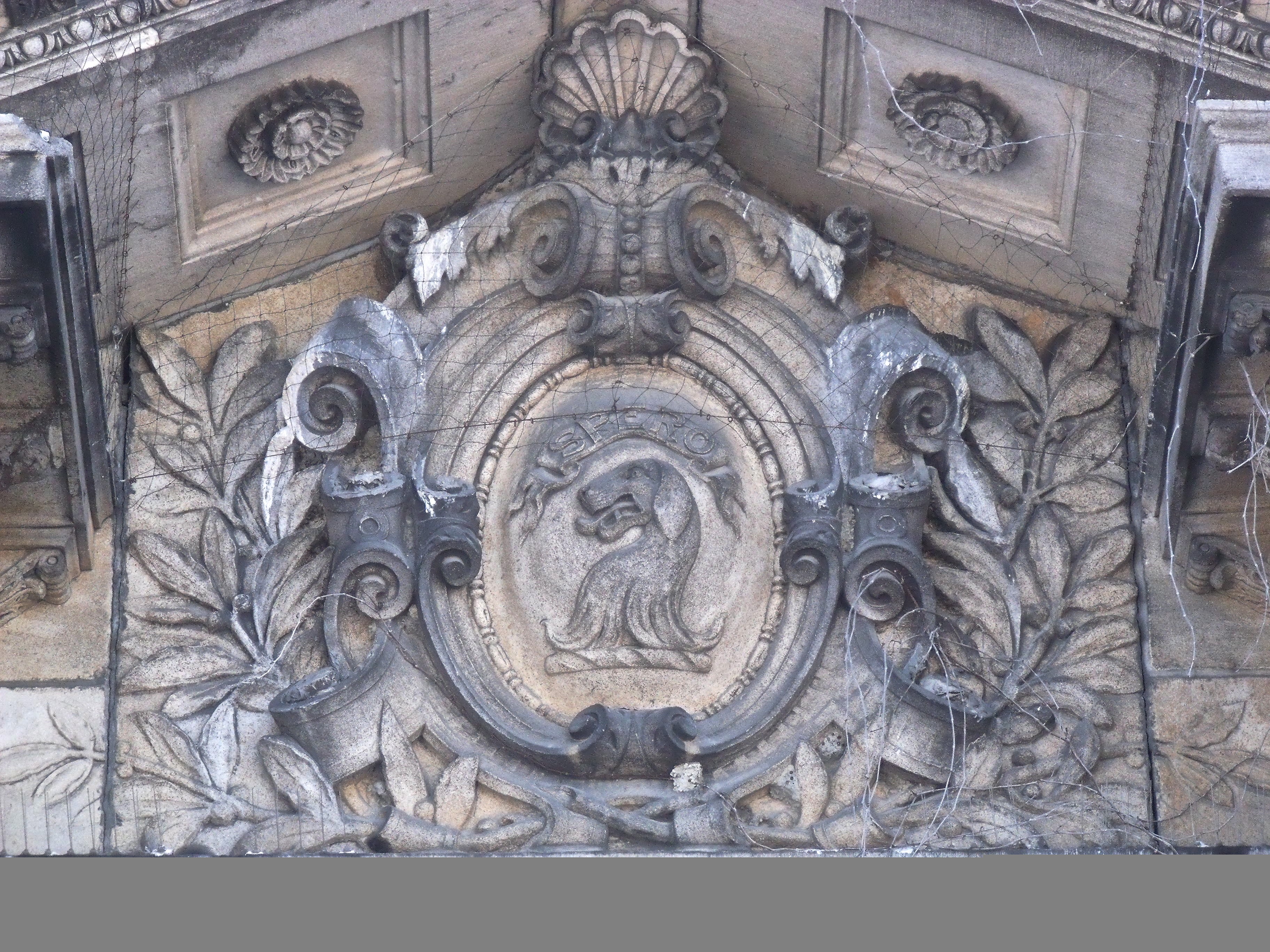
Allan was somewhat of an illustrious fellow infatuated with the realm of fantasy and mythology. As a child, Allan was obsessed with a medieval castle ruin in Scotland near Ayrshire, a castle called “Ravenscraig”, a place where he would spend countless hours exploring. After become extremely wealthy in Canada, Allan bought property in Montreal on Mount Royal to build his own castle, a mansion he dubbed oddly enough “Ravenscrag”. This imposing 72 room property was decorated with figures inspired by Allan’s interest in mythology, including hand-painted frescos and murals illustrated with mythological scenes. His favourite room at Ravenscrag, the library, was dominated by a wall-to-wall mahogany bookcase decorated with carved panels depicting sea monsters and mermaids. Above the main entrance to Ravenscrag, a sculpted crest with Allan’s motto “SPERO” greets those that enter, which in Latin means “I hope”.

Allan's motto and crest above the main entrance to Ravenscrag.

Allan’s motto and crest above the main entrance to Ravenscrag.

One can speculate that Allan had a hand in the design of the Ottawa Sparks street building in collaboration with King Arnoldi. Arnoldi’s experience with medieval church design combined with Allan’s fascination with mythology may be the reason the building is adorned with 11 sculpted heads. But who are these heads representing and why is only one smiling?

The heads are the keystones in each of the arched windows of the building. Ten of them are of a scowling bearded man that look remarkably similar to Sir Hugh Allan himself. Perhaps Allan wanted to ensconce his likeness into his building like the Greek gods he was fascinated with in ancient temples of past. Yet one of these carved heads has a completely different expression. The smiling head is perhaps a clue Allan left for us to figure out, an unsolved mystery that was part of a bigger puzzle Allan arranged with Arnoldi.

IMG_4414

Are the carved heads a representation of Allan himself? (below)

1f970bca-4af1-4da3-8036-391c2cda0ff7

A look back at Allan’s life history reveals he had 11 children. There are 11 carved heads. One of his children, Arthur Allan, was the last child to be born in 1871, in the exact same year the building was being built. Arthur later died in a fire. Is the smiling head a representation of Allan’s last born child, a symbol of hope for his empircal dynasty like his motto ‘Spero” implied? Also in the year 1871,  Allan was created a Knight Commander of the Order of St Michael and St George by Queen Victoria for his services in connection with the development of ocean steam navigation in Canada. Perhaps his knighthood in the same year the building was constructed could be a clue to the grinning carved head.

Allan died in 1882 and took with him the secret of the smile. Wanting to solve this Ottawa DaVinci Code,  I asked staff who currently work in the building if they knew why one of the heads is smiling but they hadn’t even noticed the anomaly. The architect of the building, King Arnoldi died in 1904, so we may never know what the two men were up to when they designed these heads. Until someone else comes forward with an answer to this mystery, the carved face on Allan’s grand building will continue to smile down on the Sparks Street souls that unknowingly pass below.


SOURCES

http://dictionaryofarchitectsincanada.org/node/1267

http://historicplaces.ca/en/rep-reg/place-lieu.aspx?id=4640

Click to access 1985-021(e)canada’sfourcornersbuilding.pdf

http://en.wikipedia.org/wiki/Hugh_Allan

http://en.wikipedia.org/wiki/Ravenscrag,_Montreal

HISTORIC FRANKTOWN “CASTLE” CHURCH UP FOR SALE

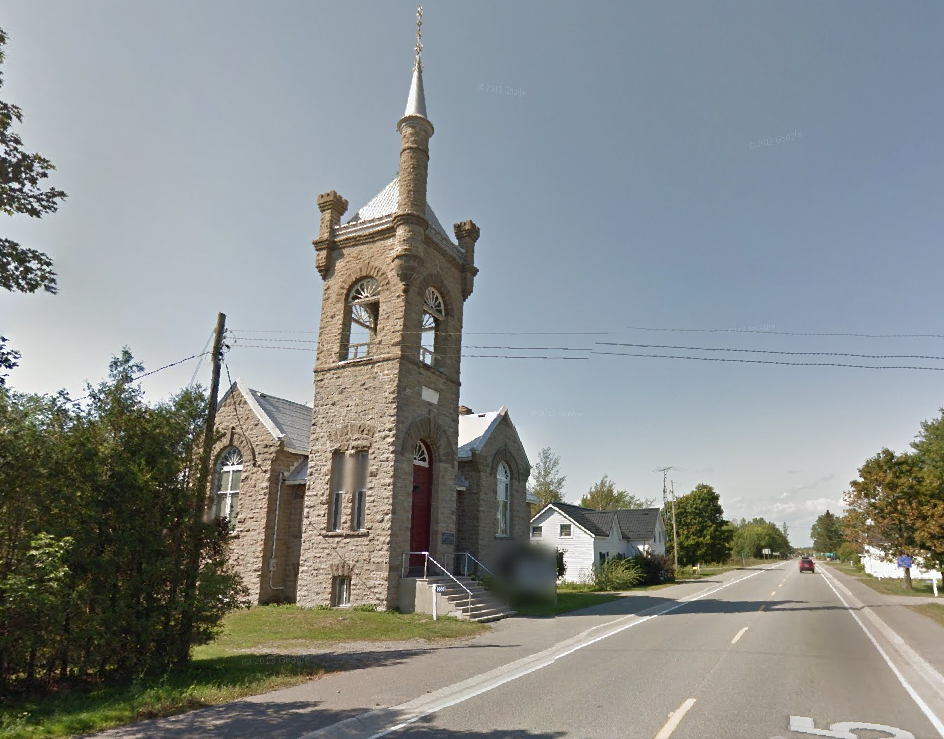
The castle-like church in Franktown, ON is up for sale. (Photo: Wikipedia)

The castle-like church in Franktown, ON is up for sale. (Photo: Wikipedia)

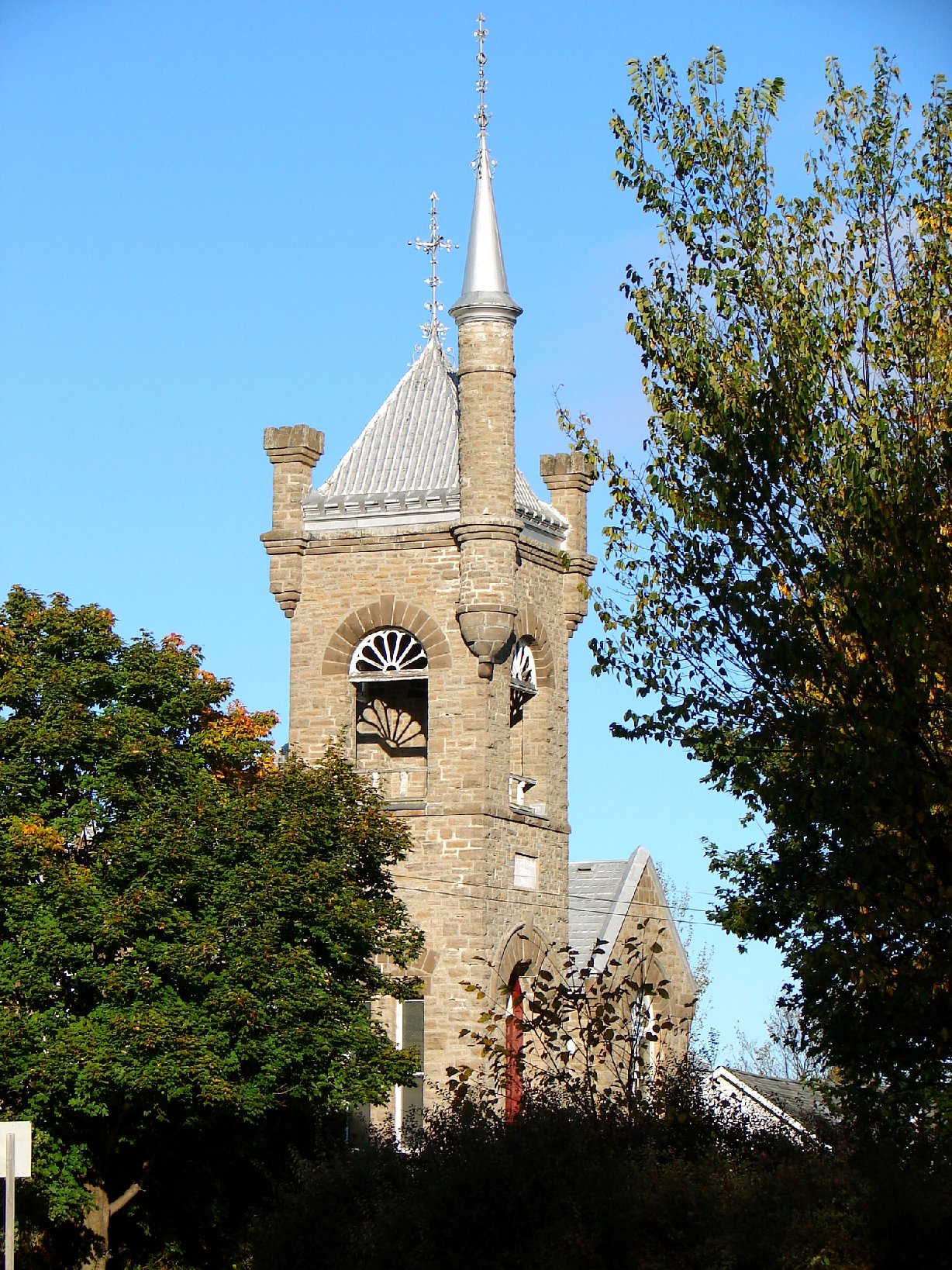
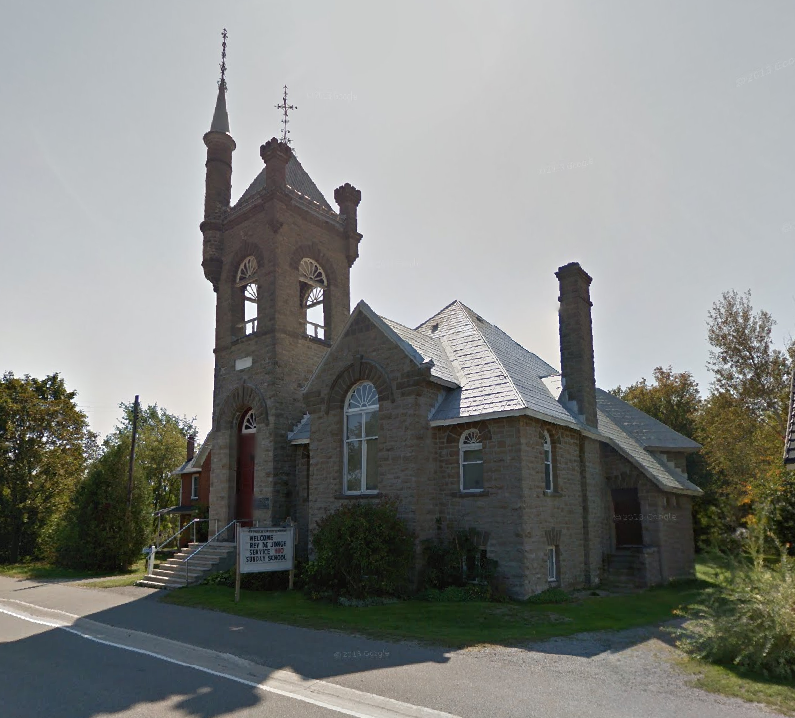
For as long as I’ve been driving back and forth to Ottawa along Highway 15 the familiar sight of a stone spire in Franktown, Ontario has signalled my journey to the Nation’s Capital was almost at an end. The landmark stone spire and conical tin roof that looks like it was grafted on to the side of the building from the Disneyland castle has always meant I had about 35 minutes left of driving before I arrived home. As a kid in the back seat of my parents car, I’d always eagerly look out for the “castle” in Franktown….and now, the century old building designed by a notable Ottawa architect is up for sale.

St. Paul's church, built in 1901-02, sits prominently along Highway 15 in Franktown, On

St. Paul’s church, built in 1901-02, sits prominently along Highway 15 in Franktown, On. (photo: Google Streetview)

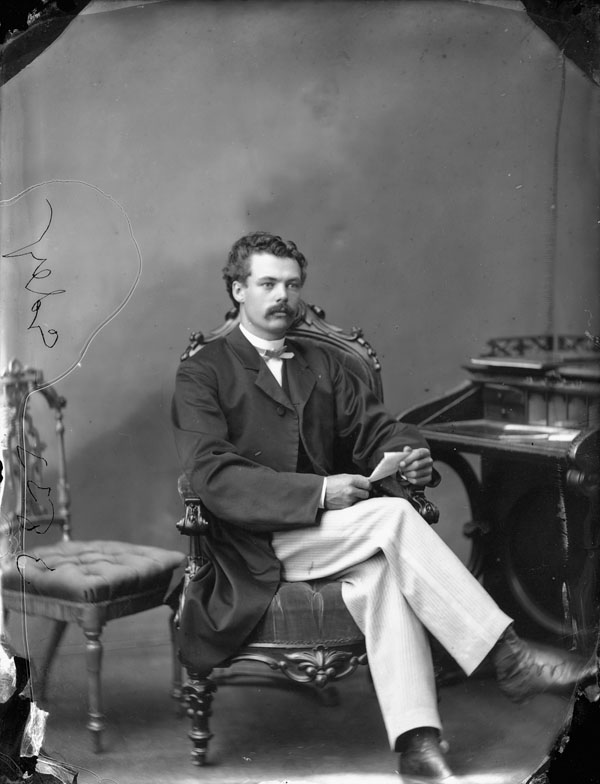
The Franktown Castle is actually St. Paul’s church, built in 1901, opened in 1903 and was designed by none other than the famous Ottawa architect Moses Chamberlain Edey . Edey also designed the Aberdeen Pavilion at Lansdowne Park, a National Historic Site and the infamous downtown Daly Building, which was Ottawa’s first department store. The construction firm who built it was ‘James Wilson’ of Perth, ON for a cost of $6100.

The Franktown church's architect, Moses Chamberlain Edey, who also designed the Aberdeen Pavilion and Daly Building in Ottawa.

The Franktown church’s architect, Moses Chamberlain Edey, who also designed the Aberdeen Pavilion and Daly Building in Ottawa. (photo:Wikipedia)

The church stone came from the J. McEwen Quarry, in Beckwith Township and was blasted out with dynamite and drawn in the raw state by the men of the congregation using horses and wagons or sleighs. The stone was dressed on site with all the materials, sand and stone, donated to the Church.

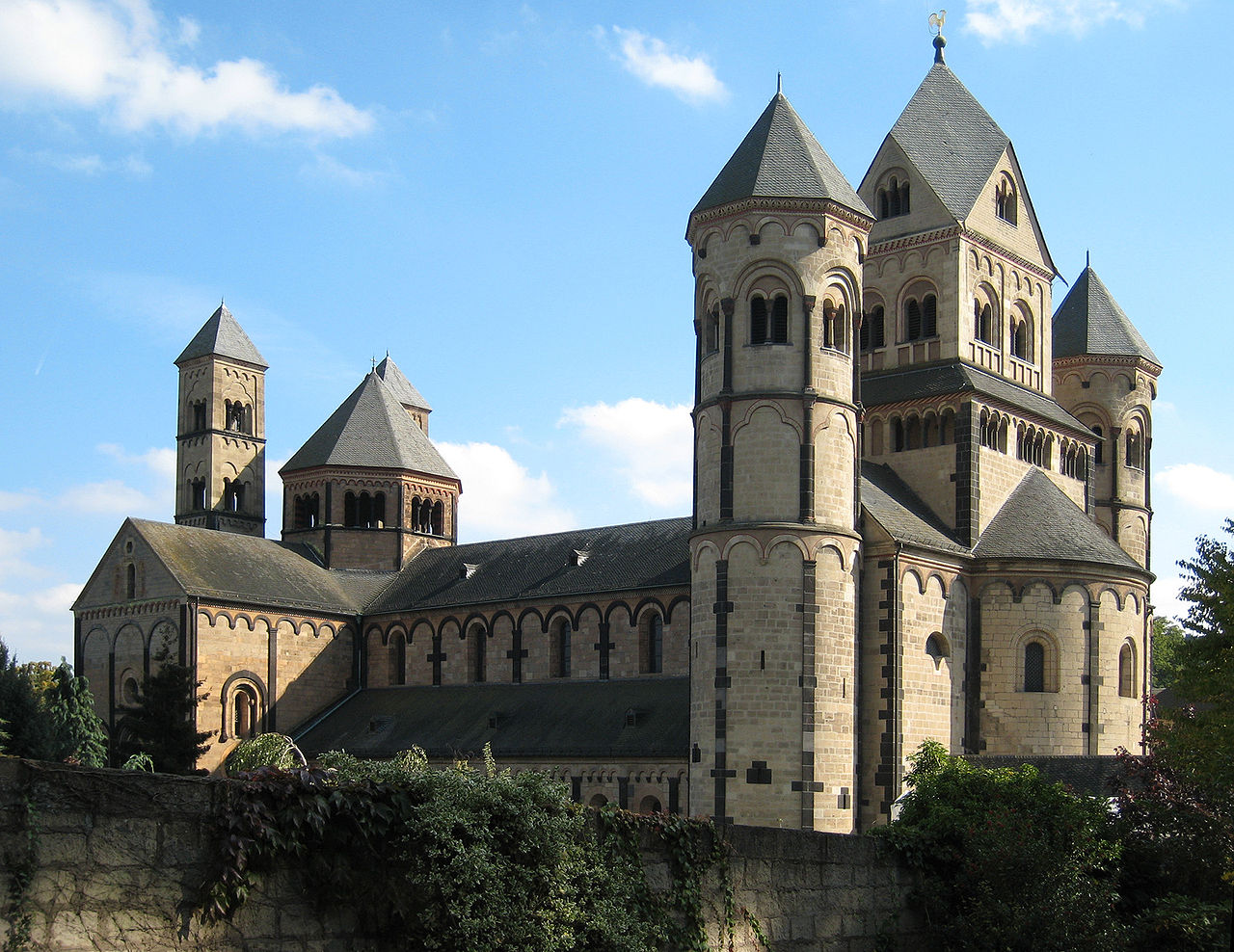
Built in a Romanesque architectural style of medieval Europe which is characterized by semi-circular arches, towers and spires, the revival of the Romanesque style was carried through Edey’s church design for Franktown. The Romanesque Revival style was widely used for churches, and St. Paul’s is no exception with its Norman castle like corbelled corner turrets and spire, complete with a conical peak.
The Romanesque style featured on the church by the architect Edey  featured turrets and arches, like medieval European castles.

The Romanesque style featured on the church by the architect Edey featured turrets and arches, like medieval European castles. (photo: Wikipedia)

A view of St. Paul's Church, which is a grand landmark in Franktown. Its distinctive turrets and spire can be seen for miles. (photo: Google Streetview)
A view of of the Romanesque St. Paul’s Church, which is a grand landmark in Franktown. Its distinctive turrets and spire can be seen for miles. (photo: Google Streetview)

Edey Romanesque style contrasts his other work in Ottawa, which was the Aberdeen Pavillion at Lawnsdowne Park, and the Daly Building which was built in the “Chicago” style, both designs that came after his work designing the church in Franktown.
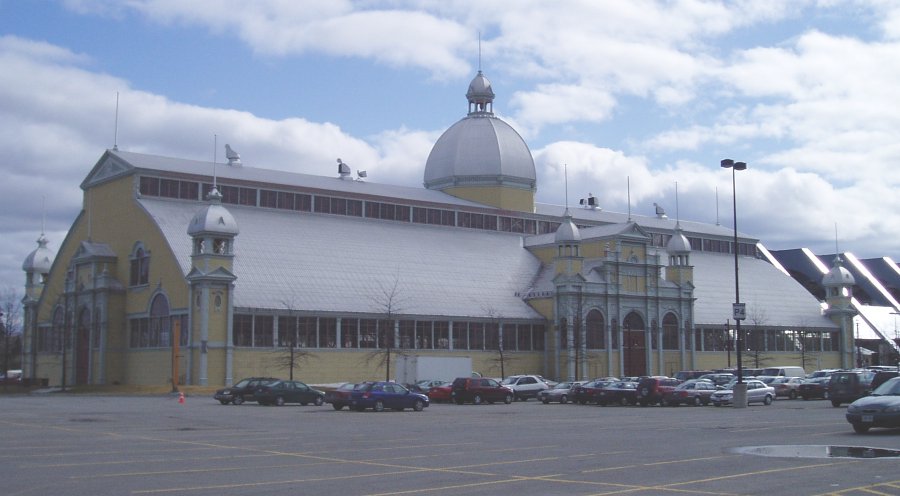
The Aberdeen Pavilion, also designed by Edey. (photo: Wikipedia)

The Aberdeen Pavilion, also designed by Edey. (photo: Wikipedia)

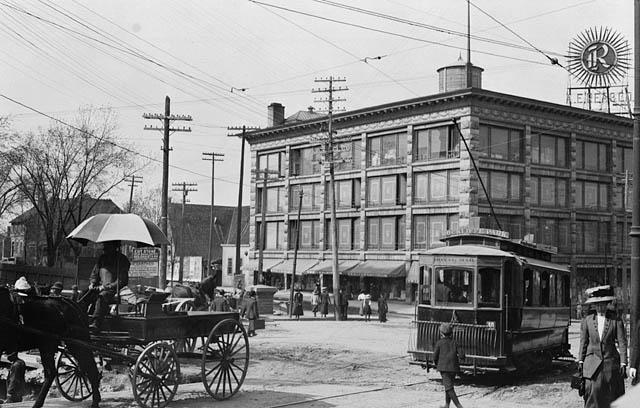
The Daly Building, Ottawa's first department store, was also designed by Edey in the "Chicago" style of architecture. (photo: Wikipedia)

The Daly Building, Ottawa’s first department store,  designed by Edey in the “Chicago” style of architecture. (photo: Wikipedia)

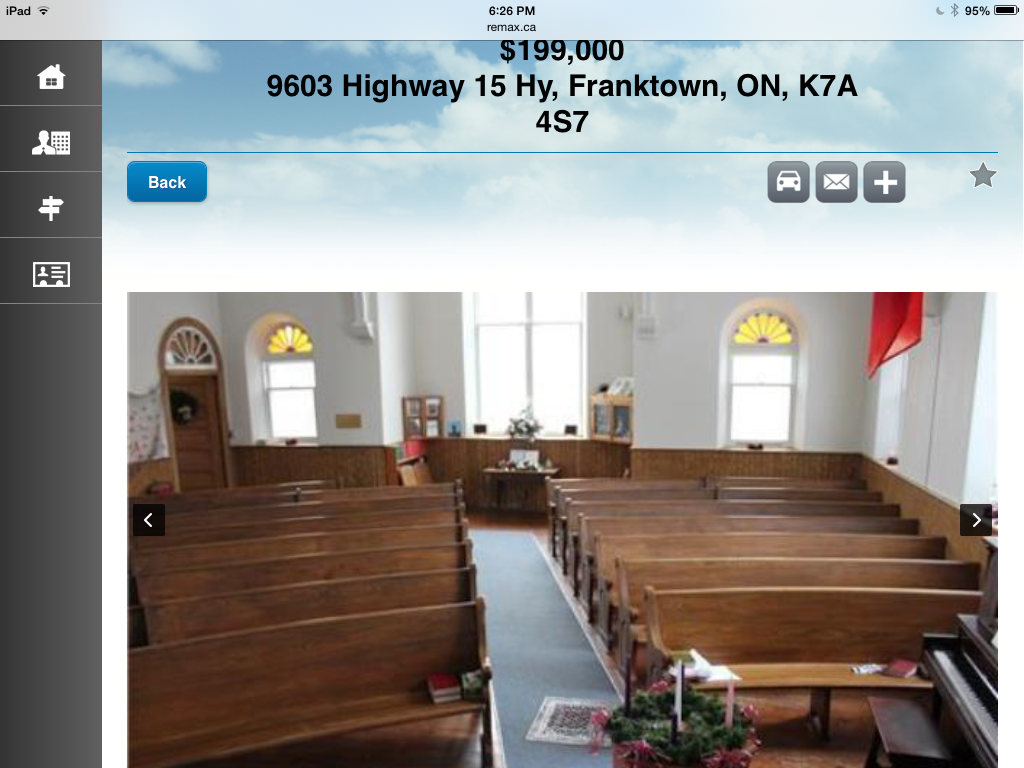
After more than a century in operation, the church congregation decided to sell the historic building in September 2014, and it it is now listed with Re/Max Realty and offered at a reduced price of $199,000. The listing can be seen here.

The structure is zoned institutional, which means if you want to purchase it and convert it into your own personal castle, you would have to apply for rezoning it as residential. The church space features a large open main floor and in the church basement there is a full kitchen so you could host your very own church bake sales.

A photo from the Re/Max realty site that is selling the church. A full church basement kitchen is perfect for bake sales.

A photo from the Re/Max realty site that is selling the church. A full church basement kitchen is perfect for bake sales.

The church has been up for sale for a few months and has been reduced in price by $50,000 from its original listing. The property is a historic landmark in Franktown, and could very well become you own personal century old “castle”. I wonder what permits would be necessary to build a moat and drawbridge…


SOURCES:

http://www.insideottawavalley.com/news-story/5325010-st-paul-s-united-church-in-franktown-up-for-sale/

http://en.wikipedia.org/wiki/Moses_Chamberlain_Edey

http://www.twp.beckwith.on.ca/historicalmap/popup.aro?id=CH7

http://en.wikipedia.org/wiki/Romanesque_Revival_architecture

Google Maps Streetview

The Lost Rocket

titlecard

The Story of Canada’s Lost Nazi Rocket

(from material originally published in my column for The Ottawa Citizen November 7 2014, which can be viewed HERE.)

Canada’s lost V2 rocket story begins during the closing months of WW2 when a Canadian Army captain began to collect captured and abandoned German equipment to send back to Canada for analysis and museum display. The Captain in charge of this 1st Canadian Army Museum Collection Team was none other than famous Canadian author Farley Mowat.

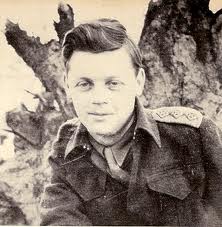
Captain Farley Mowat during WW2.

Captain Farley Mowat during WW2.

Farley Mowat in his book “My Father’s Son” outlines how Captain Mowat quickly assembled an impressive collection of German, tanks, vehicles and assorted equipment that can be seen today at the Canadian War in Ottawa.

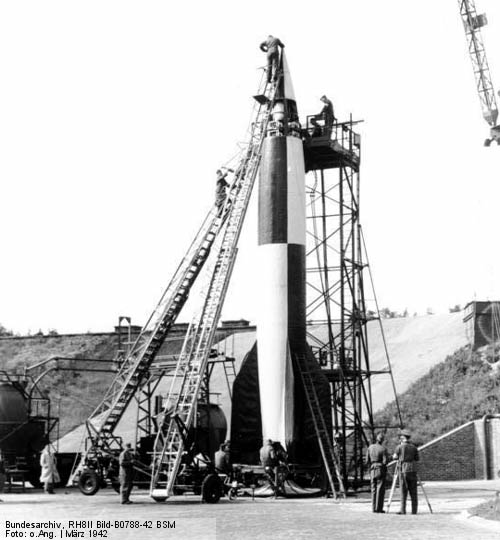
One such piece of captured German technology that was collected by Captain Mowat was an advanced 12 ton liquid fueled rocket, the V2, or (“Vengeance Weapon 2”), technical name Aggregat-4 (A4). It was the world’s first long-range ballistic missile, and the precursor to all modern rockets, including those used by the US and the Soviet space programs.

A German V-2 being tested at Werner Von Braun's advanced rocket test facility at Peenemunde in Germany.

A German V-2 being tested at Werner Von Braun’s advanced rocket test facility at Peenemunde in Germany.

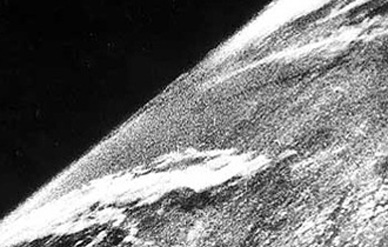
6,000 of these advanced rockets were built by German forces with half being fired onto Allied targets during the latter part of World War 2. Designed by Wernher von Braun, who was later an integral part of the American NASA rocket program and the NASA moon missions, this 50 foot  tall rocket was the most advanced weapon of its day that paved the way for rocket and space exploration after the war. The very first photo from space was taken from a captured V2 rocket in 1946 launched by US scientists.

At the end of the war, a race began between the United States and the USSR to retrieve as many V-2 rockets and their support staff as possible. Three hundred rail-car loads of V-2s and parts were captured and shipped to the United States and 126 of the principal designers, including Wernher von Braun and Walter Dornberger, were in American hands. Von Braun, his brother Magnus, and seven others decided to surrender to the United States military to ensure they were not captured by the advancing Soviets or shot dead by the Nazis to prevent their capture.

The very first image of space was taken from a captured V-2 rocket in 1946.

The very first image taken from space was from a captured V-2 rocket in 1946.

BRINGING THE ROCKET TO CANADA

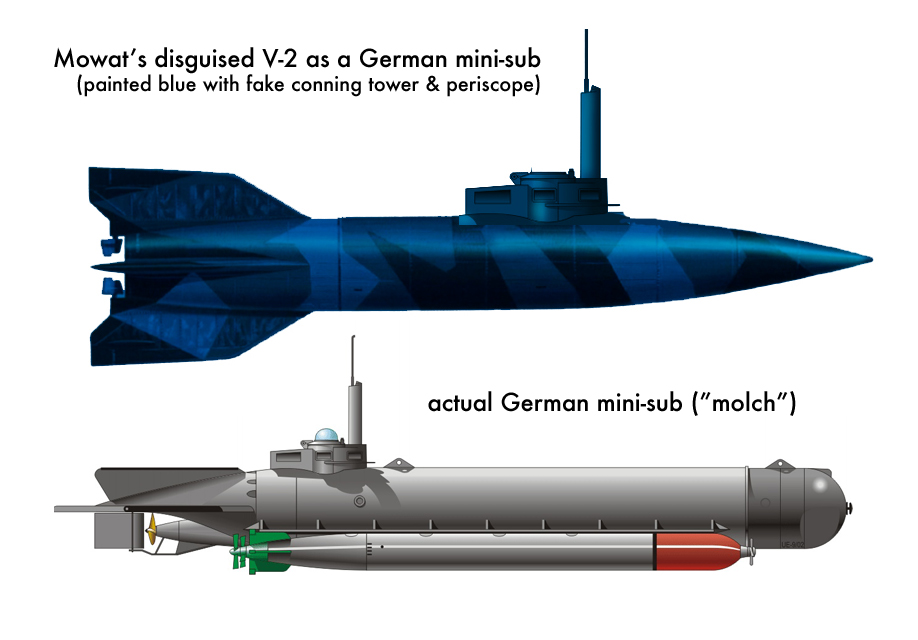
Due to the advanced technology of the V2 and its desirability by US, Russian and British research scientists, Captain Mowat was forbidden to take his captured V2 rocket back to Canada. This did not stop the determined Mowat who knew this was a valuable prize for Canada, and took the necessary action to get the rocket back to Canada. With British guards protecting the rocket which was now on a train, Mowat and his team apparently got the guards drunk, then loaded the rocket off the side of the train and onto a trailer. They then transported the rocket to Holland to a waiting Canadian cargo ship bound for Montreal. With Americans that would surely confiscate the rocket, Captain Farley and his team disguised it as a German submarine, painting the rocket blue and adding a fake periscope.

Mowat disguised the captured V-2 as a German mini-sub to smuggle it past American guards to get it back to Canada.

Mowat disguised the captured V-2 as a German mini-sub in order to smuggle it past American guards to get it back to Canada.

It was loaded without incident aboard the Canadian cargo ship and safely made it’s way back to Canada where it was unloaded in Montreal, dismantled, studied and blueprinted at the Canadian Armament Research & Development Establishment (CARDE) in Valcartier, Quebec.

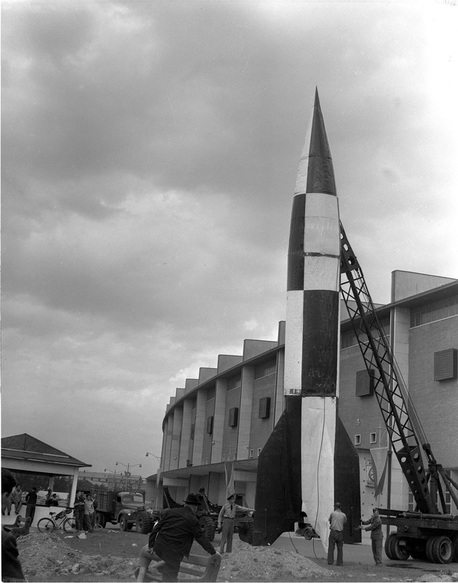
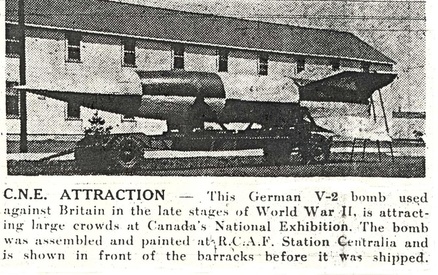
After being scrutinized by CARDE, the Department of Defence loaned the captured V2 to the CNE in Toronto to display at the 1950 CNE. Re-painted in its German test pattern paint scheme at CFB Centralia, it was transported to Toronto where the CNE placed it upright on display for the many visitors see at the 1950 CNE. After that, the history of Canada’s V2 rocket falls into relative obscurity.

photo4

The captured V-2 rocket as seen on display at the 1950 CNE in Toronto.

photo5

Department of Defence crew preparing to display the V-2 rocket at the 1950 CNE in Toronto.

photo3

A newspaper clipping showing the V-2 after being studied by CARDE between 1945-50 and re-painted to be shipped to Toronto for display at the 1950 CNE.

photo6

With its nose cone damaged (from a truck backing into the hitch it seems) the V-2 after its display at the CNE. Where it went after the CNE remains a mystery.

WHERE DID IT GO?

A retired Air Canada pilot, David Savage, who lived in Picton, Ontario during the 1960s may be able to provide some possible clues as to the final resting place of the lost V2 rocket. Picton, a small town in Prince Edward County, three hours from Ottawa, once had a massive airport full of hangers, buildings, barracks and other assorted military establishments from its WW2 role of training RCAF pilots and crew. In the 1960s, the base was still operating, but was then used for storing surplus aircraft and artillery training. Surplus P-51 Mustangs, B-25 Mitchell bombers and other assorted aircraft were stowed away to be sold off for scrap or to private collectors. In his recent book “Camp Picton”, local author Ian Robertson mentions the V2 rocket in great detail. I contacted Mr. Robertson who graciously offered his time to tell me about the V-2 that apparently ended up in Picton, Ontario in 1961.

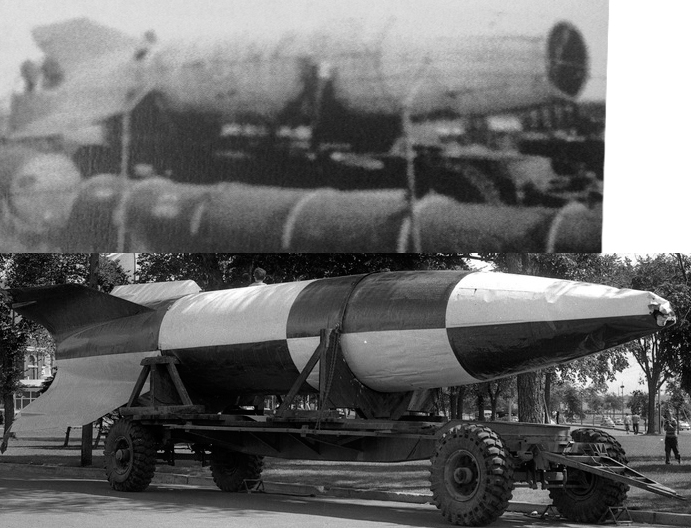
A photo that appears in Robertson’s book taken by Mr. Savage as a teenager in 1961 clearly shows what appears to be the lost V2 rocket sitting on its side, apparently on the same trailer used to transport it around at the CNE, weathered and missing its crumpled nose cone. The unmistakable shape and size is clearly that of a V2 rocket. It seems logical that it was brought to the Picton airbase for storage with all the other unwanted old DND equipment. Savage left Picton in 1962, never knowing what happened to the V2 he captured on film. The base closed in 1969, and the the whereabouts of the V2 closed with it. No further information about what happened to the stored rocket can be found.

Comparing the 1961 photo taken by Savage in Picton with the 1950 CNE photo of the V-2 rocket. A match.

Comparing the 1961 photo taken by Savage in Picton with the 1950 CNE photo of the V-2 rocket. (top photo courtesy of Ian Robertson from his book “Camp Picton”)

Comparing the 1961 Picton photo with the 1950 CNE photo provides a definite match, even when the two photos are superimposed on top of one another. An exact match.

Super-imposing the 1961 photo by Savage over the 1950 CNE photo of the V-2 provides an exact match.

Super-imposing the 1961 photo by Savage over the 1950 CNE photo of the V-2 provides an exact match.

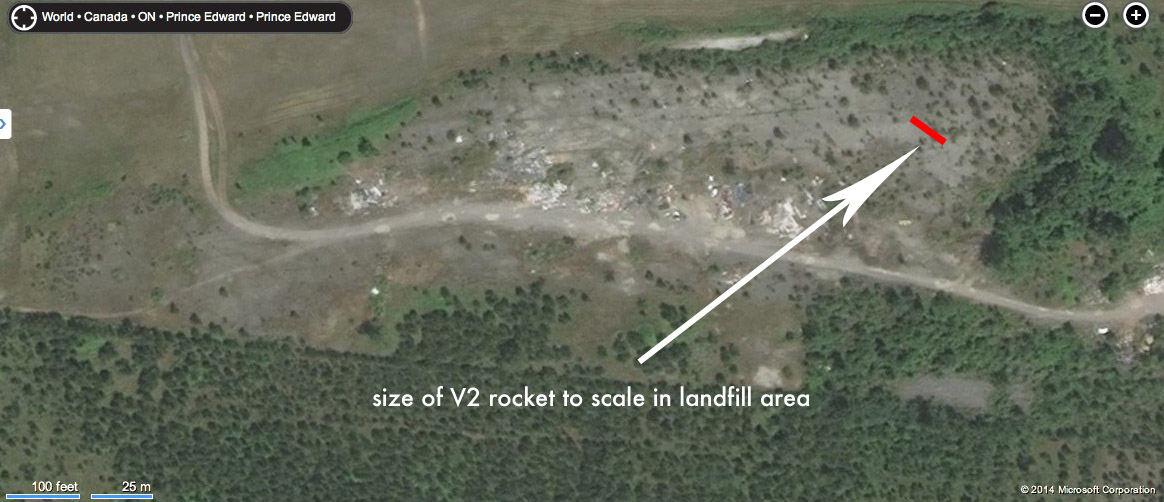
Locals in Picton who also grew up during the 1960s recall the V2 and other unwanted old equipment being bulldozed into the base landfill site. If this is the case, a very significant piece of world history lies under the surface in Prince Edward County waiting to be discovered, preserved and exhibited in a Canadian museum along with the fascinating story of how it got there. Having grown up in the area myself, and flying out of this airport many times with my dad who kept his plane here, I can attest to the fact there are many wartime artifacts strewn around the area.

Aerial view of Camp Picton as it looks today, and the last possible resting place of the V2 rocket.

Aerial view of Camp Picton as it looks today, and the last possible resting place of the V2 rocket.

The airport landfill site lies south of the current runway. Loch-Sloy currently owns the airport property.

dump3

The landfill area at Camp Picton as it looks today. The lost V-2 rocket could very well lie below its surface.

The landfill area at Camp Picton as it looks today. The lost V-2 rocket could very well lie below its surface.

The airport property, including the landfill area, is currently owned by Loch-Sloy Holdings Ltd. who have reported that the landfill area is a “contaminated” zone and further investigation or digging would be hindered by this designation. Does Canada’s lost V2 rocket sit buried underneath a layer of dirt in Picton? With only 20 remaining in the entire world out of the original 6,000 made, it would certainly be a worthwhile endeavour to excavate the area and find out once and for all if indeed our captured German WW2 rocket truly remains lost.

Sources

“Camp Picton: Wartime to Peacetime” by Ian S. Robertson 2013

Google Maps

Bing Maps

http://canadianaerospace.weebly.com/canadas-lost-v-2.html

Wikipedia

Ottawa’s Bunny Club

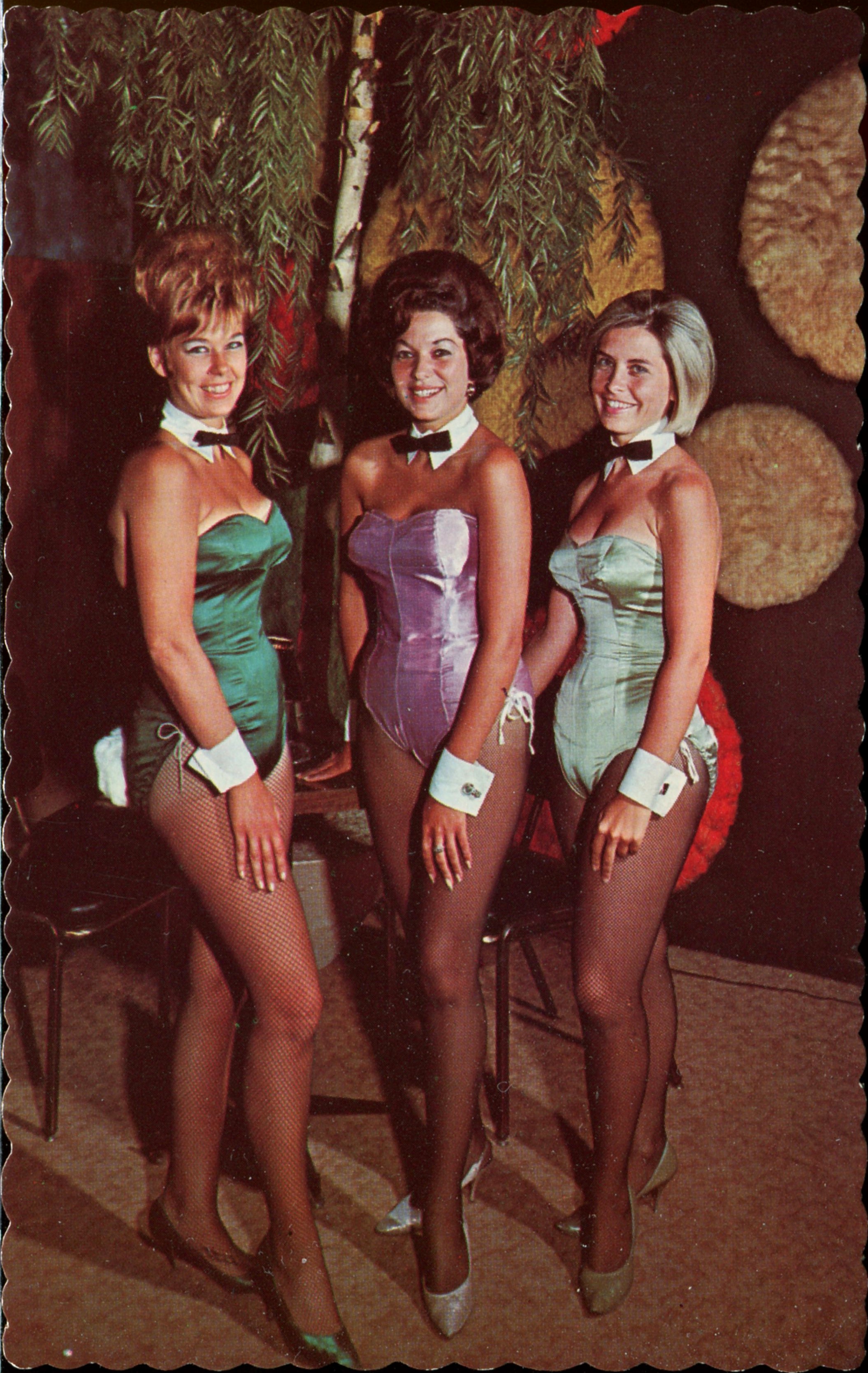
A 1968 postcard shows Ottawa's "bunnies" as they appeared at The Riverside Hotel in Vanier.

A 1968 postcard shows Ottawa’s “bunnies” as they appeared at The Riverside Hotel in Vanier.

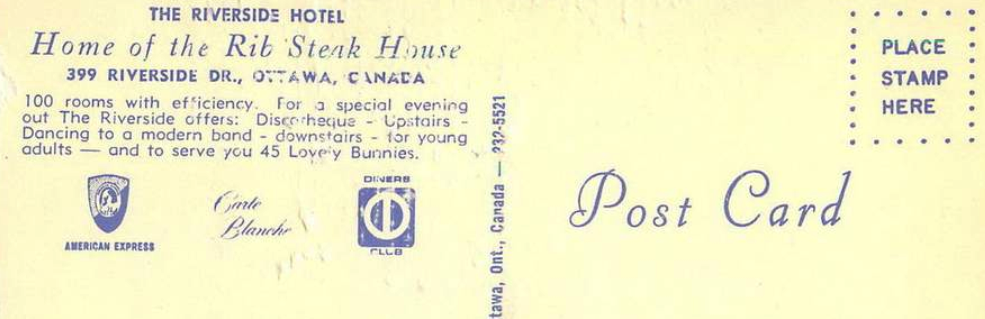
The back of the postcard gives an indication of what the Riverside Hotel offered its guests.

The back of the postcard gives an indication of what the Riverside Hotel offered its guests.

During the late 1950’s and 1960’s the “Playboy” phenomenon was sweeping the nation as Hugh Hefner’s magazine Playboy took society by storm and created a new sexual revolution. The magazine’s trademark “Playboy Bunnies” graced the pages of the gentleman’s magazine, and soon Playboy clubs were opening across North America, staffed by waitresses dressed up as the “bunnies” as portrayed in Hefner’s publication.

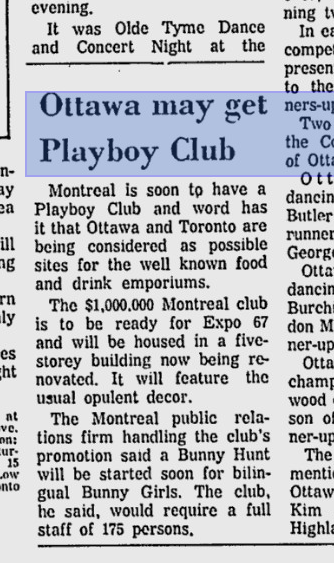
Ottawa was slated to get its own "Playboy Club" as shown in this 1967 Ottawa Citizen article. It never happened.

Ottawa was slated to get its own “Playboy Club” as shown in this 1967 Ottawa Citizen article. It never happened.

With the first Playboy Club opening in 1960, Canada only saw one Playboy Club open on its soil, and that was in Montreal which opened in 1967 for Expo67. Rumours in newspapers hinted Ottawa might also get its own Playboy Club, but this was never realized so Ottawa created it’s own version of “bunnies”…at a place called The Rib.

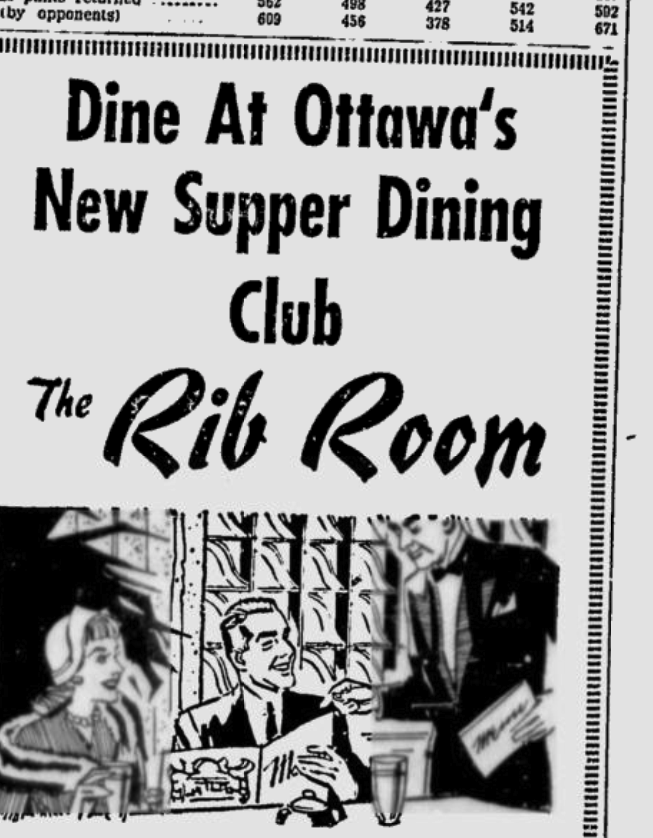
A 1962 Ottawa Citizen ad illustrates the tantalizing appeal of The Rib.

A 1962 Ottawa Citizen ad illustrates the tantalizing appeal of The Rib.

Located within the Riverside Hotel on what is now River Road N. in Vanier, the listed address in the 1960s was 399 Riverside Drive. The hotel boasted a “Businessman’s Buffet” at the restaurant called “The Rib” and it was also reported to be Ottawa’s very first and “best” steakhouse.

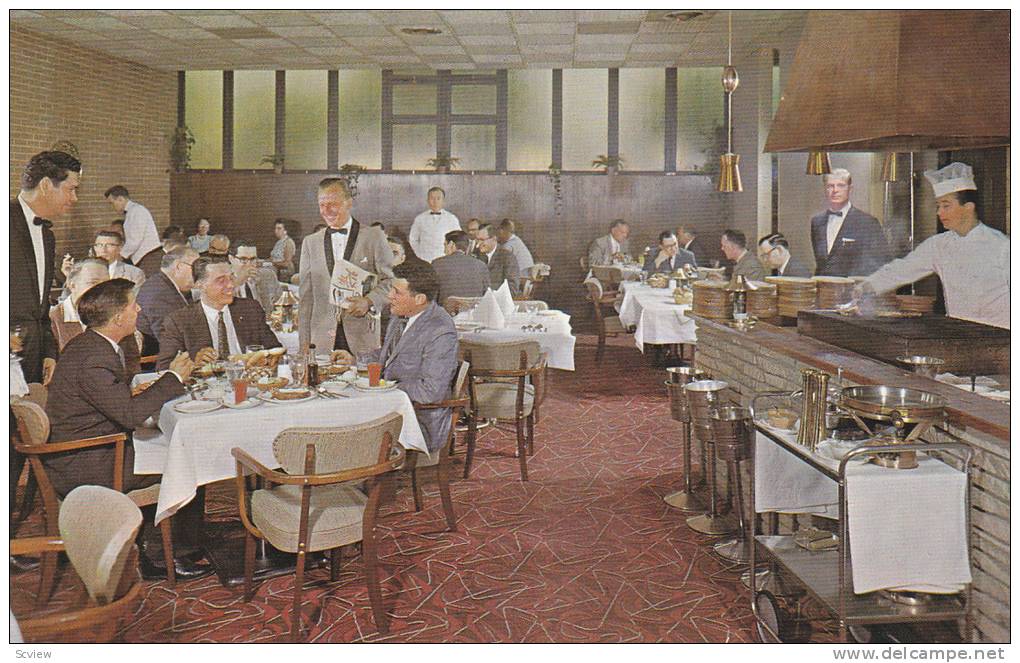
A vintage postcard of The Rib at The Riverside Hotel. Note the  "gentlemen" conducting important business meetings over cocktails and steak.

A vintage postcard of The Rib at The Riverside Hotel. Note the “gentlemen” conducting important business meetings over cocktails and steak.

Postcards and newspaper ads touted The Rib as the place to eat and be entertained, served cocktails and steaks by “45 lovely bunnies” similar to the Playboy Club in Montreal.  A discotheque and live music venue also graced the Riverside Hotel and was a popular attraction for those wishing to have, er… business “meetings”.

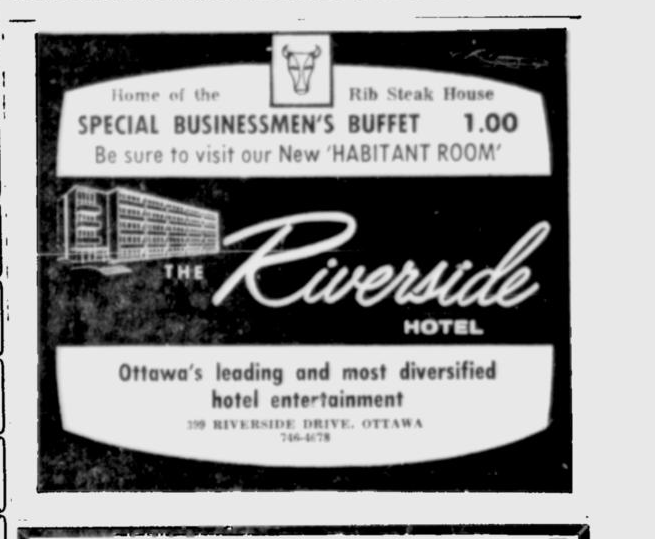
Another 1960s Ottawa Citizen ad for the Riverside Hotel.

Another 1960s Ottawa Citizen ad for the Riverside Hotel and their Businessmen’s Buffet and entertainment options.

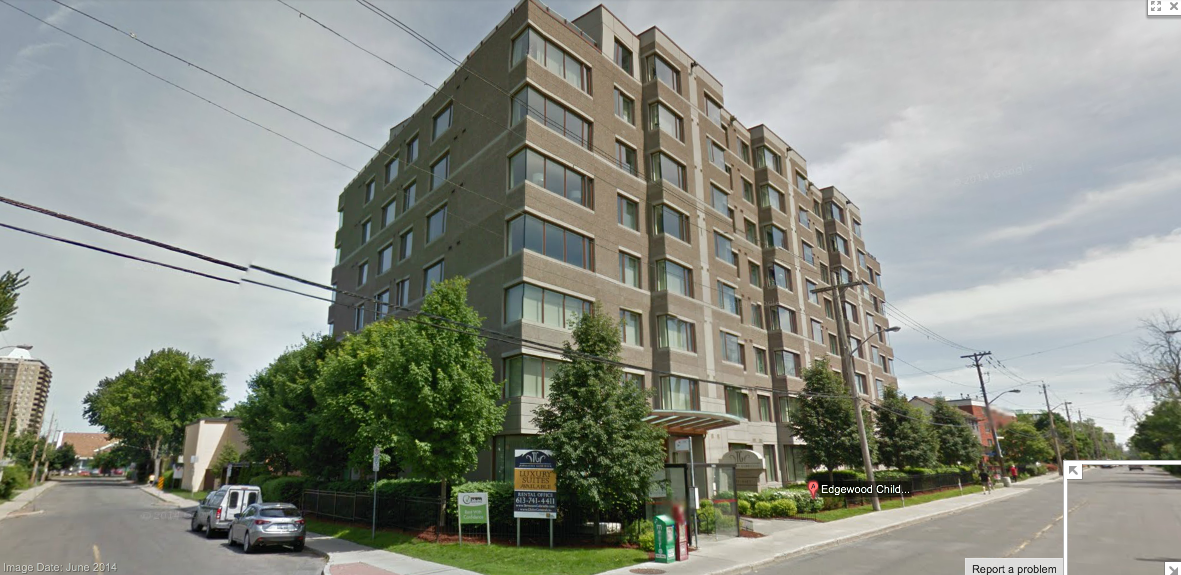
Straight out of the Mad Men era and what looks like a set piece from the show, The Rib’s atmosphere was that of gentleman’s entertainment and a source for the associated business trip expense account receipt. A special “Businessman’s Lunch Buffet” was offered at The Rib and it continued operation until the hotel closed. The bunnies left the building and it was subsequently demolished in 2006 to make way for the EdgeWood Care Centre.

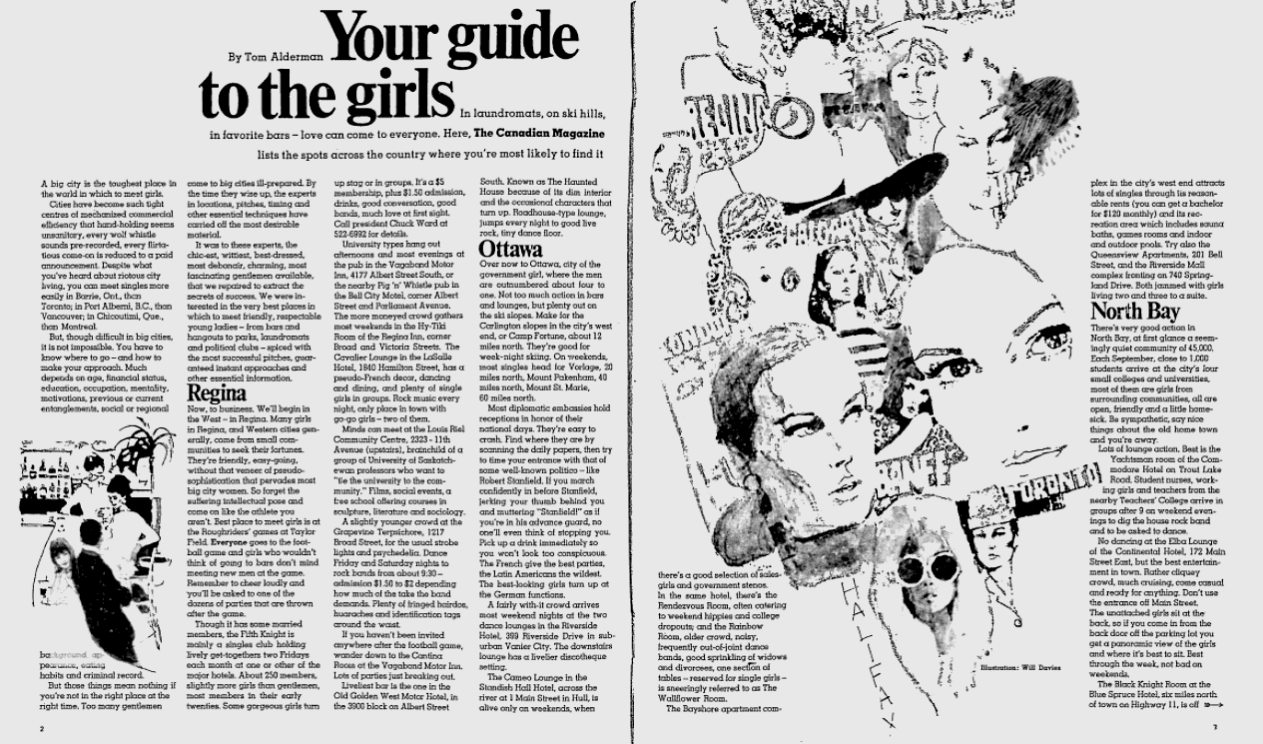
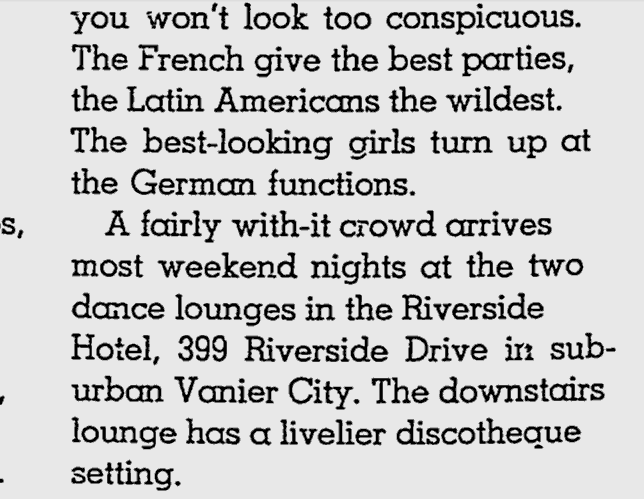
A 1969 Montreal Gazette article explains how The Riverside Hotel was the place to meet girls in its "Guide To The Girls".

A 1969 Montreal Gazette article explains how The Riverside Hotel was the place to meet girls in its “Guide To The Girls”.

Description of how The Riverside Hotel was a happening spot to meet the ladies.

Description of how The Riverside Hotel was a happening spot to meet the ladies.

The Riverside Hotel was a relic of different era and of a different mindset when it came to entertainment, all of which disappeared when it was removed from the Ottawa landscape.

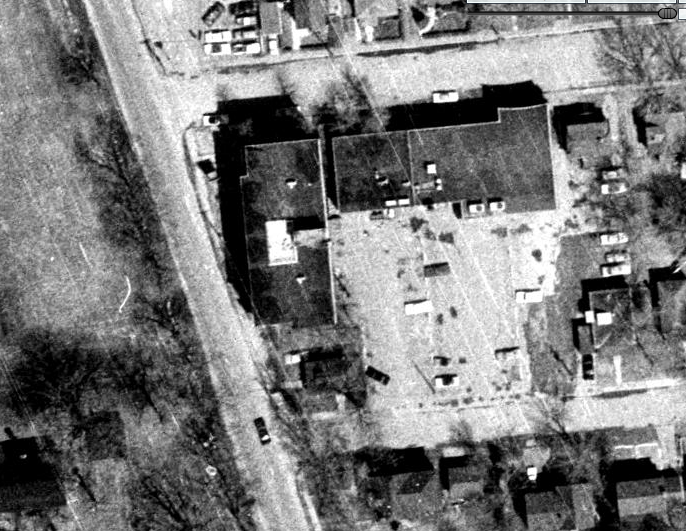
A 1965 aerial image of The Riverside Hotel. (geoOttawa image)

A 1965 aerial image of The Riverside Hotel. (geoOttawa image)

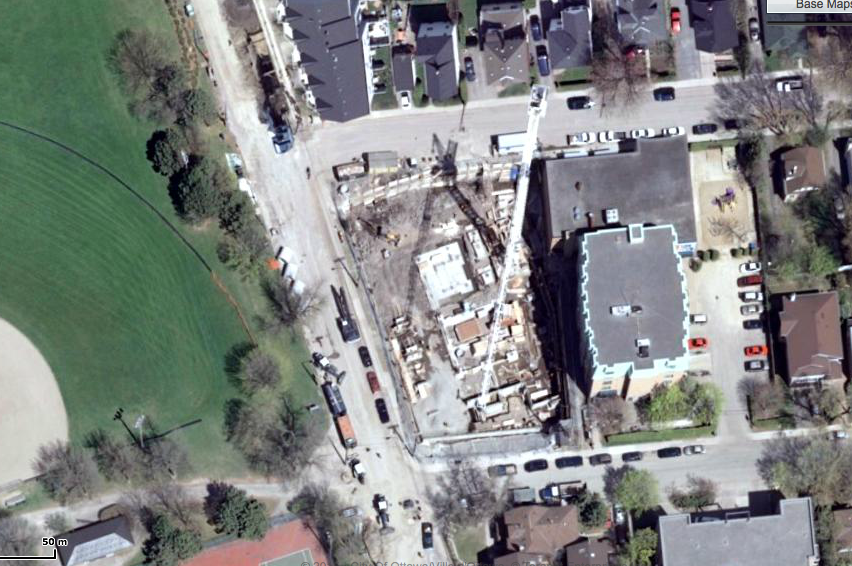
The hotel and its outdated image were demolished in 2006 to make room for the Edgewood Care Centre.

The hotel and its outdated image were demolished in 2006 to make room for the Edgewood Care Centre.

The site of the former Riverside Hotel as it looks today. (Google streetview)

The site of the former Riverside Hotel as it looks today. (Google streetview)

THE OTTAWA X-FILES: STRANGE EVENTS IN THE NATION’s CAPITAL

Street signs at an intersection in east Ottawa..Orleans. (photo Google Streetview)

Street signs at an intersection in east Ottawa..Orleans. (photo Google Streetview)

At an intersection in suburban east Ottawa, Scully and Mulder, the paranormal investigative duo from the hit sci-fi TV series “The X-files” have their names emblazoned on City Of Ottawa street signs. According to a 2008 Ottawa Citizen article the names ‘Scully Way’ and ‘Mulder Road’ were given to these two intersecting streets by Claridge Homes which developed the neighbourhood in 2001, a time when the hit FOX show was at peak popularity. Paul Rothwell the former planner with Claridge Homes said that the old City of Cumberland provided a list of street names not yet taken, one of them being “Scully”. Rothwell reflected in the Citizen article that “At the time, I guess, the TV show X-Files was a big hit and I said, OK, well, there was a name that had been approved, and “Mulder” was the obvious choice for a street to go with it.”

A fun suburban tribute to television’s fictional special agents makes for an interesting landmark, but what’s even more fascinating is that Ottawa has its own real “X-File” incidents, events that stretch beyond that street corner and into the realm of the unexplained. Here are some of my favourites:

JAM BAND

suburbia

In November of 2005 the City of Ottawa experienced an event where hundreds of residents were affected by a mysterious signal that jammed automatic garage door openers across the city. The phenomenon jammed automatic garage doors within a 25 mile radius, including embassy gates and residential garage doors between Aylmer and Casselman. Almost all automatic garage door openers operate with a remote that uses a radio signal on the 390 MHZ band, but on that day were rendered inoperable. Further investigation shows that the 390MHZ signal is also employed by Land Mobile Radio Systems used by the United States government, and a December 2005 US Government Accountability Office report coincidentally states:

“To address homeland defense needs and comply with government direction that agencies use the electromagnetic spectrum more efficiently, the Department of Defense (DOD) is deploying new Land Mobile Radios to military installations across the country. The new Land Mobile Radios operate in the same frequency range–380 Megahertz (MHz) to 399.9 MHz—as many unlicensed low-powered garage door openers.”

This seems to easily explain the phenomena in Ottawa but both the Canadian military and the US Embassy categorically denied any involvement using this new technology of radio signal jamming. It seems the mystery signal that affected Ottawa garage doors for 10 days defied all explanation until it suddenly vanished as quickly as it appeared. Industry Canada inspectors arrived in Ottawa to study the signal jamming but as they began to investigate the problem it disappeared and all systems returned to normal. No organization has claimed responsibility and it continues to defy alternative explanation.

UNDERWATER UFO

In 2009 an extensive search operation involving military and police equipment scoured the Ottawa River for what was reported to be a crashed UFO. (this photo I snapped is from that search near the Champlain Bridge)

In 2009 an extensive search operation involving military and police equipment scoured the Ottawa River for what was reported to be a crashed UFO. (this photo I snapped is from that search near the Champlain Bridge)

I recall in July of 2009 a number of military helicopters were circling near the Ottawa River at the Champlain Bridge and in typical Spielbergian fashion, I grabbed my bike and hastily pedaled my way down to the river to see what all the commotion was about. Search and rescue helicopters and military vehicles as well as city police equipment had gathered around the river in what looked like a complex recovery operation. Further investigation revealed that the previous night people in Ottawa and in Gatineau reported they saw an object streak across the night sky and crash into the Ottawa River with a “thunderous boom.” The object reportedly had lights on it and appeared to change course several times before it hit the water.

Multiple witnesses called authorities which prompted police, firefighters, paramedics and a helicopter from CFB Trenton to scour the waters for a downed aircraft. Using sonar and underwater cameras the investigation continued into the next day when an object was discovered about 30ft below the surface. An Ottawa Sun article stated that local police constable Alain Boucher said something was down there. “The size and the shape doesn’t lead us to believe it’s any piece of an airplane or fuselage or anything like that. It could be a rock, it could be a bunch of logs stuck together, it’s hard to say.”

Soon police remarked that due to a strong current in the river and because no aircraft were reported missing, there was no debris or oil slick the search was to be terminated. No known further investigation into what happened in the river that July night has been reported and the incident remains a mystery.

BARRHAVEN BEAST

The legend of the cupacabra states the beast preys viciously on livestock.

The legend of the chupacabra states the beast preys viciously on livestock.

Earlier this year a “mystery creature” viciously attacked a horse in Ottawa near Barrhaven within the NCC Greenbelt. Officials only described the animal as “wildlife incident” and closed off trails in the area to lay traps in an effort to capture whatever attacked the horse. The owner of the horse and neighbours told media that it was “no coyote” and the ottawa sun reported that Dr. Brent Patterson, “a wildlife expert with the Ontario Ministry of Natural Resources and the Environmental and Life Sciences professor at Trent University, also studied the photos of the horse’s wounds and ruled out coyotes, bobcats or cougars as the culprits.”

So what attacked the horse with such severity? A nearby farmer reported a cougar was spotted in his barn, but that animal had been ruled out as the attacker. The traps never caught anything and the area was soon re-opened. Speculation ranged from a bear, rabid dog, a fisher and even the legendary “chupacabra”, an odd beast rumoured to inhabit parts of the Americas. The name comes from the animal’s reported habit of attacking and drinking the blood of livestock. Described as a heavy creature, the size of a small bear with a row of spines reaching from the neck to the base of the tail. Eyewitness sightings have been been reported as far north as Maine but most experts say they are simply coyotes infected with a parasite whose symptoms would explain most of the features of the chupacabra. The attack and the perplexing case of the Barrhaven Beast remains unsolved.

WORLD’S FIRST UFO RESEARCH FACILITY 

"Building 67", the world's first UFO research facility off Carling Ave. near Shirley's Bay. Demolished 2011. (photo Bing Maps)

“Building 67”, the world’s first UFO research facility off Carling Ave. near Shirley’s Bay. Demolished 2011. (photo Bing Maps)

During the 1950s reports of Unidentified Flying Objects grew each day with both the general public and government agencies from around the world quickly reacting. Canada was not without its own concerns over these new “alien spacecraft” roaming the skies, and set up a special investigation unit in Ottawa under the name “PROJECT MAGNET”. An UNIDENTIFIED FLYING OBJECT (UFO) study program was established by the CANADIAN DEPARTMENT OF TRANSPORT (DOT) on December 2, 1950, under the direction of Wilbert B. Smith, senior radio engineer for the DOT’s Broadcast and Measurements Section. Smith, the Defence Research Board and the National Research Council (NRC) were trying to determine that if UFOs did really exist, they might hold the key to a new source of power using the Earth’s magnetic filed as a source of propulsion for their vehicles. The top secret project in Ottawa also worked with their American counterparts in the CIA to determine if this new UFO “power source” could be studied and harnessed.

Smith’s geo-magnetic studies grew, and in 1952 the investigation was moved to Shirley’s Bay, a government facility on the Ottawa River approximately 15km west of Ottawa. UFO detection equipment was installed and by the end of October of 1952 the installation was complete. It became the world’s first UFO research facility. The 12 foot by 12 foot building housed instruments such as a gamma-ray counter, a magnetometer, a radio receiver (to detect the presence of radio noise) and a recording gravimeter within a 50 mile radius from the station.

Smith and his UFO research team at Shirley’s Bay conducted a number of experiments trying to attract UFOs to the area using their newly installed equipment. After months of potential UFO activity being recorded in the area, the facility soon had their most unusual occurrence.

At 3:01pm on August 8, 1954 the instrumentation at the Shirley’s Bay installation registered an unusual disturbance. In Smith’s words “the gravimeter went wild”, as a much greater deflection was registered than could be explained by conventional interference such as a passing aircraft. Smith and his colleagues rushed outside their research building at Shirley’s Bay to view the craft that was creating such a enormous reading on their equipment. Once outside the building they were disappointed to find a heavily overcast sky with limited visibility. Whatever kind of craft that was up there was well hidden under the cover of clouds. The only evidence the researchers had of this large UFO was the deflection registered on the chart recorder paper.

Local newspaper article relating the 1954 UFO event at the Ottawa facility.

Local newspaper article relating the 1954 UFO event at the Ottawa facility.

Two days later Smith and the Shirley’s Bay research facility were abruptly shut down upon orders from the Department Of Transport. Many speculate the findings and strange occurrence at Shirley’s Bay prompted the project to go “underground”, with all findings entering the “TOP SECRET” status of operation elsewhere. Smith was allowed to remain if he chose to, but all government funding to conduct his UFO research was halted. Without government subsidies. Smith continued his research, funded by “other sources”. Smith carried on working at Shirley’s Bay, developing what he claimed was a breakthrough anti-gravity device. In a 1959 presentation Smith stated “ We have conducted experiments that show that it is possible to create artificial gravity (not Centrifugal force) and to alter the gravitational field of the Earth. This we have done. It is Fact. The next step is to learn the rules and do the engineering necessary to convert the principle into workable hardware.”

Smith, who headed the UFo research lab was stricken with cancer and died before he could complete his studies.

Wilbert Smith, who headed the Ottawa UFO research lab was stricken with cancer and died before he could complete his studies.

As Smith was about to finish work on this anti-gravity device he was stricken with cancer and died at the age of 52 on December 27 1962. The research facility at Shirley’s Bay was closed. The Project Magnet building he worked in existed until 2011 at the Shirley’s Bay Department of National Defence complex now known as “Defence Research and Development Canada” off Carling Avenue. It was simply marked as Building 67 but has since been demolished.

CONCLUSION

Odd events occur in many communities, usually later explained through logical explanation; a mysterious light becomes a plane, a loud sound turns out to be an icequake and so on. Yet there are some events that defy explanation, and Ottawa is no exception to being host to some of these interesting “X-files”. Perhaps it is because our city is the Nation’s Capital and the frequency of these unexplained events lends itself to being a perplexing anomaly. Or maybe the truth is here.

SOURCES

http://www.canada.com/story.html?id=228dd1fc-156f-4e0b-b31f-0c219d402615#__federated=1

http://www.cbc.ca/news/canada/ottawa/mysterious-signals-jamming-garage-door-openers-1.532740

http://www.cbc.ca/news/canada/ottawa/garage-doors-work-after-mystery-signal-vanishes-1.549198

http://www.wellandtribune.ca/2009/07/28/did-ufo-crash-into-ottawa-river

http://ottawacitizen.com/news/local-news/mystery-wildlife-attacks-horse-in-greenbelt-ncc-says