Mystery Of The Buried Blade

The area of Constance Bay located twenty five kilometers north of downtown Ottawa is no stranger to dramatic historical events. Previously OttawaRewind.com uncovered archeological documents revealing an ancient settlement from 500BC on its sandy shores and more recently that it was the site of a gruesome Fur Trade battle in the 17th century. From ancient times when the Ottawa River was an aqua-highway conduit used to transport copper ore from mines on Lake Superior to the Atlantic Ocean to its more modern role as a colonial outpost, the shoreline of the Ottawa River is if full of history waiting to be uncovered. That being said, it was not unusual to be contacted by a reader in Constance Bay who had unearthed a rusty sword in her garden two years ago. After contacting the War Museum without answer and knowing the area is largely unrecognized for its historical importance, I grabbed my own gear and headed to Constance Bay in search for answers to this Mystery of the Buried Blade.

THE FIND

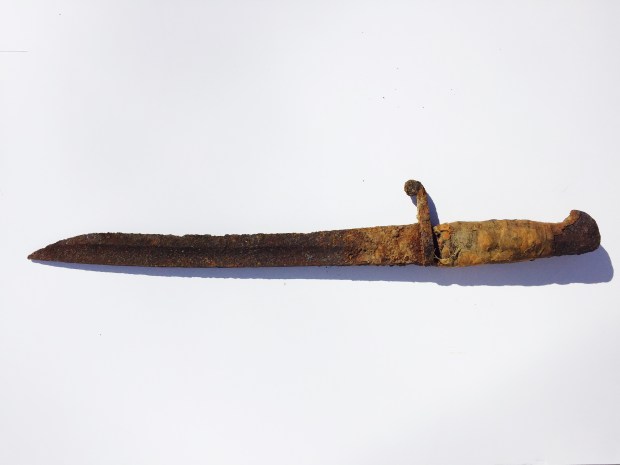
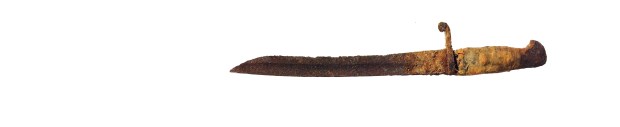
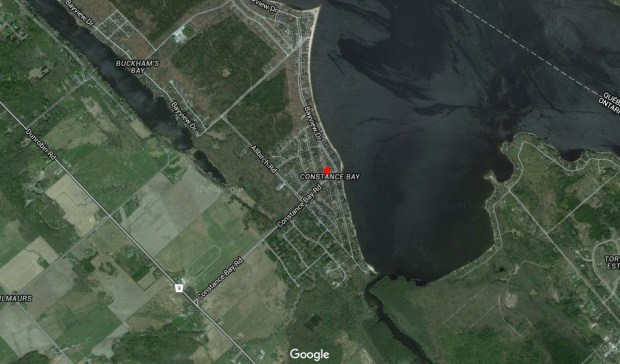
Kim and Steve Fagan of Constance Bay live a stone’s throw from the sandy beach edge of the Ottawa River, an area of significant historical action, much of it not known to the public who have been building homes and cottages along its shoreline. Two years ago while doing some gardening, Kim was shoveling a garden plot and hit something metallic. “We were digging out a garden in the front yard and we found it about 12 inches below the surface.” said Kim Fagan, who has kept the blade in her closet, unsure of what it was. Pulling out of the sandy soil a relic from another time, Fagan had no idea how or why a sword ended up in her garden. It was only after reading the article in OttawaRewind that she thought it might be something of historical importance.

FullSizeRender

The blade found buried in Kim and Steve Fagan’s front yard.

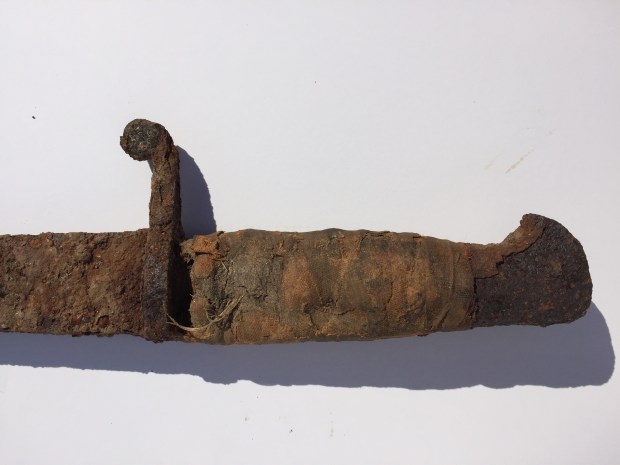
Driving the short distance to Constance Bay I examined the blade in person and noted details about its construction, noting that its shape seemed less like a sword but more like a knife blade. The hilt reminded me of old bayonets I had seen in museums. Asking Fagan to study the blade further I measured the sword to be about a half metre long with an obviously modified hilt where cloth had replaced either a leather or wooden handle that had long since disintegrated. The hilt had been broken on one side, and the blade had a curved, almost scimitar shape to it like sword blades of the Middle East.

IMG_7475

The hilt of the sword looked to be broken and once wrapped in cloth.

Comparing the photographs to various resource sites on weapon blades, it seemed more and more likely not to be a sword but rather some kind of bayonet. I narrowed my search down to antique bayonet websites that provided more of a match to the relic’s shape than any sword.

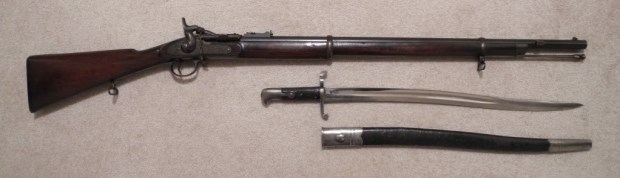
I contacted Derek Complin of bayonetsplus.com, and a member of The Society of American Bayonet Collectors for his thoughts on this buried blade. Complin, an avid collector and obvious expert on all things bayonet concurred the blade was that of a bayonet, more specifically “A British Pattern 1860 sword bayonet”. Complin explained that these were issued to troops in Canada to be used with the Snider Short Rifle. The buried blade had at one time been subjected to a shortening of its blade and “the removal of the muzzle ring, and the grips, which appear to have been replaced with a cloth binding.”

Complin speculates the buried bayonet was “sold out of service at some point, or perhaps left service along with a retired soldier, and was modified or adapted for less warlike use.”

Researching more about this idea of it being a bayonet, I found that the unearthed blade matches almost perfectly the size and shape of the British Victorian Volunteer P1860 Short Rifle/Snider Sword Bayonet just as Complin theorized. Using photos of the original and superimposing them overtop the rusted old blade, the match was undeniable perfect. It was a modified bayonet blade from the 1860’s, once paired to a Snider/Enfield short rifle first issued to Canadian forces in 1867. A shipment of 30,000 of these rifles arrived from Great Britain in August of that year.

comp1swordcompghost

comp2sword

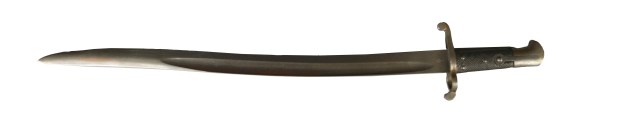
The original 1860 yataghan sword bayonet compared to the buried blade shows an exact match. (top photo Derek Complin)

This bayonet was based on the North African and Middle Eastern Yataghan swords, with their distinctive curved blades. Why that odd shape was chosen is unclear but some think the curve ensured that the blade was out of the bullet trajectory when it was attached to the end of the rifle. The bayonet was only issued for the Snider SHORT rifle, which in turn, was issued only to Sergeant’s and higher ranking officers in the Canadian Militia of that time.

ShortSniderMark3

The Snider/Enfield Short rifle and the bayonet sword issued with it to the Canadian Militia in 1867. (photo britishmilitariaforums.yuku.com)

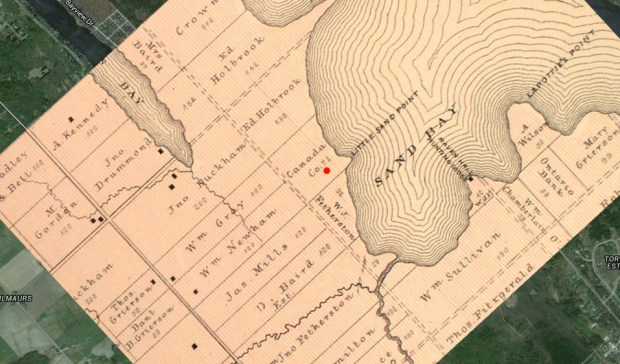
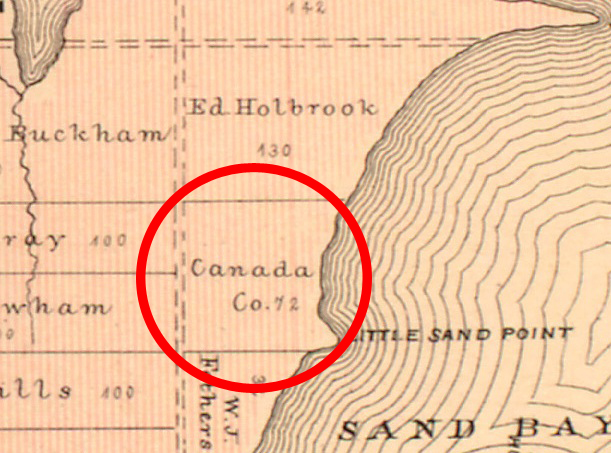
How the bayonet became buried in the sands of Constance Bay is open to conjecture, but a study of an 1880 map shows the land of the current Constance Bay village was once property belonging to the Canada Company. The Canada Company was a large private chartered British land development company, to aid in the colonization of Upper Canada. The Canada Company helped emigrants by providing safe ships, low fares, implements and tools, and inexpensive land. The company surveyed and subdivided crown land areas, built roads, mills, and schools and advertised it to buyers in Europe. The company then brought new settlers to these area by means of a boat, which the company also owned.

conbaycomp1mapconbaycamp2map

conbay1880closeupmarked

An 1880 map of the area shows the land that is now the village of Constance Bay was once owned by the Canada Company. (red dot is where blade was found)

Perhaps the buried bayonet was part of a settler’s tools in a new land, or maybe it was a lost relic of a military operation in that area that was forgotten and buried over time. The Fagans have no plans for the 150 year old weapon but said they’d be “happy to donate it to a museum if they want it.”

compghost

The possibilities of how a modified 19th century bayonet became buried on the Fagan’s property remains open to the imagination, but we can be sure that this was once a military bayonet yataghan sword used by a higher ranking member of the Canadian Militia. Perhaps it was modified and used as a tool for carving out a new life in the unsettled wilderness north of the newly formed Nation’s Capital, or part of some other more nefarious business. Whatever the case may be, the area of Constance Bay continues to provide significant relics of our past that lie buried in the sands of time.

Andrew King, OttawaRewind.com 2016

Special thanks to Kim & Steve Fagan of Constance Bay and Derek Complin who graciously offered their time and information for this post.

SOURCES

bayonetsplus.com

https://en.wikipedia.org/wiki/Canada_Company

https://en.wikipedia.org/wiki/Yatagan

http://britishmilitariaforums.yuku.com/topic/13496#.Vt3zLoRiNBy

Google Maps

McGill Digital Atlas Project.

Ottawa’s Sealed Mid-Century Underground Tunnel


IMG_7207

Before security and safety issues were of concern, Ottawa had a number of publicly accessible underground tunnels that allowed residents to escape the frigid above-ground winter temperatures and move about in conditioned comfort.

The most famous of these underground tunnels is probably the one that links The Chateau Laurier with the old Union Station, once connecting train passengers to the hotel without ever having to step outside. Now closed to the public, this tunnel will most likely never be accessible again after the old tunnel becomes part of the new Senate Building. Accommodating  the Senate chamber while the Centre Block undergoes major rehabilitation work, it is expected that the Senate will remain there for up to 10 years.

Screen shot 2016-02-15 at 4.09.37 PM

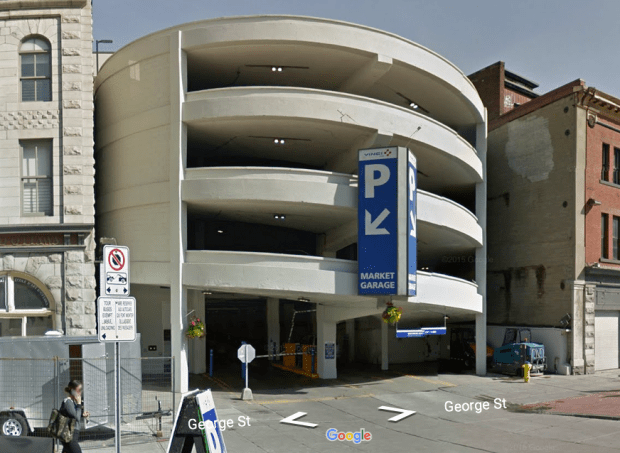
The former Freiman’s Parkade where the subterranean tunnel was accessed. (Google Streetview)

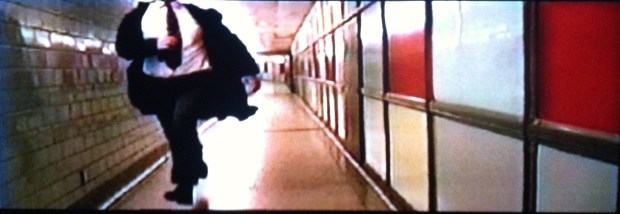
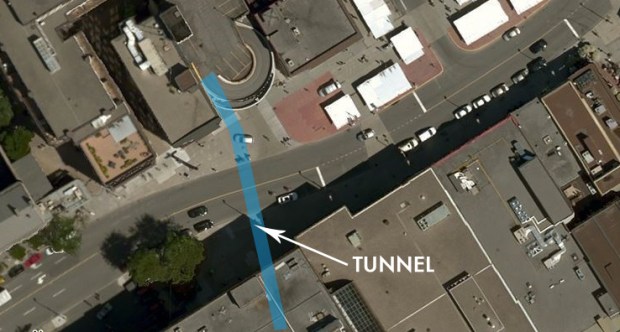
A lesser known tunnel under Ottawa is a sealed mid-century tunnel that once connected Freiman’s Shopping Mall (now Hudson’s Bay) to their own Parkade facility on George St. This tunnel was closed sometime in the early 2000’s but I was fortunate enough to record the tunnel on video back in 1999 when I filmed a chase scene for a short film I was working on.

tunnelMARKED

Having recently stumbled across the closed off entrance in The Bay basement while looking to buy a Hudson’s Bay wool blanket to escape the cold, I was reminded to dig out the old VHS tape that documents this tunnel also used to escape the cold.

photo

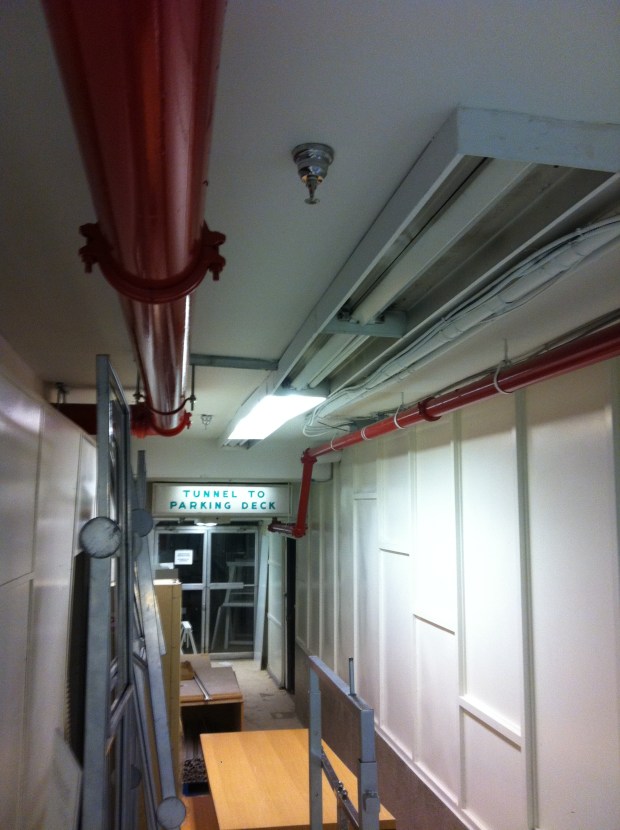
The now sealed entrance to the tunnel from The Bay that is now used for storage. Note the painted over coloured acrylic panels.

The tunnel is actually a phenomenal piece of mid-century architecture, utilizing materials and an aesthetic that provides a unique glimpse back to mid-century shopping conveniences. Resembling a colourful set piece from the TV show “MadMen” I dusted off the poor-quality VHS tape of the tunnel and have posted this piece of subterranean history below.

IMG_7211

BACKGROUND

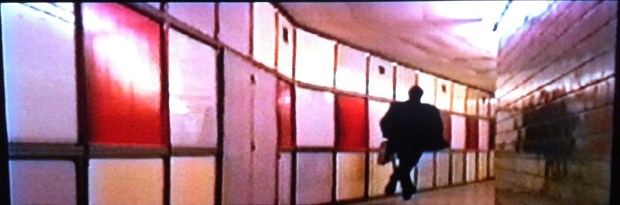
On November 4 1959 Freiman’s Department Store opened their “ultra modern” parkade on George street, a Guggenheim museum inspired spiral parking garage that linked to their store across the street by an air-conditioned and heated tunnel. In a ribbon-cutting ceremony that saw the Mayor and other community leaders attend, guests toured through the 231 foot tunnel that was finished in glazed subway tiles and a kaleidoscope of coloured acrylic panels that also acted as storage compartments for seasonal store decorations in Freiman’s.

IMG_7206

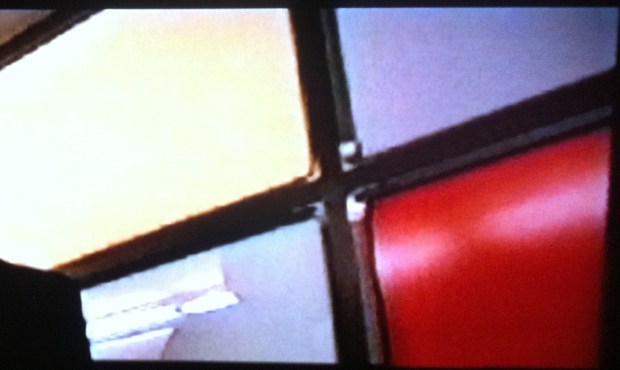
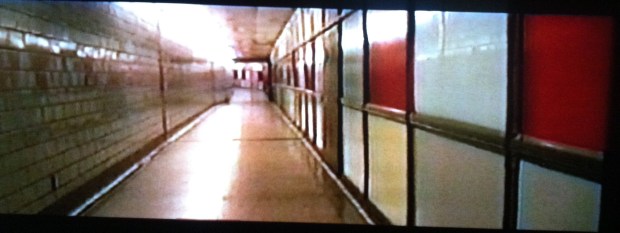
A still from the film that shows the coloured panels and storage area behind them.

After Freiman’s department store was acquired by the Hudson’s Bay Company in 1972, the tunnel remained opened and in service until sometime in the early 2000’s, probably just after 9-11 when security concerns likely forced the tunnel to close.

Screen shot 2016-02-09 at 7.42.34 PM

Screen shot 2016-02-09 at 7.41.37 PM

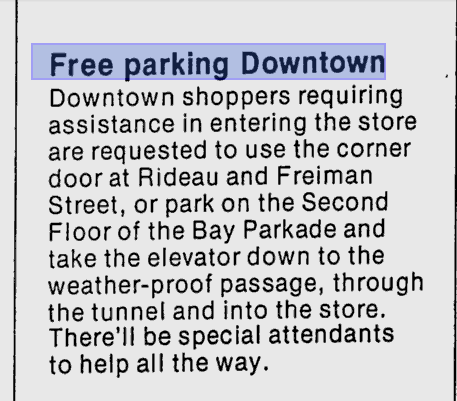
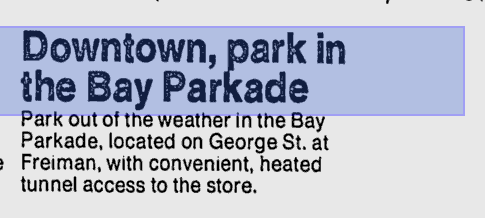
Ads in the newspaper entice shoppers to use the “weather-proof” passage. (GoogleNews)

It has remained sealed since then, and The Bay has closed off the tunnel entrance and used the area for storage but the original 1959 illuminated sign can still be seen. The entrance from the Parkade side has also been sealed and locked.

With this unique time capsule of a tunnel forgotten below the city, lets take a closer look with some stills of the scene filmed there in 1999. If you would like to see the full film clip of the tunnel chase scene you can see it here.

IMG_7209

The 231 foot length of the tunnel was finished in glazed tile and multi-coloured acrylic panels.

IMG_7212

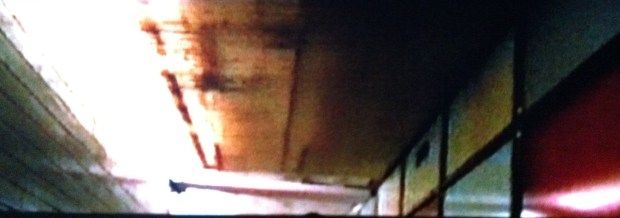
The ceiling of the tunnel was a typical 1959 tunnel ceiling with odd pipes and eerie clinical fluorescent lighting.

SOURCES

Google Maps Streetview

Ottawa Journal

Ottawa Citizen

Bing Maps

PARLIAMENT ILLUMINATED


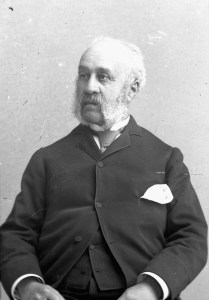
parliamentillumToday marks the 100th Anniversary of Canada’s original Parliament Buildings being destroyed in a fire that swept through the structure on February 3 1916. All that remains today of the original Parliament structure is the Library of Parliament, a unique round building at the rear of the current Centre Block. Designed by Thomas Fuller, an architect and member of the Freemasons, the original buildings have a unique connection to an ancient Order and their secret symbology.

thomas_fuller_canadian_architect

Thomas Fuller, architect of the original Parliament Buildings and Freemason.

The unusual characteristics of our original Parliament buildings designed by Fuller constructed in 1860 have already been examined in a previous post, the “Knights Templar and Canada’s Parliament Buildings” . The connection to the ancient order of Knights Templar and the Freemasons was exposed but now we will look closely at a new connection to that of the Eye Of Providence, the most notable depiction of this eye being on the reverse of the Great Seal of the United States, which appears on the United States one-dollar bill.

BACKGROUND

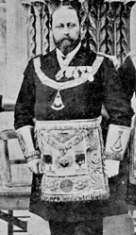
The original Parliament buildings began their construction September 1 1860 when The Prince Of Wales, later to become King Albert Edward, a known member of Freemasonry, presided over the Masonic ritual of laying the cornerstone of the Parliament Buildings. The Masonic Ceremony included The Prince Of Wales and Fuller exchanging Masonic vows while lowering the ceremonial stone. In 1875 Albert Edward became Grand Master of the Convent General of the Knights Templar.

founda1

Prince Albert, shown here in Freemason attire, presided over the ritual of laying the cornerstone for Parliament.

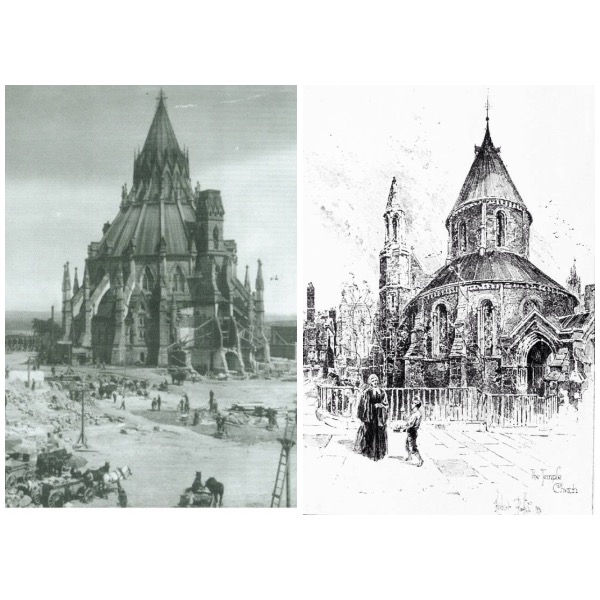
The Library of Parliament shares an uncanny resemblance to the Temple Church of the Knights Templar built in 1185 in London, perhaps a coincidence but with Fuller’s connection to Freemasonry and their subsequent link to the Templars, it seems unlikely.

IMG_6428

Comparison of the lone surviving Library of Parliament on the left (c.1860) after the fire of 1916 and on the right, the Templar Temple Church in London (c.1185)

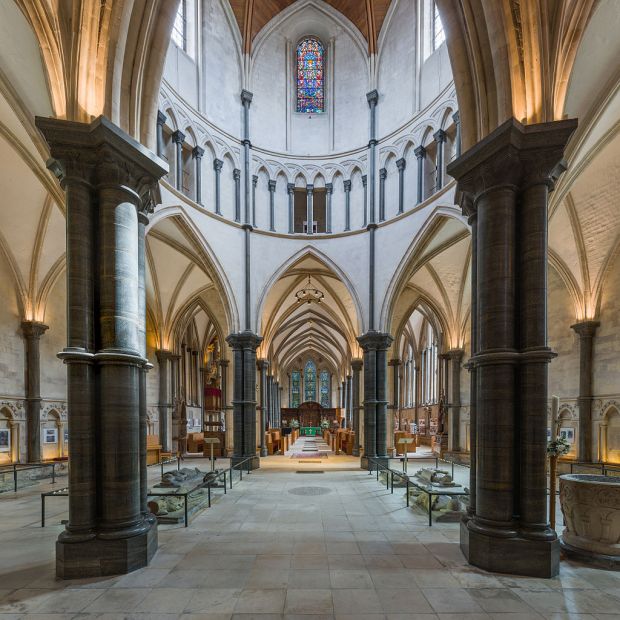
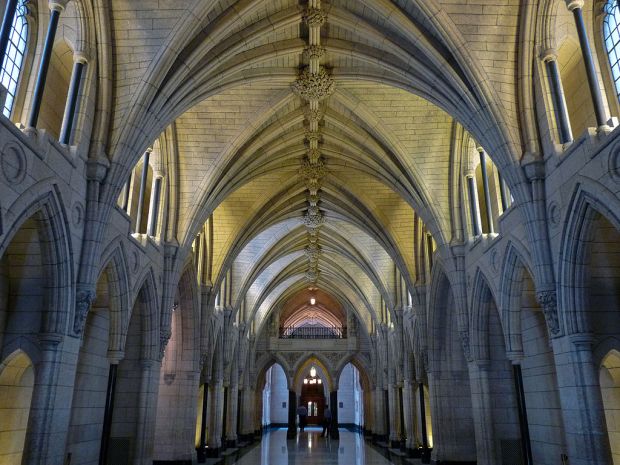
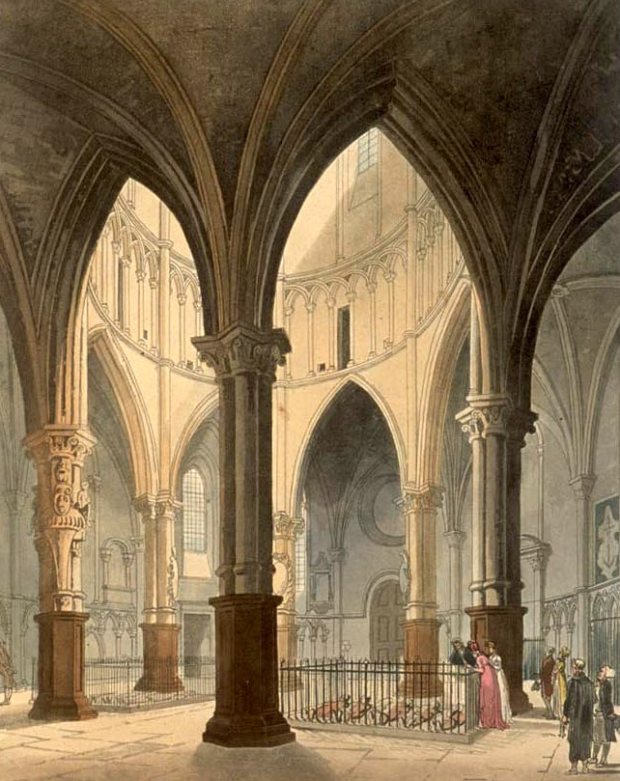
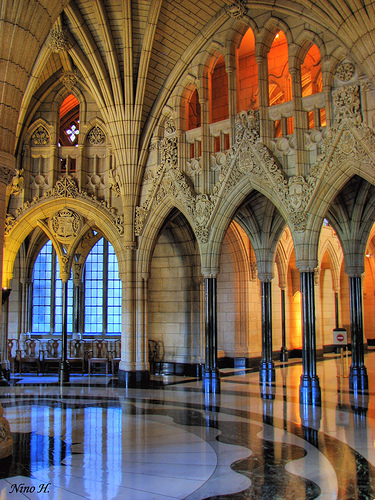
To have the exterior of the Parliament Library resemble a Templar church is one thing, but to have our Parliament INTERIOR also match Templar architecture is another. The interior of the Parliament buildings compared to the interior of Templar churches are shown below.

1024px-Temple_Church_5,_London,_UK_-_Diliff

Interior of Knights Templar temple church, London, 1185AD.

1024px-Hall_of_Honour-Centre_Block-Ottawa

Interior Hall Of Honour, Centre Block of Parliament, Ottawa. 

Temple_Church_edited

Interior chamber Templar church, London 1185AD.

IMG_6426

Interior Parliament Buildings, Ottawa. 

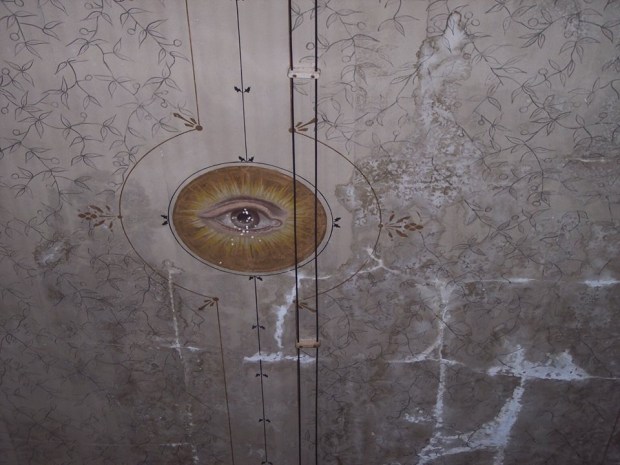
The influence of the Knights Templar and Freemasonry has also been connected to the Eye of Providence on the Great Seal of the United States, which appears on the United States one-dollar bill. This eye in a triangular shape above an unfinished pyramid was adopted as part of the symbolism on the reverse side of the Great Seal in 1782.

Dollarnote_siegel_hq

The Eye of Providence as part of the Great Seal on the reverse side of the U.S. One dollar bill.

It was first suggested as an element of the Great Seal by the first of three design committees in 1776. The use of the same symbol within Freemason symbology dates to 1790 and of all the members of the various design committees for the Great Seal, only Benjamin Franklin was a known Freemason.

IMG_0764

The “All Seeing Eye” symbol used in a 19th century Freemason hall. 

Now in 1860 when the Parliament Buildings began construction in Ottawa under Fuller, the symbology of the ancient Order seems to have made its way into Canada’s original centre tower as we will see below…

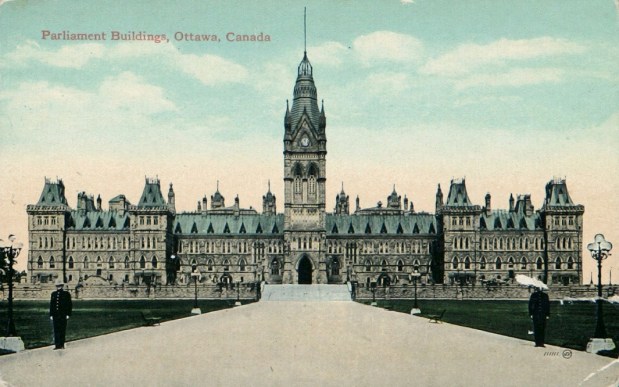
OriginalCentreBlockPostcard

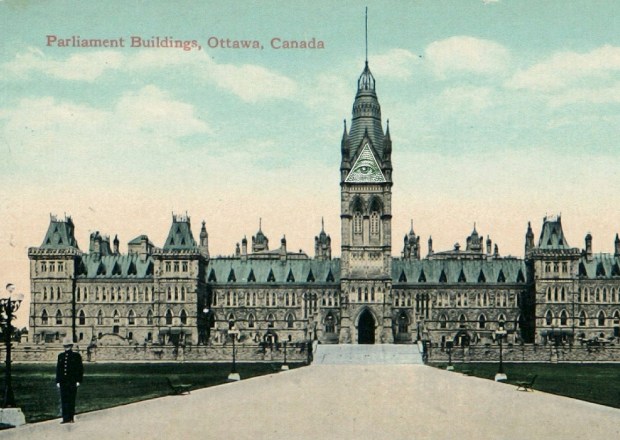
The original 1860 Parliament Buildings as built by Fuller before the 1916 fire.

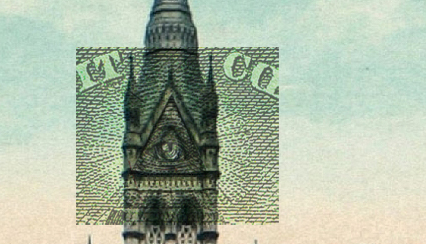
comp1

Zooming in on the original tower in comparison to the Eye Of Providence. 

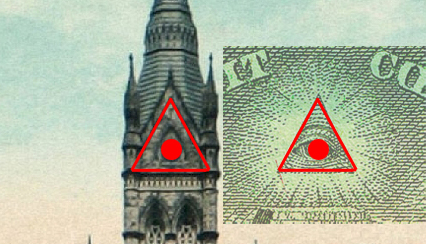
comp2

Superimposing the Eye of Providence over the original tower and clock we see the two match perfectly.

comp4

The “eye” aligns perfectly to the original round clock, the triangle is also a perfect match with all respects to angles and proportions. 

One could argue that this is pure coincidence, and that Canada’s original Parliament building was in no way meant to incorporate the Freemason symbol and Eye Of Providence. But as I am learning, there seems to be a deeper meaning as to why things are designed a certain way.

On this 100th Anniversary of the fire that destroyed the original building, look closely at what other symbols can be found in buildings designed by Fuller and their connection to an ancient order that is still operating among us today.

SOURCES

https://en.wikipedia.org/wiki/Centre_Block

https://en.wikipedia.org/wiki/Temple_Church

https://en.wikipedia.org/wiki/Eye_of_Providence

Constance Bay Revenant

The 17th Century Fur Trade On The Ottawa River was just as gory as The Revenant…

The recently Oscar nominated film “The Revenant” follows the exploits of colonial fur traders in the American mid-west and the ensuing conflicts with native people whose land they encroach upon. The film explicitly conveys the harrowing battles between the  fur traders and native warriors through gruesome tactics and fights to the death. It may seem like a distant part of the past that occurred in a distant part of the United States wilderness but in fact, equally gruesome fur trade battles happened right here in Ottawa on the banks of the mighty Ottawa River, the superhighway of fur trade in the 17th and 18th centuries. One such battle happened just a few kilometres north of the city in Constance Bay. 

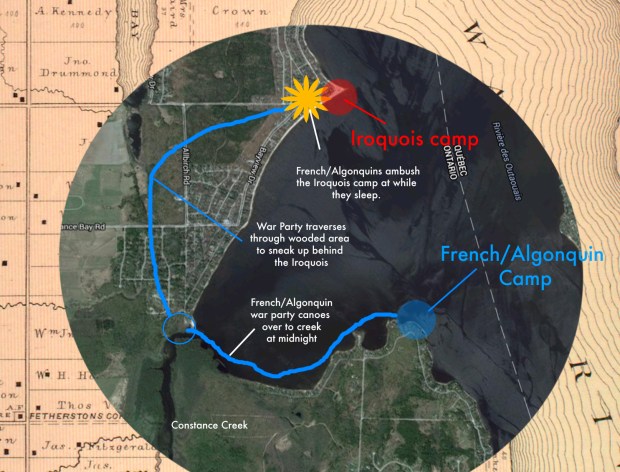
warpartymarked

The site of a bloody battle during the fur trade era on the shore of the Ottawa river.

Originally published in a 1909 edition of  The Ottawa Naturalist (Vol. XXIII, No. 4: 61-68 & Vol. XXIII, No. 5:92-104) author and early local historian T. W. Edwin Sowter heard a story one night while camping at Chats Falls near Fitzroy Harbour on the Ottawa river, and, though far in the past for him in 1909, the tales of the “Indians” and the bloody battles that occurred on the sands of the Ottawa prompted him to record and publish a gruesome verbal tale of the Fur Trade from the latter part of the 1600’s at Constance Bay.

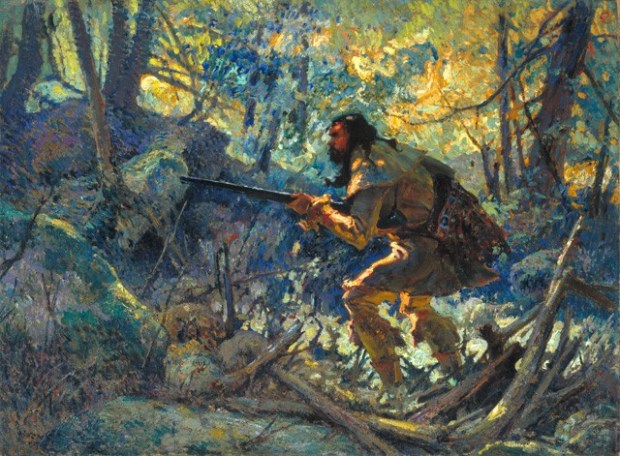
Suzor_Cote_-_Coureur_des_Bois_-_Artefacts_Canada.32874209_std

The French allied with the Algonquin/Hurons against the Iroquois along the Ottawa River. (painting by Marc-Aurele de Foy Suzor-Cote)

Constance Bay is a body of water about half an hour’s drive north along the Ottawa River, a quaint community of cottages and monster waterfront homes, but unbeknownst to many is the fact the area was the scene of a bloody battle as depicted in The Revenant film. A spit of land known as Big Sand Point, a sandy beach area now lined with cottages, was once scattered with the bones of “Indian warriors” as the author Sowter describes, and who actually uncovered skeletal remains and associated battle relics within the sands.  Sowter tells of a war-party of Iroquois warriors who, having taken possession of big Sand Point at Constance Bay, defended themselves to the death against a force of French and Algonquins, “who surprised them in a night-attack and butchered them all.”

Algonquins

Algonquins. (Wikipedia)

The Iroquois and Algonquin/Huron tribes were enemies at the time, “a time when fierce conflict was bred from a desire to mercilessly destroy the other in a campaign of extermination.” Sowter describes how the Ottawa River portage areas were dangerous, full of war-parties of natives who held these places with a “toll with the tomahawk and harvested with the scalping-knife the fatal souvenirs of conquest.”

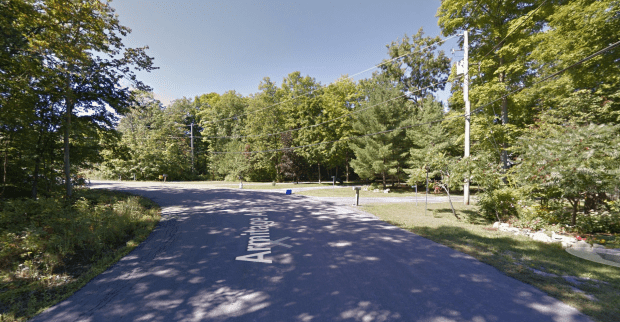
Screen Shot 2016-01-18 at 8.02.19 PM

The site of the French camp as it appears today. (GoogleStreetView)

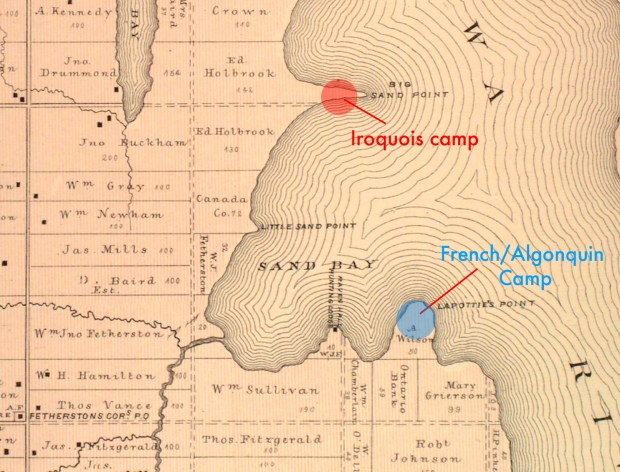
The area of Sand Bay, at the outlet of Constance Creek, has two opposing points of land across the bay, Big Sand Point to the NorthWest and a place called Pointe à la Bataille, now called Horseshoe Bay off Armitage Drive. The two points are about a mile apart with the outlet of Constance Creek almost in the middle.

battlelines1

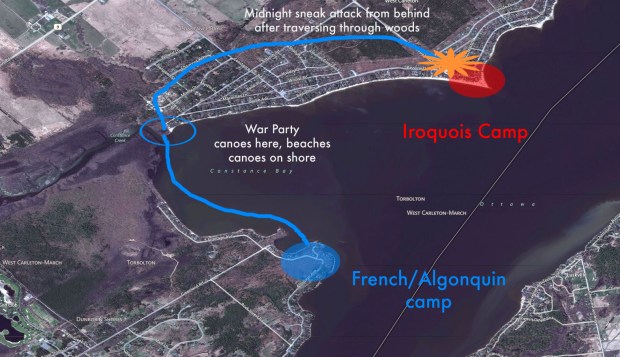
A map from 1880 shows the areas where the enemies were camped. (McGill Digital Atlas)


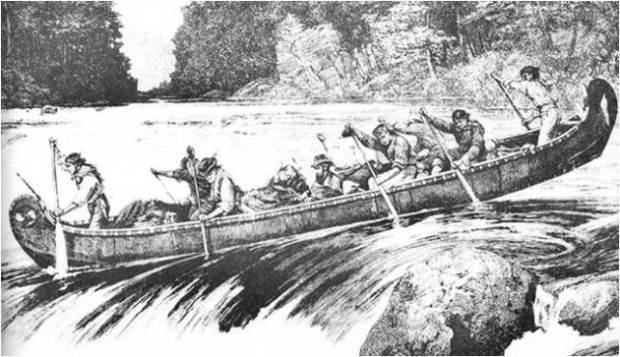
According to the story told by Sowter, a party of French fur-traders, together with a number of friendly natives set up a camp on Pointe à la Bataille. They lit their fires, cooked their meals and rested after a long journey along the Ottawa River in their canoes. The night was not to be restful however, as the campers noticed a glimmer of fire across the bay. A reconnaissance party was sent out and it was determined a large war-party of Iroquois were in a barricaded encampment at Big Sand Point. The French and Algonquins knew they would probably also soon be discovered and realized that the Iroquois camp, with its fierce warriors, would soon inflict a horrific attack on their own camp.

ottawa-river-route-5

The French/Algonquins knew it was either “us or them” so they devised a plan to attack them first. The French were outnumbered and decided not to enter into diplomatic relations with the enemy who would surely torture and kill them. It was decided they would attack them in their sleep under the cover of darkness. Sowter recounts how the French and their allies knew very well that “if their plans miscarried and the attack failed, the penalty would be death to most of their party, and that, in the event of capture, they would receive as fiery and painful an introduction to the world of shadows as the leisure or limited means of their captors might warrant.”

It was near midnight, the  French attacking party left their camp at Pointe à la Bataille and quietly paddled their canoes over to Constance Creek where they ditched them and headed into the surrounding forest. I have personally visited this site and it is still quite a forested wilderness with the distinct possibility relics from this battle are still to be found, hidden for centuries under the cloak of time.

Screen Shot 2016-01-18 at 8.06.08 PM

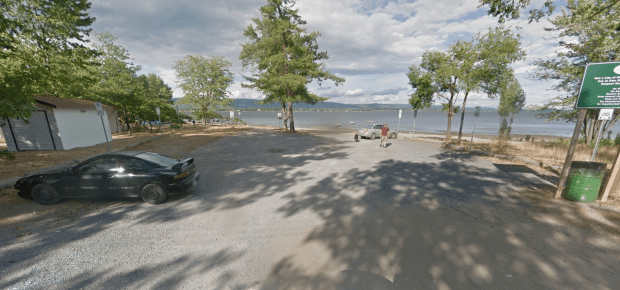
The site of the bloody battle is now a quiet beach area. (GoogleStreetview)

Taking a long detour through the forest now known as Torbolton Forest, owned by the City Of Ottawa, the attack proceeded to reach behind the enemy enabling the French and their allies to rush the enemy barricades from the rear while sentries and guards were positioned on the shore of the river.

CbayAttack

The French and their allies then swept upon the unsuspecting Iroquois with devastating effect as Sowter explains, “Many of the Iroquois died in their sleep, while the rest of the party perished to a man, in the wild confusion of a midnight massacre.” A grim attack that shed the blood of men onto the sands of what is now a peaceful cottage community.

Sowter later visited the site of this gruesome attack and uncovered “the bones that are found in the drifting sands at that place” and discovered “the remains of friend and foe who fell in that isolated and unrecorded struggle.”

So, if you happen to visit that area or live there, keep an eye out for the lost relics of a bloody attack on the shores of Constance Bay, a part of our Ottawa River fur trade history that rivals that of any Hollywood movie.

SOURCES

https://en.wikipedia.org/wiki/Algonquin_people

http://www.historymuseum.ca/cmc/exhibitions/archeo/sowter/1909/sowter1909e.shtml

BING MAPS

GOOGLE MAPS

McGill Digital Atlas

Raiders Of Antarktika: Secret WW2 Nazi mission exposed on WikiLeaks

splashpage

In the 1981 Steven Spielberg film “Raiders Of The Lost Ark”, Indiana Jones pursues Nazis who have recovered the Ark of the Covenant, a religious relic with great powers. The plot of the film was created and written by screenwriter Philip Kaufman who based it on Adolf Hitler’s World War II obsession with recovering supernatural religious artifacts, including his supposed possession of the ‘Spear Of Destiny’.

A new Indiana Jones adventure in Antarctica?

A new Indiana Jones adventure in Antarctica?

Used by the Roman centurion Gaius Longinus to pierce the side of of Jesus upon the cross during his crucifixion, Hitler obtained the relic and later knowing the end of the Third Reich was near, German U-boats were supposedly loaded up with Nazi treasure including the Holy Lance and spirited away to a secret base in Antarctica. A story perhaps worthy of another Indiana Jones film, but upon further research in to this fantastical claim it turns out there actually was a secret Nazi mission to Antarctica. A recent WikiLeaks Document (10.1017/S003224740600578X) exposes a 2006 report that explains in great detail the very real…

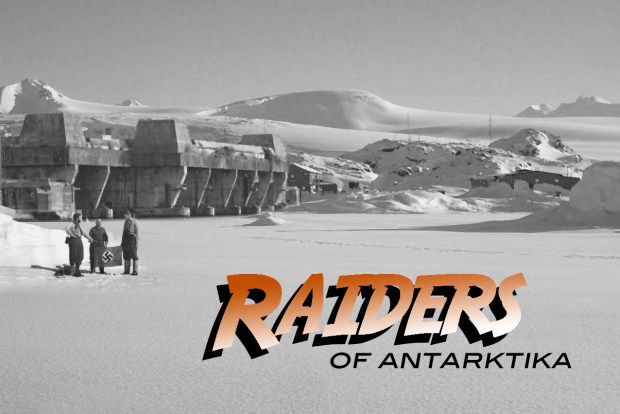
RAIDERS OF ANTARKTIKA

Published in 2006 by the Scott Polar Research Institute and written by Colin Summerhayes from the University of Cambridge and a Canadian who does corporate research in predictive trend analysis, Peter Beeching, the expose entitled “Hitler’s Antarctic base: the myth and the reality” explains in great detail the actual events of a Nazi expedition to Antarctica, the supposed secret WW2 British task force sent to flush them out, the mysterious disappearance of German U-boats after the war, their appearance in Argentina months after the German surrender, a subsequent post war operation by the United States and the mysterious detonation of nuclear weapons in the sub-continent. It is all quite marvellously unbelievable, and after sifting through the information, some startling evidence brings to light what seems to be a real-life Indiana Jones movie.

The area of Antarctica surveyed by the secret Nazi expedition in 1939.

The area of Antarctica surveyed by the secret Nazi expedition in 1939.

THE FACTS

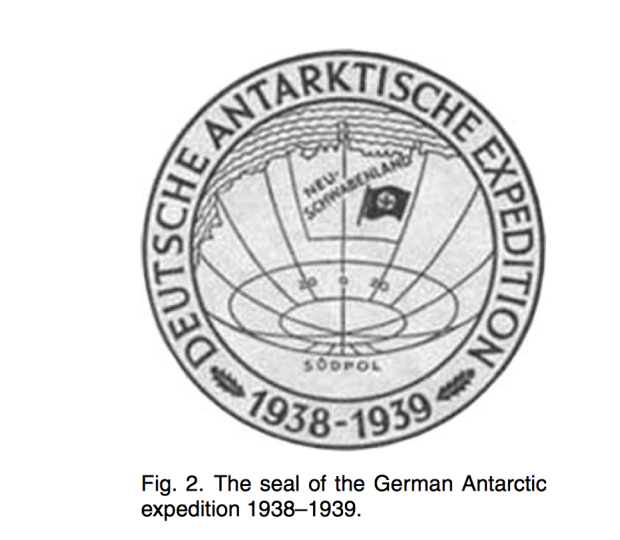
With much conspiracy speculation swirling around, it is hard to isolate what actually happened in Antarctica and what the Third Reich was actually up to there. According to the WikiLeaks report there is concrete evidence that the Nazis did indeed conduct a secret operation in Antartica in 1938-39 under the guise of a “scientific operation” but it was in fact a survey mission to claim parts of the relatively unknown continent for Germany.

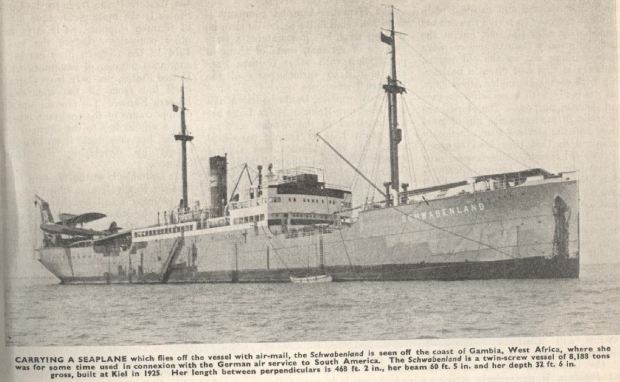
The Schwabenland ship used in the 1939 expedition with the Lufthansa seaplanes that were catapulted off the ship.

The Schwabenland ship used in the 1939 expedition with the Lufthansa seaplanes that were catapulted off the ship.

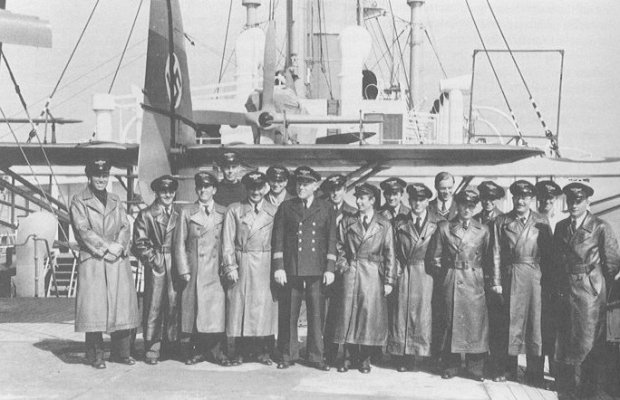
This expedition was organized to claim a piece of Antarctica for Germany and to find a place suitable for a whaling fleet. Authorized by Herman Goering as part of the German four-year plan for economic development, on 17 December 1938 the “New Swabia Expedition” left Hamburg for Antarctica aboard the MS Schwabenland, an expedition with 33 members plus the Schwabenland’s crew of 24.

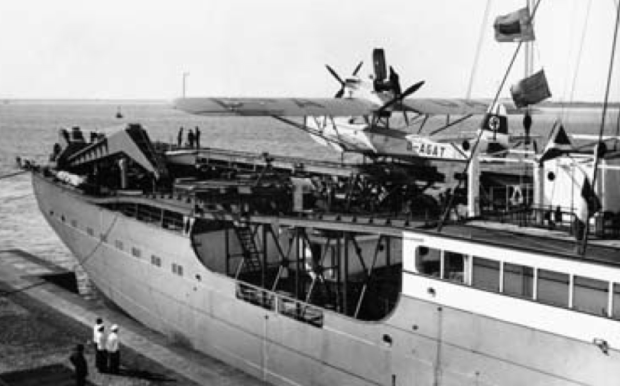
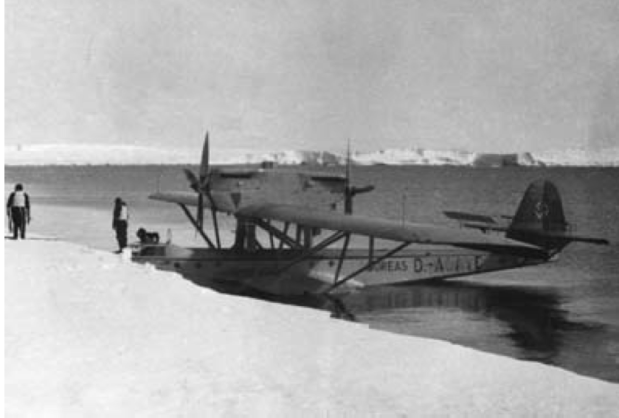
Dornier Do 15 seaplanes aboard the Nazi expedition ship.

Dornier Do 15 seaplanes aboard the Nazi expedition ship. (photo: WikiLeaks)

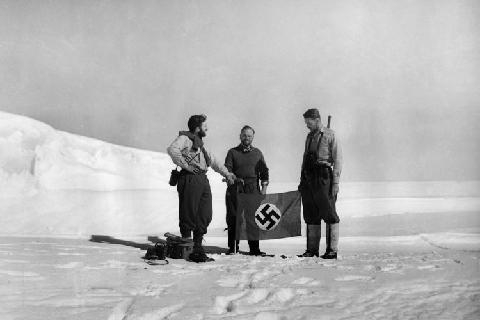
The Nazi Antarctica expedition members aboard the Lufthansa ship during the 1939 operation.

The Antarctica expedition members aboard the Lufthansa ship during the 1939 operation.

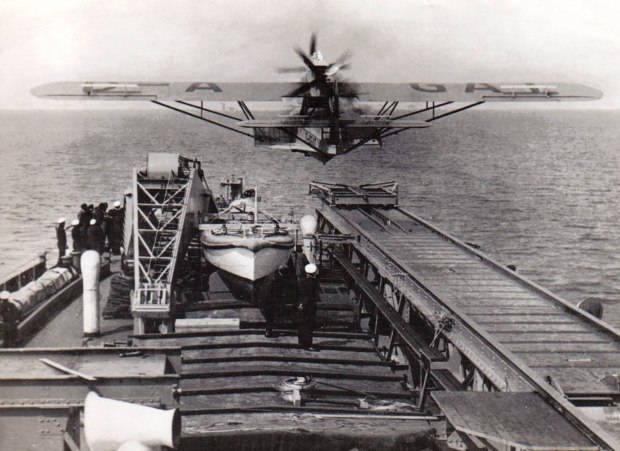
MS Schwabenland was a German catapult ship owned by the Deutsche Luft Hansa company (the predecessor to the modern day airline Lufthansa, but legally not associated). The Cambridge document publishes very rare photos of this Nazi expedition and the aircraft used to claim parts of Antarctica when they arrived in January 1939. Survey “bombs”, aluminum cylinders emblazoned with the Nazi swastika were air dropped from the Lufthansa Dornier D15 seaplanes launched by catapult from the Schwabenland ship.


The Dorner Do15 seaplane being catapulted off the ship for the Nazi landing in Antarctica.

The Dorner Do15 seaplane being catapulted off the ship for the Nazi landing in Antarctica. (photo: WikiLeaks)


One of the German Dornier sea planes arriving on the ice shelf of Antarctica.

One of the German Dornier sea planes and pilots arriving on the ice shelf of Antarctica. (photo: WikiLeaks)

Altogether the Nazi expedition flew over hundreds of thousands of square kilometres and took more than 16,000 aerial photographs, some of which were published after the war along with colour photographs of the operation. This indeed actually happened and to this day those 1939 survey markers are probably still there buried under the ice in Antarctica. Germany made no formal territorial claims to New Swabia, and no whaling station or other lasting bases were apparently built there. Yet, the myth continues perhaps in part to the 1943 statement by Admiral Donitz of the German Navy who said “The German submarine fleet is proud of having built for the Fuhrer, in another part of the world, a Shangri-La on land, an impregnable fortress.”

The Nazi flag being placed on Antarctica. 1939. (photo: WikiLeaks)

The Nazi flag being placed on Antarctica during the secret expedition. 1939. (photo: WikiLeaks)

Screen Shot 2015-08-13 at 8.45.47 PM

OPERATION TABARIN

It is now known that during WW2 another expedition was sent to Antarctica, but this time the British sent in a team under the name OPERATION TABARIN, perhaps to flush out any Axis bases since the Kriegsmarine (German navy) was known to use remote Antarctic islands as rendezvous points, and for sheltering U-boats and supply ships.  Unknown to Churchill at the time and led by Lieutenant James Marr, on Saturday January 29, 1944 a team of 14 from the Admiralty and the Colonial Office left the Falkland Islands in two ships, HMS William Scoresby and Fitzroy, for Antarctica. The British operation saw the first ever bases to be constructed in Antarctica completed.

THE COLLAPSE OF THE NAZIS AND THE MYSTERIOUS MISSING UBOATS

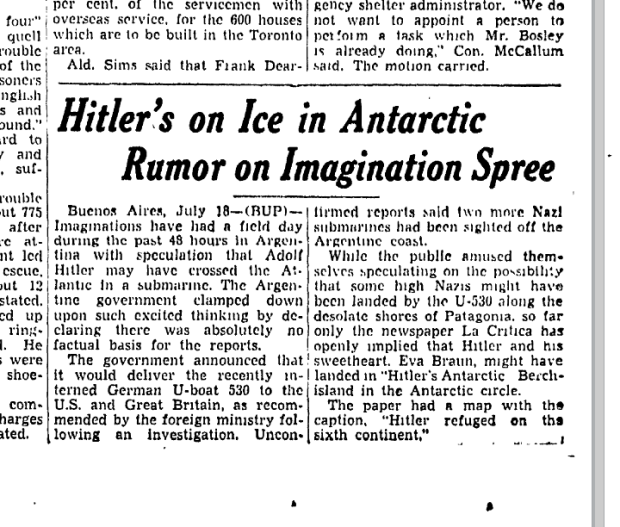
After the defeat of the Nazis, Admiral Donitz, Hitler’s successor after his death, gave the order for all U-boats to surrender to Allied forces. Almost all did except for U-530 and U-977, two German subs that vanished for two months after the official surrender, but later appeared in an Argentinian harbour, one without log books and missing crew lists. Speculation arose, and the Toronto Star even published an article “Hitler’s On Ice in Antarctica”.

a 1946 article in the Toronto Star about the theory Hitler escaped with treasures to Antarctica. (GoogleNews)

A 1945 article in the Toronto Star about the theory Hitler escaped with treasures to Antarctica. (GoogleNews)

Reports began to circulate that Hitler knowing his imminent demise had ordered documents and artifacts loaded aboard U-boats to take them to Antarctica under “Project Valkyrie 2”. A book by Nigel Braddon “The Mystery Of U-33: Hilter’s Secret Envoy” describes how four lead lined bronze boxes were loaded aboard the U-boats and ordered to cache them in Antarctic caves.

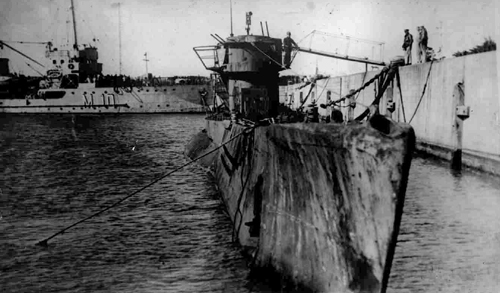
The surrendered U-boat U-530 after arriving in Argentina two months after the war's end.

The surrendered U-boat U-530 after arriving in Argentina two months after the war’s end.

U-530 did go missing after the war, her captain, Oberleutnant Otto Wermuth, had decided to surrender in Argentina but did not explain why it had taken him more than two months to reach there, nor why the submarine had jettisoned its deck gun, or why the crew carried no identification, nor what had happened to the ship’s log. After interrogation and explanation of the reasons behind the delayed appearance in Argentina, the German sub was taken by the US Navy and sunk during target practice in 1947.

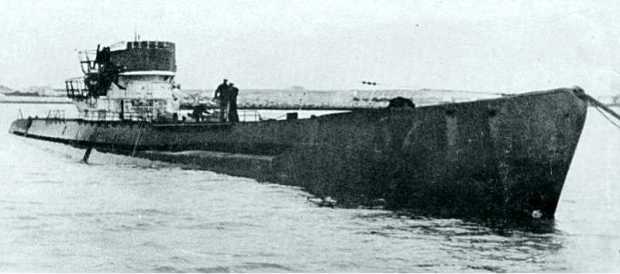
U-977 after surrennder in Argentinian harbour 99 days after the end of the war.

U-977 after surrennder in Argentinian harbour 99 days after the end of the war.

The other sub, U-977 left for waters south after the war with its captain, Oblt.z.S. Schaffer, deciding to sail to Argentina rather than surrender. The U-boat made various stops along the way and later Schäffer wrote a book: U-977 – 66 Tage unter Wasser (“U-977 – 66 Days Under Water”), the first postwar memoir by a former U-boat officer. That sub was also sunk by target practice by the US Navy in 1946.

OPERATION HIGHJUMP

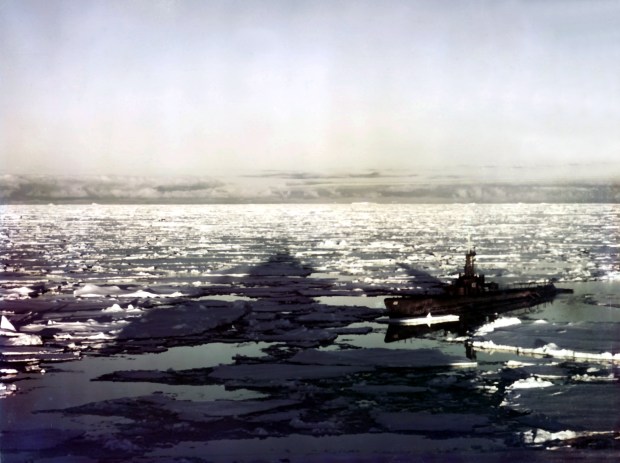
The WikiLeaks document continues to explain the various conspiracies surrounding stories of a Nazi base in Antarctica and tells of a very real US task force sent there in 1947 under the code-name OPERATION HIGHJUMP, officially titled The United States Navy Antarctic Developments Program. In 1946–1947, the United States Navy organized an operation by Rear Admiral Richard E. Byrd Jr. with Task Force 68, an operation involving 4,700 men, 13 ships, and 33 aircraft.

A US sub in Antarctica waters as part of Operation Highjump. (photo: Wikipedia)

A US sub in Antarctic waters as part of Operation Highjump. (photo: Wikipedia)

Operation Highjump’s primary mission was to establish an Antarctic research base. Another US led task force returned in 1947 under the code-name Operation Windmill, the United States Navy’s Second Antarctica Developments Project, an “exploration and training mission”.

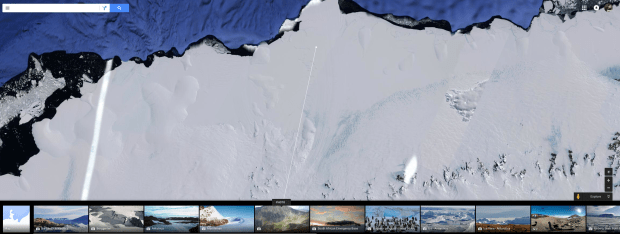
A Google Earth image showing the area surveyed by the German expedition 1939.

A current Google Earth image showing the area surveyed by the German expedition of 1939.

CONCLUSIONS

The extensive report by Summerhayes and Beeching seems to successfully disprove any notion of an “Antarctica Conspiracy” and thoroughly researches all angles of the Nazi connection and the post-war military operations. You can read the full document here. Peppered amidst the snowbanks of speculation are flakes of truth, and even though its likely fiction, a secret Nazi submarine base in Antarctica certainly makes for a good script to propel Indiana Jones back to the big screen in a unique new adventure. Below are some composite photographs based on these stories that bring that idea to life in Indiana Jones and the Raiders Of Antarktika.

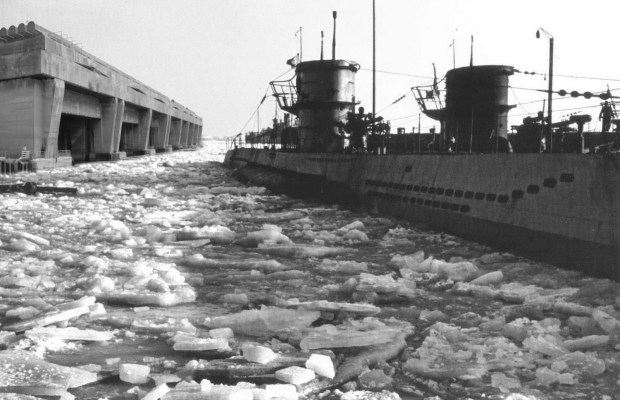
A secret U-boat base built on the shore of Antarctica. (NOTE: fictional composite photo)

A secret U-boat base built on the shore of Antarctica. (fictional composite photo)

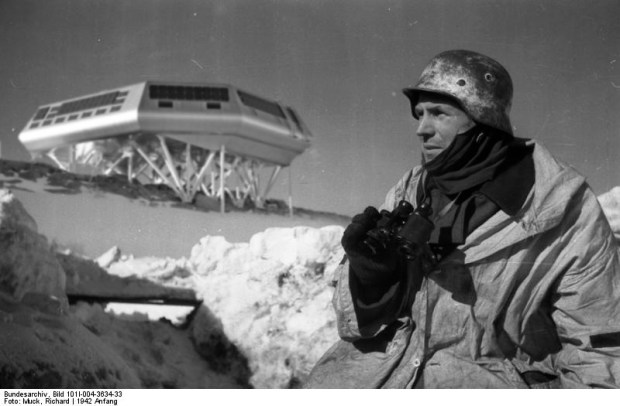
A german soldier keeps a look out for Indiana Jones at a remote Antarctic outpost. (NOTE: fictional composite photo)

A german soldier keeps a look out for Indiana Jones at a remote Antarctic outpost. (fictional composite photo)

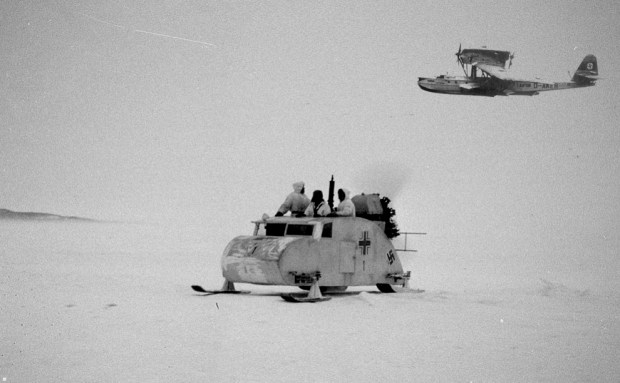
German tracked snow vehicle on patrol for Indiana Jones with a Dornier seaplane above. (Note: fictional composite photo)

German propellor powered snow vehicle on patrol for Indiana Jones with a Dornier seaplane above. (fictional composite photo)

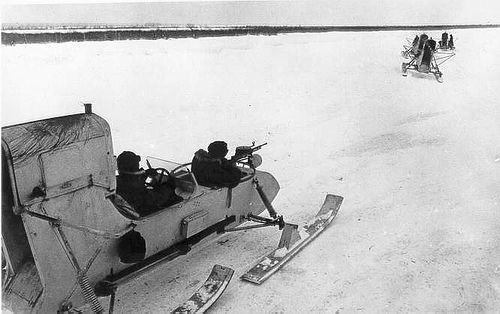
German Aerosleds take chase after Indiana jones successfully retrieves the lost Spear Of Destiny.

German Aerosleds take chase after Indiana jones successfully retrieves the lost Spear Of Destiny.

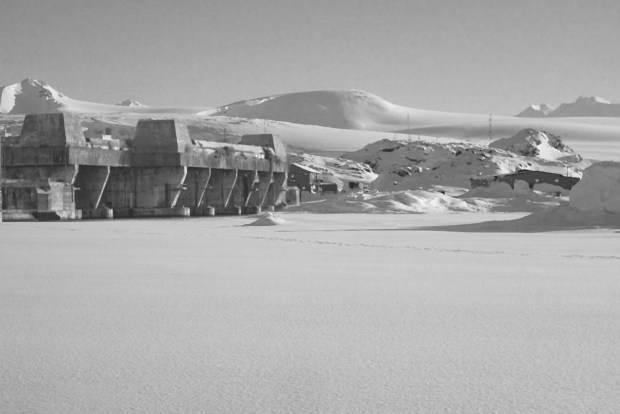
A concrete Nazi bunker constructed on Antarctica contains secrets yet to be exposed. (Note: fictional composite photo)

A concrete Nazi bunker constructed on Antarctica contains secrets yet to be exposed.  fictional composite photo)

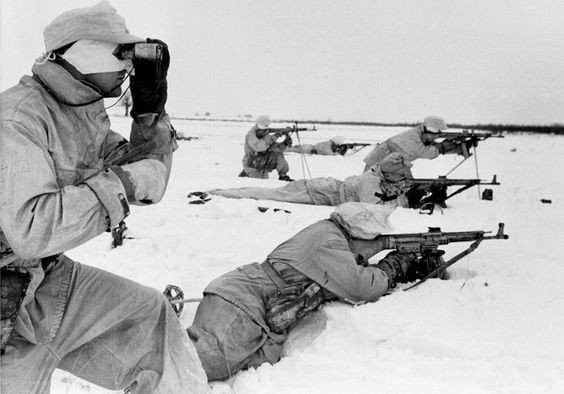
The arrival of Indiana Jones brings out a welcoming party on Antarctica.

The arrival of Indiana Jones to Antarctica brings out a welcoming party.


SOURCES

WikiLeaks: https://wikileaks.org/gifiles/attach/49/49783_.pdf

National Post: http://www.nationalpost.com/news/story.html?id=2356e6bb-5122-47f1-844a-047a13f2db1d

Wikipedia: https://en.wikipedia.org/wiki/New_Swabia

Wikipedia: https://en.wikipedia.org/wiki/MS_Schwabenland_(1925)

Wikipedia: https://en.wikipedia.org/wiki/Operation_Highjump

Wikipedia: https://en.wikipedia.org/wiki/Operation_Tabarin

Wikipedia: https://en.wikipedia.org/wiki/Operation_Windmill

Google Earth

Ottawa’s Secret Cold War Missile Bunkers

QRA-splash

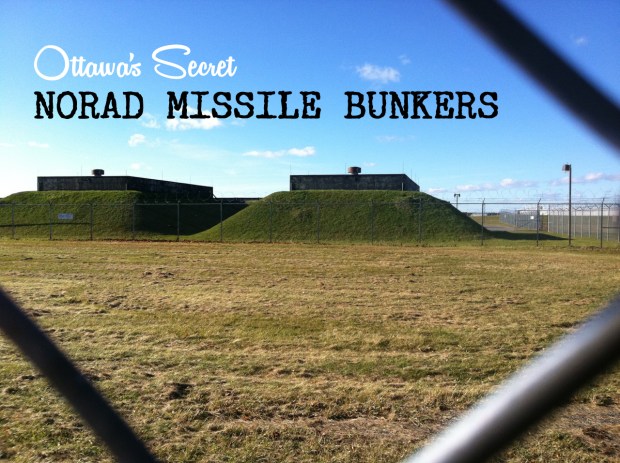
As the cold of winter once again grips Ottawa, a remote group of buildings quietly stands as a relic of our Cold War past, once a secret NORAD base of operations during a very different war on cold..that of the nuclear age.

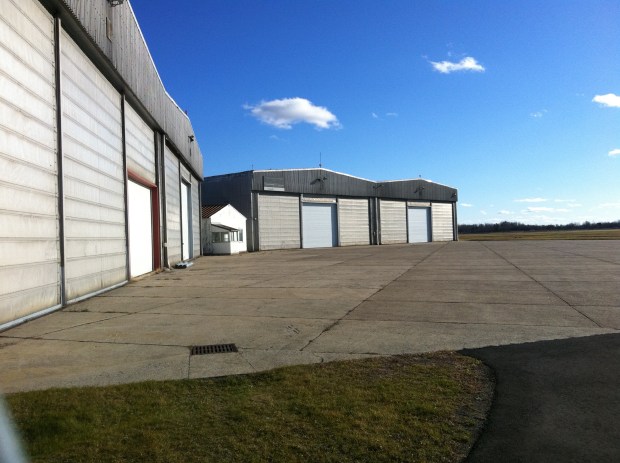
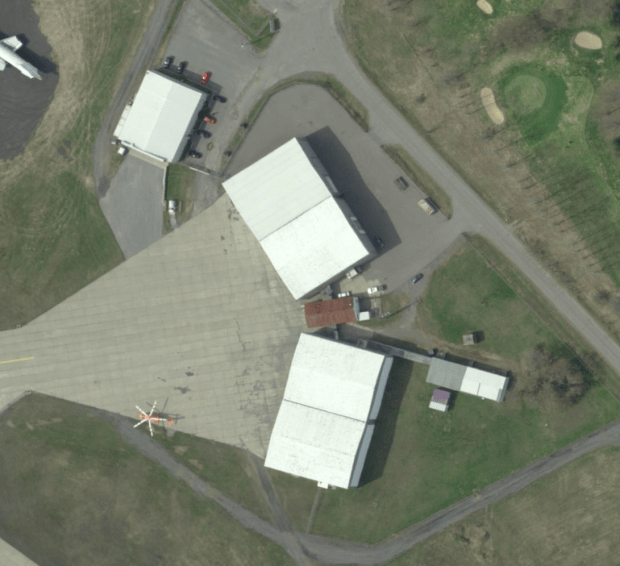
A unique abandoned Cold War fighter jet hangar sits forgotten in Ottawa.

A unique abandoned Cold War fighter jet hangar sits forgotten in Ottawa. Hangar doors now modified to a single narrow door.

At the height of the Cold War in Ottawa, the threat of nuclear attack by Soviet Russia was taken so seriously that a QUICK REACTION ALERT or QRA station was constructed on the outskirts of town at Uplands Air Force Base off Hunt Club Road. Now forgotten and hidden behind rusting barbed wire fencing, this unique defence facility constructed sometime in the late 1950’s was a special unit of the Royal Canadian Air Force base and played a key strategic role in the air defence of Canada and North America during the Cold War. Part of North America’s Air Defence, or NORAD, Ottawa’s QRA station formed part of a network of 5 other Canadian all-weather jet fighter bases armed with missiles and possible nuclear capabilities to counter surprise attacks by Soviet bombers in North American airspace. An excellent blog set up by Steffan Watkins, “Camping Canadian” explores various Cold War sites in Canada in amazing detail, and outlines the various QRA sites in Canada, including the station here in Ottawa. A direct link is HERE.

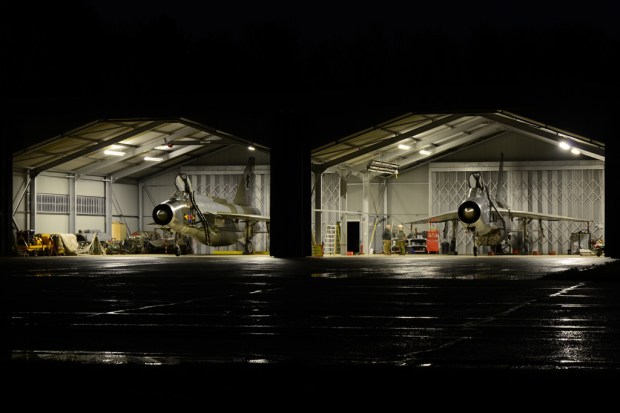
A photo of a RAF QRA hangar still in operation.

A photo of a RAF QRA hangar still in operation.

Screen Shot 2016-01-04 at 3.00.17 PM

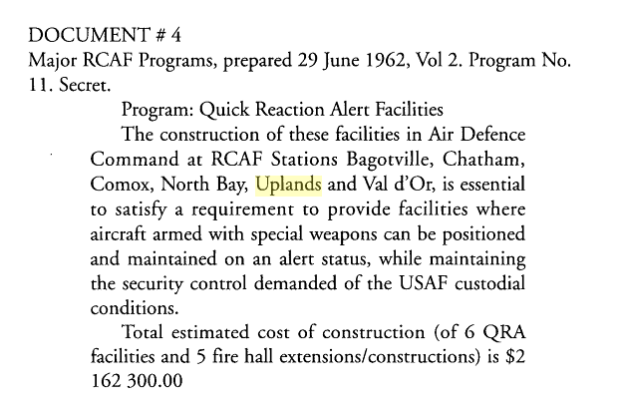
In a document prepared in 1962 labelled as “PROGRAM 11-SECRET” Ottawa was to house a special jet fighter intercept station “essential to satisfy a requirement to provide facilities where aircraft armed with special weapons can be positioned and maintained on alert status, while maintaining the security control demanded of the USAF custodial conditions.”

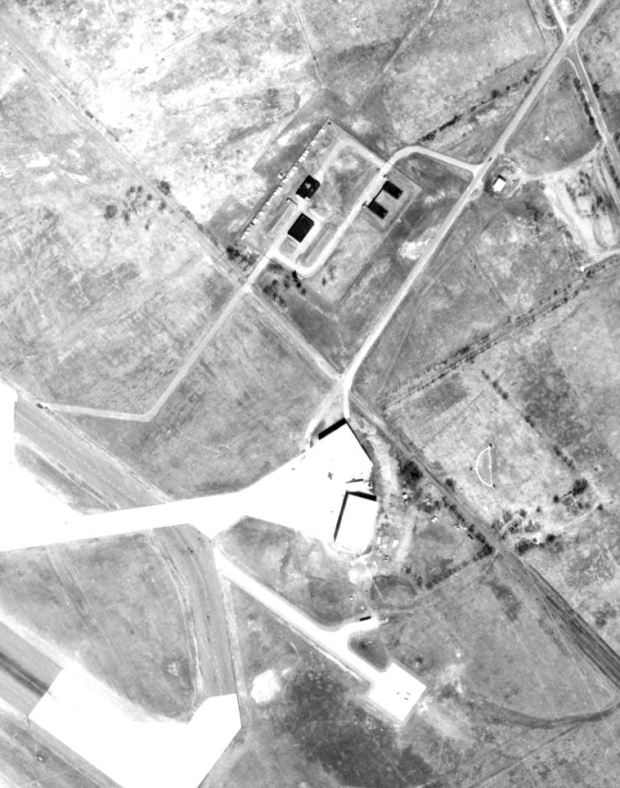
a 1950s satellite image shows the special NORAD QRA facility. Missile bunkers located at top.

A 1950s satellite image shows the once remote NORAD QRA facility. Missile bunkers located at top.


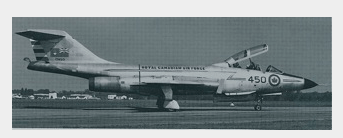
The actual CF101 Voodoo fighter jet that would have been stationed inside the special QRA hangars.

Photo of an Ottawa based CF101 Voodoo fighter jet that would have been stationed inside the special QRA hangars.

A special isolated hangar and some missile bunkers were constructed at a remote part of the Uplands airport that would house Cf-101 Voodoo fighter jets supplied by the USAF after the cancellation of the Avro Arrow program. Ottawa would most likely have seen Avro Arrows stationed in these specially built QRA intercept hangars if the Arrow program was not cancelled. Along with the special windowless secret hangars, special bunkers were constructed to house missiles for these jets on alert, including nuclear missiles. The Voodoo’s primary armament was the nuclear-tipped AIR-2A Genie unguided air-to-air rockets, and was used as Canada’s primary means of air defence.

A model of the Ottawa NORAD Alert fighter jet.

A model of the Ottawa based NORAD Alert fighter jet.

Another 1962 document labelled “PROGRAM NUMBER 10-SECRET” it is mentioned that “special weapons (most likely nuclear) needed to be housed. “A requirement exists to provide RCAF Station Uplands with special armament storage facilities to accommodate the ready-use weapon loads required by CF101 aircraft and to provide these bases with facilities for security control of such weapons.” I was unable to find confirmation that nuclear weapons were actually stored in the bunkers, but it seems likely if the Voodoo was usually armed with the Genie missile. A future Ottawa Citizen article says no nuclear weapons were ever housed in Ottawa.

Currently unused, the Cold War era facility is clearly in good shape, even the pilots mess hall and barracks are still standing.

As of November 2015, the Cold War era facility is clearly in good shape, even the pilots mess hall and barracks are still standing.

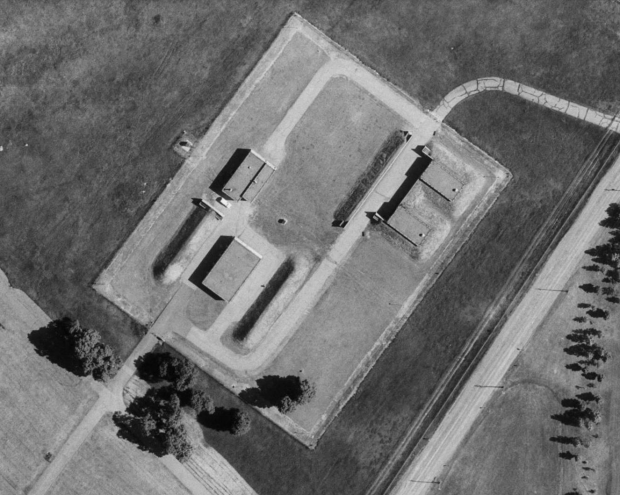
These “special weapon” facilities were indeed built, and can still be seen today near the QRA hangars at the south end of Ottawa’s airport. Surrounded by barbed wire fencing there are a number of these special built concrete bunkers surrounded by earth piles meant to absorb any explosion of the missiles inside the bunkers. Air vents can clearly be seen from the road sticking above the bunkers and a quick Google map search clearly shows these missile bunkers in aerial images of the area.

A 1965 aerial image shows the missile bunkers for the fighter jets armament.

A 1965 aerial image shows the missile bunkers for the fighter jets armament.

as seen from the road the facility that once housed the standby-fighters during the Cold War.

As seen from the road the facility that once housed the standby-fighters during the Cold War.

as seen from the road the facility that once housed the standby-fighters during the Cold War.

IMG_6593

The bunkers as they appear today that once housed the missiles for the Voodoo fighters in the nearby hangars.

Operational as 410 Squadron as of Christmas Day 1961, these secret NORAD QRA stations provided a unique lifestyle for its occupants during the Cold War.  Ottawa pilots and ground personnel spent up to a week at a time inside the hangar, ready to jump into a ready fighter jet at a moment’s notice. In the event of an alert, hangar doors quickly opened allowing the jets to take off almost immediately. Eating facilities and sleeping quarters were located in between the two hangars, and the bunkers situated a few hundred metres away housed the missiles that the planes would be armed with to intercept the Soviet aircraft.

Screen Shot 2015-11-08 at 6.00.34 PM

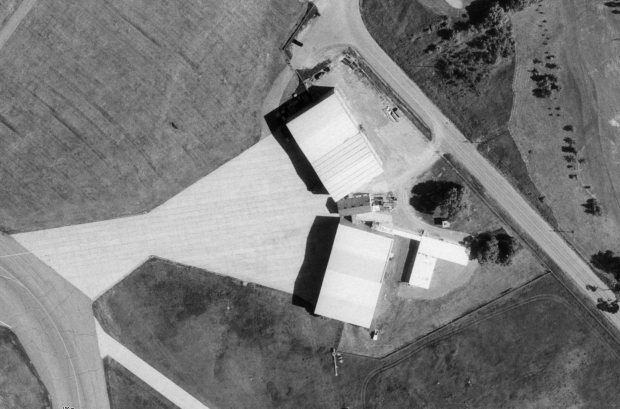
a current aerial image of the old Cold War facility. Net ORANG medi-vac chopper.

A current aerial image of the old Cold War facility. Note ORANG medi-vac chopper.

In 1964 Defence Department cuts axed the QRA NORAD facilities and Ottawa’s unit was disbanded with its 8 Voodoos saying farewell to the Nation’s Capital. At midnight on March 31 the commanders give up alert commitment and 410 Squadron ceased to exist.

An Ottawa Citizen article describing the shut-down of the NORAD facility in Ottawa.

An Ottawa Citizen article describing the shut-down of the NORAD facility in Ottawa.

Of the six QRA facilities constructed, only a few remain in existence. The QRA facility in Bagotville, Quebec was designated a National Historic Site in 2005, and with Ottawa’s facility in relatively good condition despite sitting unused in a remote part of the airport, it would seem appropriate to take the necessary steps to protect and preserve this unique part of Ottawa’s, and Canada’s Cold War history.

SOURCES

Bing Maps

Google Maps

GeoOttawa

Google News

“Canadian Nuclear Weapons: The Untold Story Of Canada’s Cold War Arsenal” by John Clearwater, 1998

CF-101B Voodoo, No. 410 Squadron, RCAF Station Uplands, 1960s (1:72) by Hobby Master Diecast Aircraft
Item Number: HA3709

“Camping Canadian” a blog by Steffan Watkins: http://campingcdn.blogspot.ca/2012/11/rcaf-voodoo-and-genie-storage-facilities.html


CHRISTMAS MYSTERY: A B17 Bomber from Ottawa loaded with Christmas cargo disappeared without a trace on December 15th 1944

b17

(This story originally appeared as part of an earlier post from December 2013 HERE)

During World War 2, Ottawa’s Rockcliffe air base operated a total of six B17 Flying Fortress aircraft that were outfitted as transport “mailbirds” ferrying thousands of letters and packages between Canada and the fighting forces overseas in Europe. Tracing the serial numbers of each of the B17s I was able to uncover what happened to each of these mailbirds during their wartime mail missions. Most were eventually either damaged or scrapped, but one in particular, B17 Serial#9203, went mysteriously missing. This is the story of Ottawa’s lost B17…a MailBird Mystery.

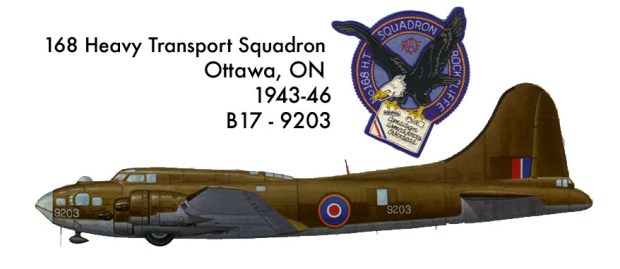
B17-9203 from Ottawa's Rockcliffe 168 Squadron and its insignia crest patch worn by crew during World War 2. (Patch image CC-SY)

B17-9203 from Ottawa’s Rockcliffe 168 Squadron and its insignia crest patch worn by crew during World War 2. (Patch image CC-SY)

In October of 1943 Rockcliffe airport became the site of 168 Heavy Transport Squadron which was formed to handle the large quantities of mail that needed to be delivered to personnel serving in the European and North African campaigns during World War Two. 168 Squadron became the site of a bustling hub of mail from across Canada that needed to be delivered to the troops and service personnel overseas. Love letters, family correspondence, birthday and holiday gifts as well as freight were all transported to the men and women far from home, boosting morale and keeping them connected to loved ones back home. B17-9203 had just delivered a load of Christmas mail to Canadian troops serving in North Africa through a Royal Canadian Air Force base in Morocco.

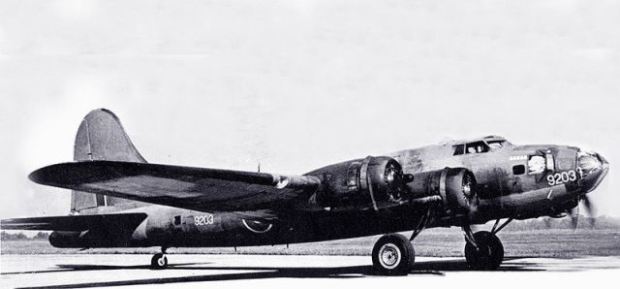
USAF file photo of Hillcoat’s B17-9203 from Rockcliffe painted in RCAF markings. Note serial number “9203” painted on the nose. It was on its way home when it disappeared over the Atlantic Ocean in 1944.

USAF file photo of Hillcoat’s B17-9203 from Rockcliffe painted in RCAF markings. Note serial number “9203” painted on the nose.

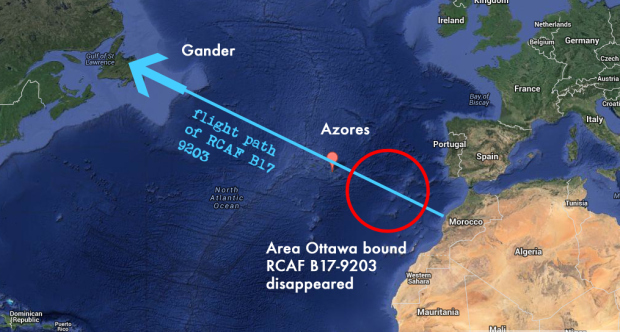
On December 15 1944 the aging B17 Flying Fortress from Ottawa, handed down from the United States Air Force, was loaded up with return Christmas mail bound for the Nation’s Capital. Pilot Horace Hillcoat and his crew of eight prepared the B17 to return home for the holidays with their precious Christmas cargo. Throttling up the four radial engines of the B17, Hillcoat lifted the mailbird into the Moroccan skies, heading for the Azores, a small group of islands in the North Atlantic Ocean. After a brief stop there, Hillcoat would then fly to Newfoundland before reaching his destination at Rockcliffe, Ottawa. Leaving the African shoreline, Hillcoat took the B17 across the Atlantic headed for the island airstrip some 1,500 km away. As they lost sight of the African coast, B17-9203 and its crew were never heard from again.

azores-map

When contact was lost with Hillcoat’s B17, a search and rescue mission scoured the area of the ocean where the plane may have disappeared. Some mailbags were found floating on the surface of the ocean, but no other signs of wreckage, survivors or debris were ever found. No distress calls or radio contact was made before the plane disappeared. B17-9203 had simply vanished. Hillcoat and the crew were classified as “Missing”.

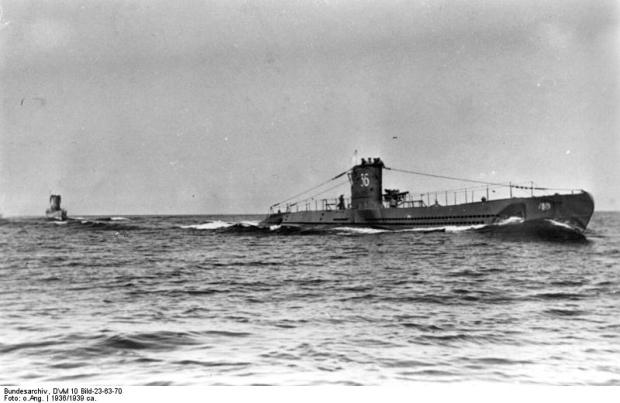
Was Hillcoat and his crew ambushed by attacking German Luftwaffe aircraft, sending them to a watery grave? Did the well-used B17 suffer a mechanical malfunction and Hillcoat unsuccessfully ditched his plane in the Atlantic? Another theory is that the ill-fated B17 was shot down by anti-aircraft guns aboard a German U-boat prowling the waters below the B17. A number of German U-boats shot down Allied aircraft in the vicinity of the Azores, a fate that could have taken down Hillcoat’s aircraft. Numerous U-boats were also sunk by Allied anti-submarine patrols in that area with their sub crews taking their secrets and records to watery depths. It is quite possible Hillcoat’s B17 was shot down by one of these sunken U-boats with the story submerged along with it.

Did a lurking German Uboat down Ottawa's Christmas Cargo over the Atlantic?

Did a lurking German Uboat down Ottawa’s Christmas Cargo over the Atlantic? (photo Wikipedia)

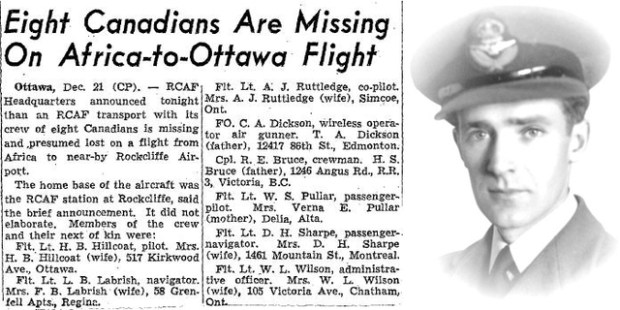
A 1944 newspaper clipping from December 21 reports the missing plane with a listing of all those on board. It turns out that the pilot, Horace Hillcoat was actually the only crew member of the eight aboard that was from Ottawa. He and his wife lived on Kirkwood Ave. in Westboro, and the house is still there today.

photo16

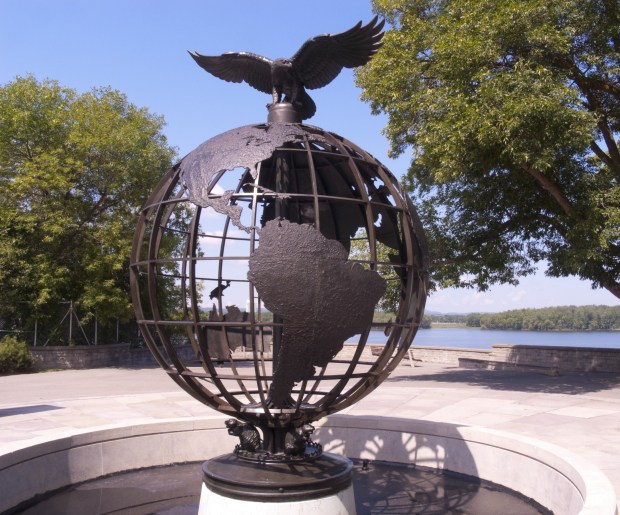
Hillcoat and the rest of the crew aboard the ill-fated Christmas B17 are part of the Commonwealth AirCrew Memorial on Sussex Drive.

Hillcoat and the rest of the crew aboard the ill-fated Christmas B17 are part of the Commonwealth Aircrew Memorial on Sussex Drive.

Hillcoat’s plane and its Christmas cargo were never found and with its crew still deemed missing, they join hundreds of other missing aircrew from World War Two on the Commonwealth Aircrew Memorial on Sussex Drive. The lost Christmas B17 from Ottawa continues to be an enduring mystery that may never be solved.

Vikings In Canada: Part 2 – They’re here.

vikingsSPLASHPART 2 of a two part series examining the mystery of Norse settlements in Canada

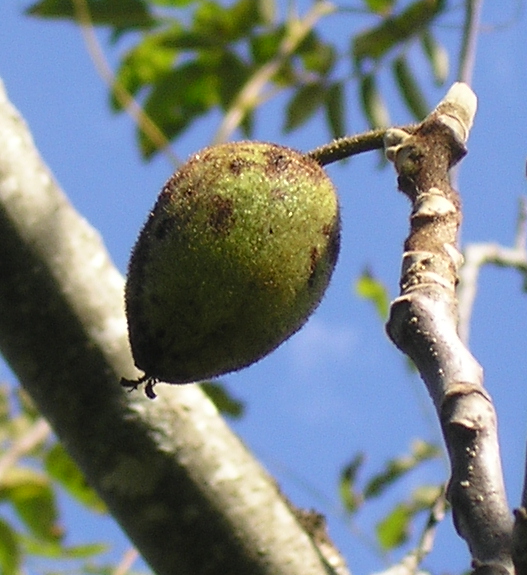
The idea of Norsemen exploring towards the interior of Canada is probably met with the same scepticism as the idea of them once crossing the Atlantic Ocean. Yet that idea was finally proven fact by the Ingstads in the 1960s after what was I’m sure was much controversy. The Ingstads hard work and determination paid off and legend soon became fact. The excavation of the ruins at L’Anse Aux Meadows proved that it was not a permanent settlement, but rather a staging ground for further ventures elsewhere and the out-of-province butternut illustrates something was indeed happening. Whether the butternut was from a far distant land and arrived through trade with the indigenous peoples or that the Norse brought it back with them after a another trip elsewhere into Canada illustrates a deeper interaction within our country than first thought.
OLYMPUS DIGITAL CAMERA

A butternut like the one found at L’Anse Aux Meadows.

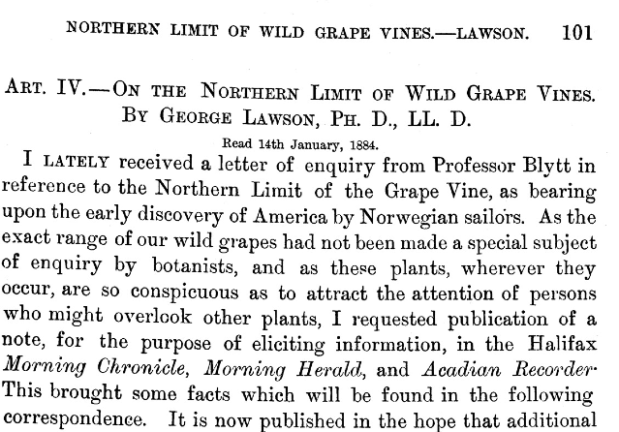
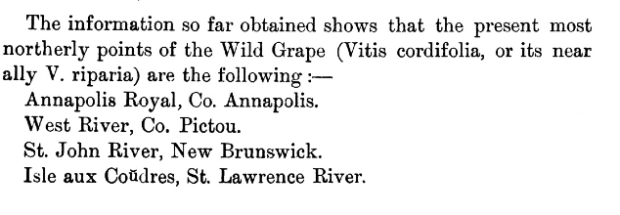
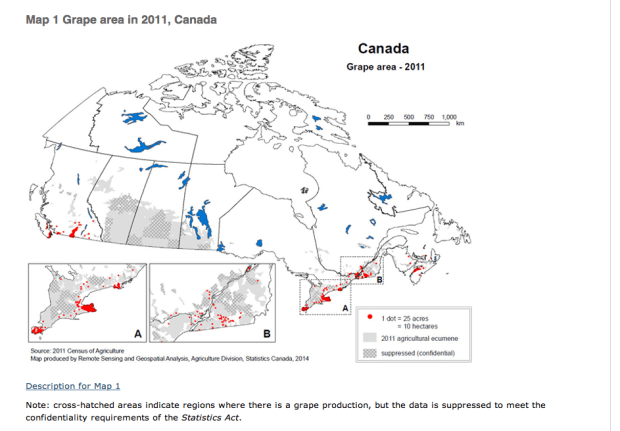
The earliest Canadian document I could find exploring the idea of further Norse exploration was Dr. George Lawson’s article from 1884. (see previous post: PART 1) Lawson concluded that the wild grapes that could describe “Vinland” were present on the shores of Lake Ontario west of Kingston (Prince Edward County, currently a popular wine region) the banks of the St. Lawrence in the 1000 islands up to Trois Riviere, QC and the St.John River region in New Brunswick. (we will talk more about the grape regions later)
Screen Shot 2015-11-16 at 11.12.34 PM

Dr. George Lawson describes the northern extent of wild grapes in Canada for Norwegian scholars in 1884.

Screen Shot 2015-11-16 at 11.10.24 PM

A current map showing extent of wild grapes in Canada.

A 2011 map showing extent of wild grapes in Canada.

STONE COLD

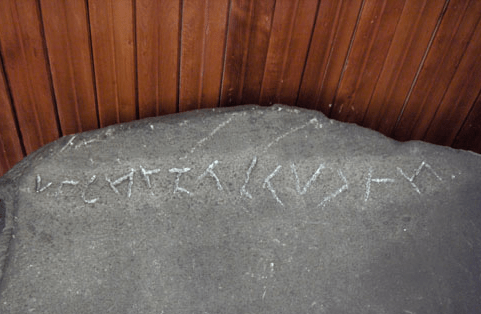
In 1812, a stone weighing almost 600 pounds was discovered by a Dr. Fletcher on his property at the mouth of Yarmouth harbour Nova Scotia. Inscribed on the stone were odd carvings that resembled old Norse runic writing. The stone was found near the ruins of an old stone dock and moved to a hotel, then the local library. Then stone then was taken to Norway before WW1 to be admired by the descendants of the stone’s author, later stored in a warehouse in London, England as it was deemed too unsafe to travel across the ocean with it during wartime. After the war ended it returned to Yarmouth where it was put in the local library and later moved to the local Yarmouth Museum where it remains today. It sits in the little museum and it remains to be studied further as authentic evidence the Norse made their way to Yarmouth, Nova Scotia.
Screen Shot 2015-11-24 at 2.34.52 PM

The Yarmouth Stone found in 1812 inscribed in what is thought to be Norse runes. (photo posted with permission of  Yarmouth County Museum and Archives)

Screen Shot 2015-11-24 at 2.34.41 PM

I contacted the Curator of the museum in Yarmouth to ask permission to publish photos of the rune stone, which they have graciously allowed and it is shown above. Nadine Gates, the Director/Curator of Yarmouth County Museum and Archives (direct link HERE ) emphasized that the museum remains neutral on the stone’s authenticity and states “Please understand that this is NOT a confirmed “Viking” stone. This is but one of several theories surrounding the rune stone found by Dr. Fletcher in 1812.” The stone currently remains in the county museum and has yet to be verified as authentic evidence of Norse visitation to the region.

SPEAR OF DESTINY

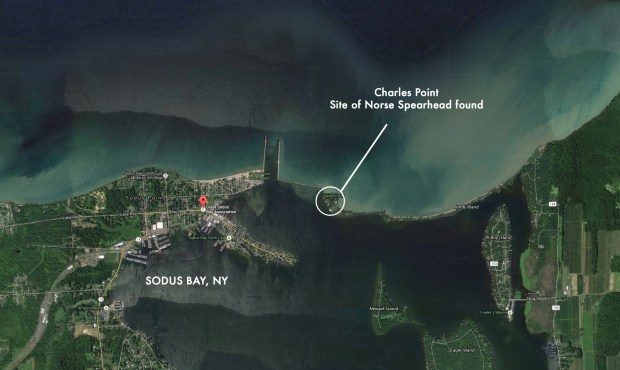
In 1929 the owner of a summer home near Sodus Bay, NY was repairing his breakwater after a heavy storm washed away some of his property and was trying to find a suitable place to rebuild his boathouse. The property owner, Augustus Hoffman, was excavating his land and unearthed an object found about twenty feet from shore.

Location of where an authentic Norse spearhead was found.

Location of where an authentic Norse spearhead was found. (Bing Maps)
sodus1marked

Hoffman picked up the iron object that he assumed was an old Indian tool and tossed it aside. A year later Hoffman showed the iron object to a friend who in turn contacted the Royal Ontario Museum in Toronto across the Lake Ontario. The object was confirmed to be an authentic Norse iron spearhead with an age that ranged from the ninth century to the fourteenth century. The Norse spearhead now resides in the Museum of Wayne County History, NY where it rests as an authentic Viking spear with its reasons for being there unknown.
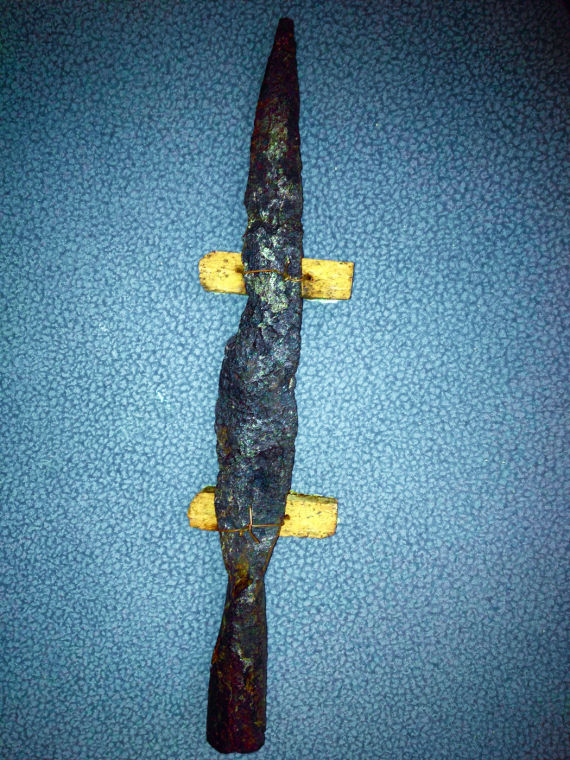
The iron spear head of Norse origin dated to the century.

The iron spear head of Norse origin dated to 9th-14th century now in Wayne County Museum

Sous Bay (red) due south of Prince Edward County on the shore of Lake Ontario.

Sodus Bay (red) due south of Prince Edward County on the shore of Lake Ontario where the spear was found.

Was it a lost relic from a a Norse exploration party who traversed the St. Lawrence river into Lake Ontario to Sodus Bay on the south shore? Or was it a traded item through indigenous tribes that somehow made it all the way from LAM? Its location is almost due south of Prince Edward County.

MORE BEARDS

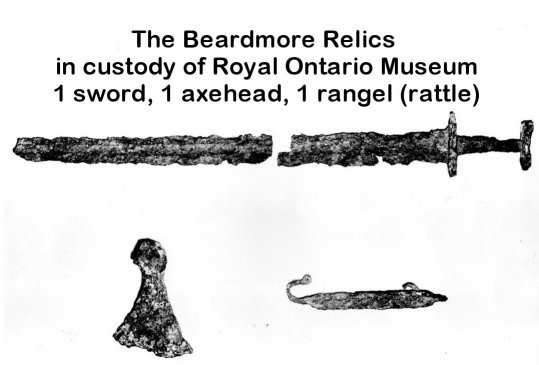
Almost at the same time as the Sodus Spear discovery, James Dodd, a CNR trainman in Port Arthur was prospecting near Beardmore, ON and uncovered something that continues to be a controversial piece of Viking lore . While prospecting for gold in 1931 Dodd claims he unearthed some old metal and like Hoffman of Sodus Bay, thought they were some “old Indian relics” and took them home where they sat for five years. Dodd later contacted the Royal Ontario Museum and the curator at the time took a closer look at them with great interest as they resembled not ‘Indian” relics” but that of the Norse. The curator, Charles Currelly bought the items for $500 off of Dodd and sent photos of the relics to Europe for analysis to see if they resembled anything from the Norse culture. They were indeed authenticated as genuine Norse articatcts: A Viking Sword, A Viking axe and a Viking Shield handle. 100% legitimate Norse artifacts.
IMG_4004

The museum proudly displayed them soon afterwards as genuine proof of Vikings visiting Ontario but soon academics and archeologists questioned the provenance of the artefacts and accused Dodd of planting the objects. The museum, in an effort to avoid controversy removed the Viking relics from their display and put them in storage for almost 30 years. No one was allowed to photograph them. Dodd’s son, Walter, later was told to give a sworn statement in 1957 that the objects were planted by his father and they remained in storage until about the 1990s when they reappeared in the museum with no mention of their checkered past. They remain in the museum to this day in the “weapons” wing, and last winter I had an opportunity to see them in person. They are indeed heavily corroded iron artifacts on display without any of the history behind them, but using previously published photos of the relics I was able to identify them in the display case. They are shown below.
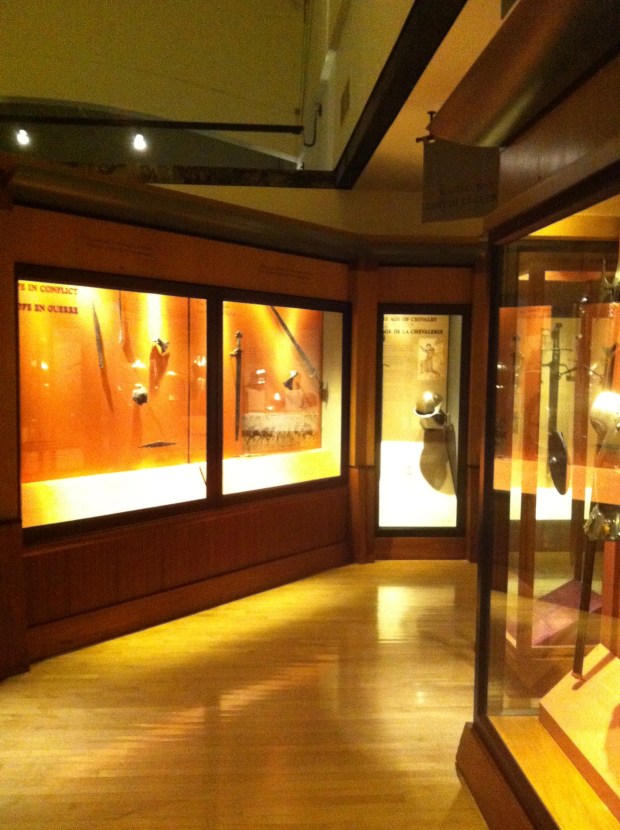
The Beardmore relics are displayed in ROM without mention of their discovery or how they got there.
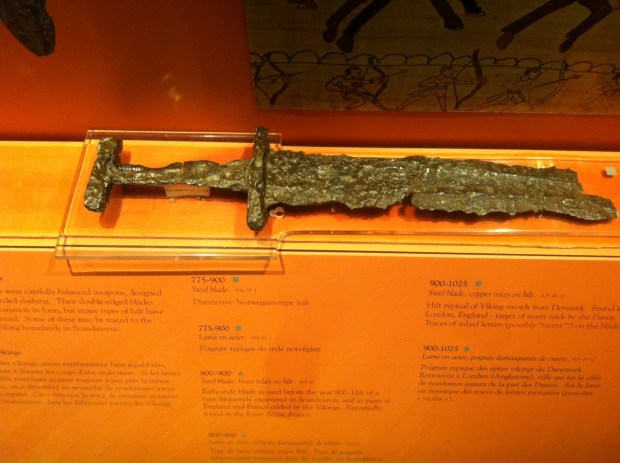
The Beardmore relics are displayed in ROM without mention of their discovery or how they got there.

The actual Beardmore Viking Sword deemed a hoax item as displayed at Rom. No mention of its illustrious past is shown.

The actual Beardmore Viking Sword as displayed at ROM. No mention of its illustrious past described, marked only with “Distinctive Norwegian Blade 775-900AD”
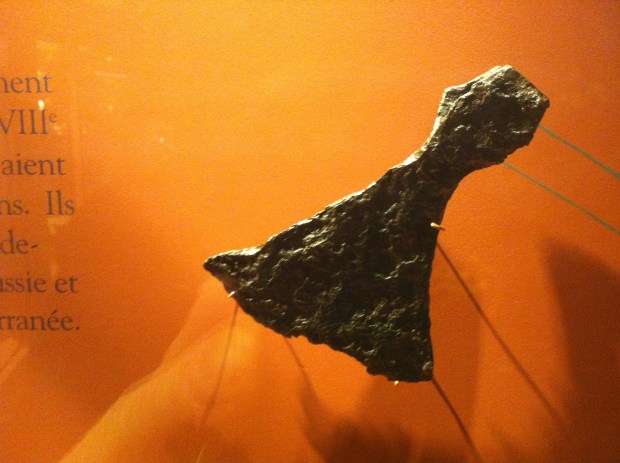
The Viking axe from the Beardmore relics on display with any mention of its past noticably absent.

The Viking axe from the Beardmore relics on display with mention of its past noticably absent.
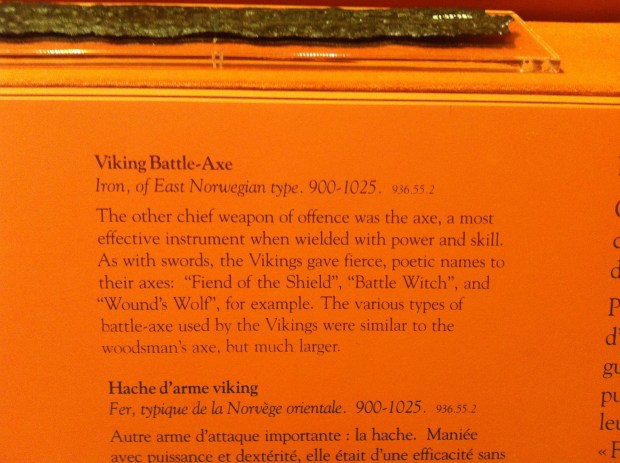
Description of the Beardmore axe.

Description of the Beardmore axe in the ROM display case.

1950s FINDS

Another Norse discovery was made in Aillik, Labrador when a Viking sword was found in a remote outpost on the coast of Labrador in 1953. A newspaper article of the time reports the find but I have been unable to determine what happened to the sword and whether or not it was authenticated. Perhaps it still lies in storage somewhere.
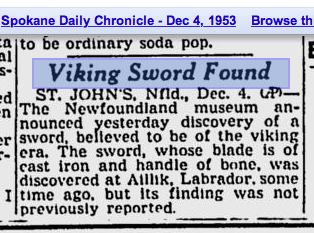
Newspaper article describing a Viking sword found in Aillik, Labrador.

Newspaper article describing a Viking sword found in Aillik, Labrador.

A few years later in 1957 Guy Mellgren, a local resident and amateur archaeologist, found a coin on August 18, 1957 in Brooklin, Maine. At first, like the previous finds, it was not thought to be Norse. It was thought to be a British penny from the 12th century. In 1978, experts from London considered that it might be of Norse origin. Today the identity of the Maine Penny was been authenticated by Kolbjorn Skaare of the University of Oslo who determined the coin had been minted between 1065 and 1080 AD. The penny was discovered with a hole in it that indicates it was probably used as a pendant of some sort, most likely by the indigenous people of Maine at the time it was being circulated by the Norse. The Norse penny currently resides in the Maine State Museum.
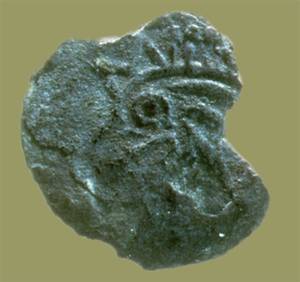
The Maine Penny. (photo Maine State Museum)

The Maine Penny. (photo Maine State Museum)


The Norse coin is thought to have ended up in Maine through native trading channels, coming down the coast from the Norse settlement at LAM. No Norse pennies have ever been found at LAM.

MOUNDS OF MYSTERY

In the same year the Maine Penny was discovered an archeologist from ROM travelled to Rainy Lake, Onatrio where he excavated a series of unusual mounds. Walter Kenyon visited the mounds and I was able to acquire his complete report on the 1957 excavation of the mounds that are located 250 km west of Thunder Bay on the border of Minnesota and Ontario. Of particular interest is Kenyon’s excavation of a large mound structure on Oak Point Island. Kenyon in his report on the find explains the mound showed evidence of intrusive burials, that is, someone had dug into an existing mound and put their own own bodies and items into it. As Kenyon unearthed the mound he discovered large angular rocks positioned with two burials and a number of items that present a curious collection of artefacts.
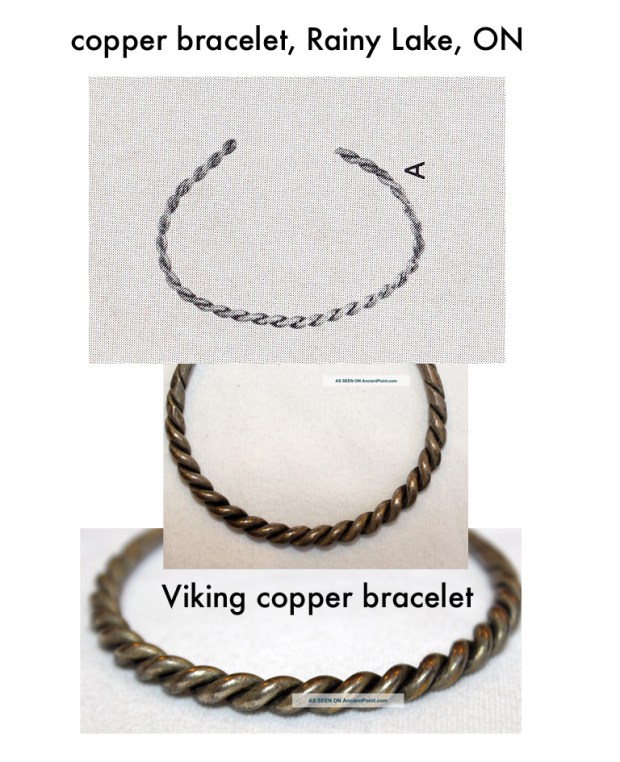
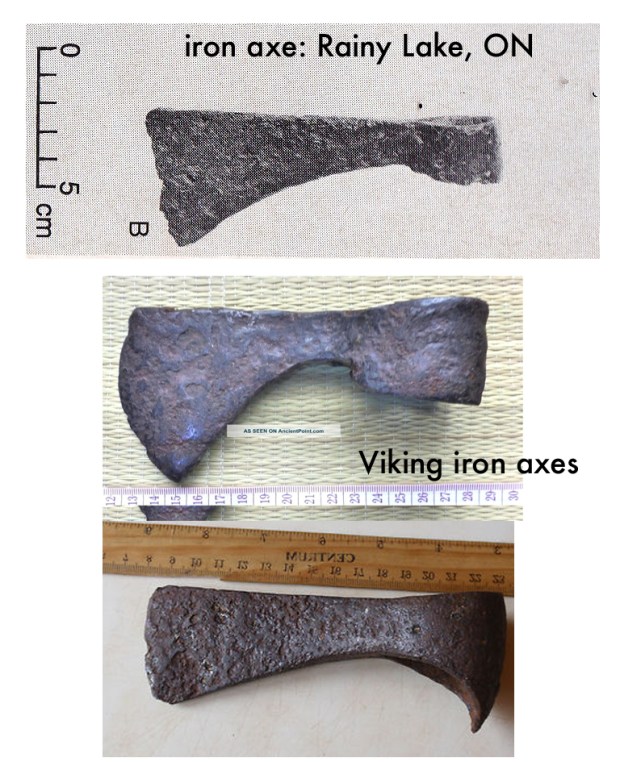
moundcompKenyon uncovered an iron axe, that was used as a hammer at some point, its head being distorted. Also uncovered were a finger ring, a twisted strand copper bracelet, thirteen thimbles, a copper spring, metal “ornaments” and a variety of other artifacts that included glass beads of various designs. Kenyon photographed and documented each item which was included in the archeological report but he gives no indication of their origin or why they are in a mound other than the fact there were a number of skeletal remains also discovered within. With the L’anse Aux Meadows site yet to be discovered, perhaps Kenyon wanted to play it safe and not make any speculation.

Examining these artifacts Kenyon unearthed I noticed some odd similatires to artifacts I had seen while visiting the Viking exhibit at the Museum Of History. There were strikingly similar details so I have placed them side by side in comparison for you to review for yourself and come to your own conclusions. This could be pure coincidence, and represent items from a different time period. It is also unknown where these artifacts are today. Do they rest in some storage container in the ROM warehouse, shoved away to never again be displayed for the public to see? It would seem logical to try and date these items and figure out their origins. Until then, we will have to settle for the accepted view that they are of native origin or from a much later date.
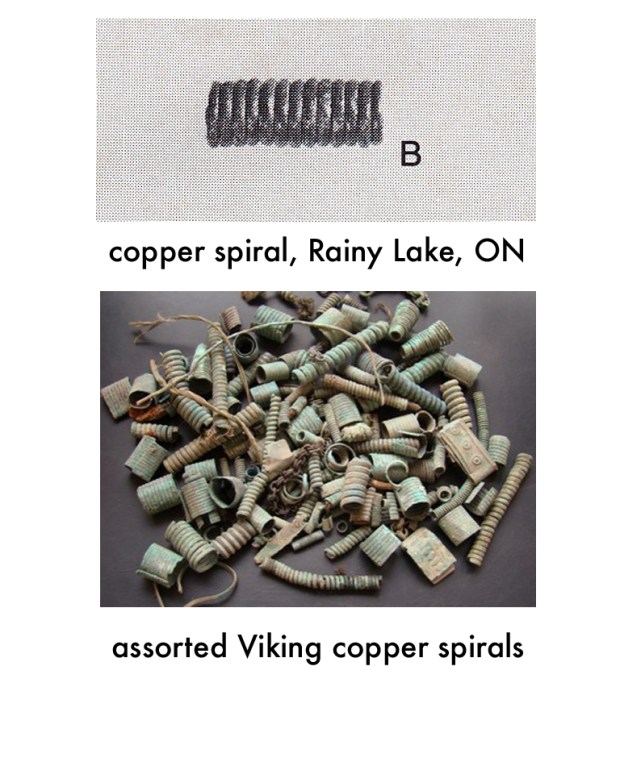
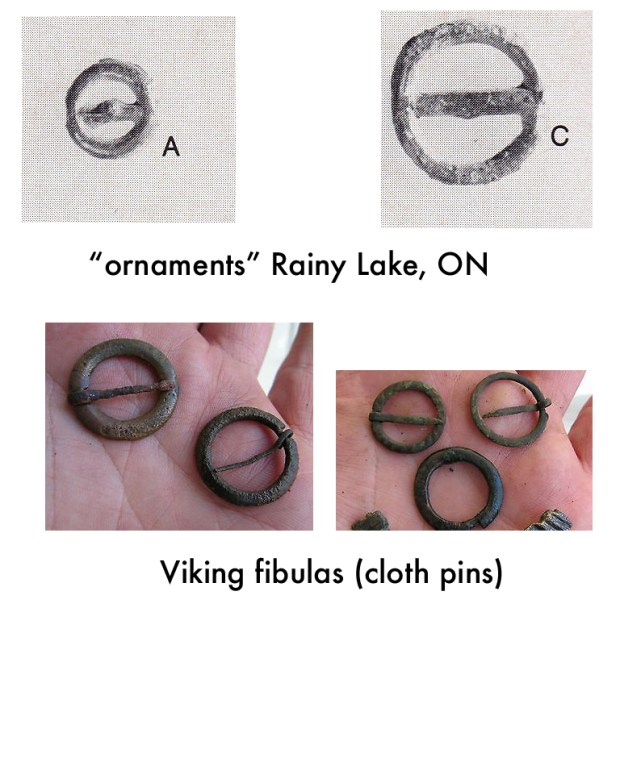
spiralcompfibulacompbraceletcompaxecomp

Kenyon also includes in his report a mention of the mounds in Prince Edward County discovered and studied by Thomas Wallbridge in 1860. Acquiring a copy of Wallbridge’s 1860 report on his findings of odd mounds in “The Canadian Journal Of Industry, Science and Art- 1860″ as part of the Smithsonian Institution collection, Wallbridge notes that before the native Iroquois that once roamed the region, there were “traces of a more ancient race”.
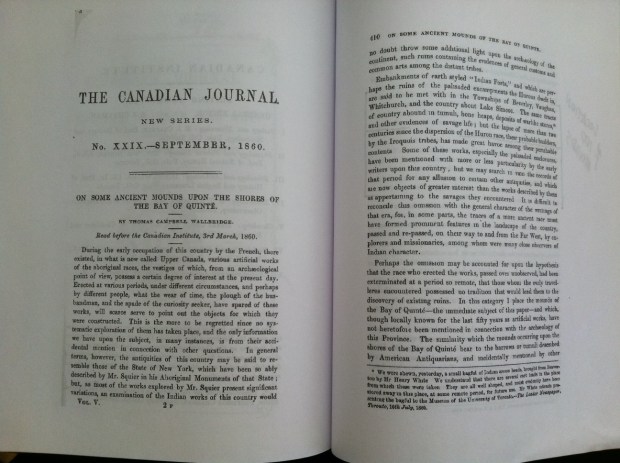
The 1860 archeological report of Wallbridge's examination of unusual mounds in Prince Edward County.

The 1860 archeological report describing Wallbridge’s examination of unusual mounds in Prince Edward County.

The fascinating entry in the journal remarks on how some “race” had erected works in Prince Edward County unnoticed, which became the subject of the first documented archaeological report in Ontario. Wallbridge noted that 100 mounds existed in Prince Edward County, and they occurred in groups of two on the shores of water. Upon excavating one of the mounds Wallbridge discovered a limestone box made up of flat stones, within which skeletons were found sitting in an upright position with folded arms.
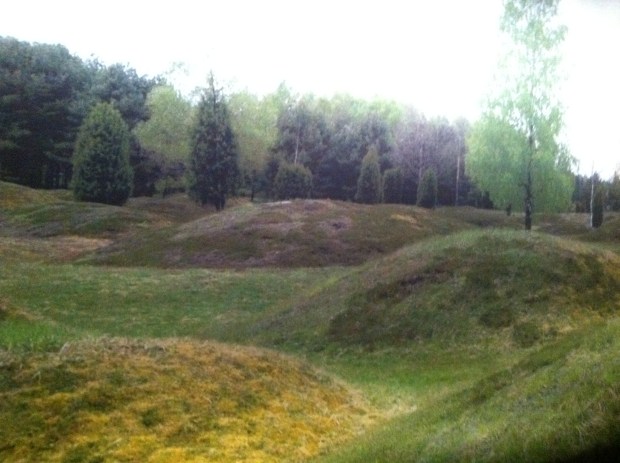
IMG_6768

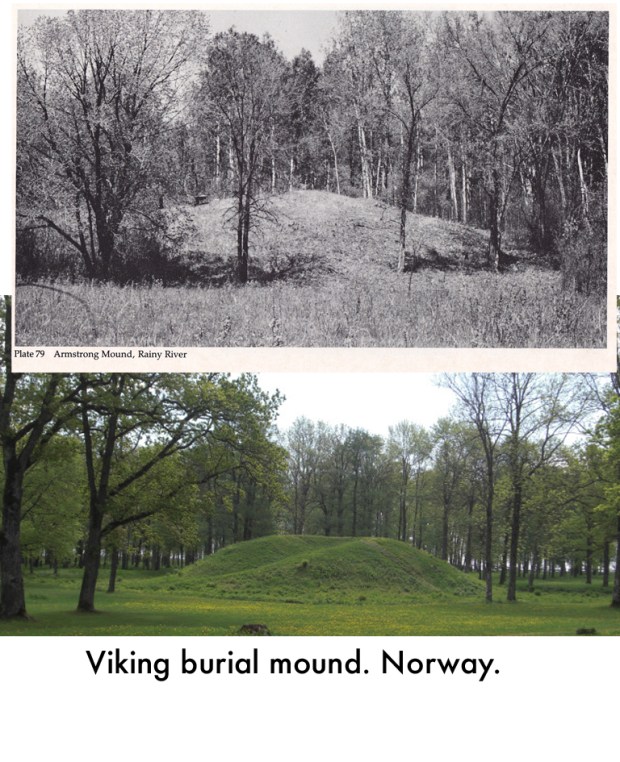
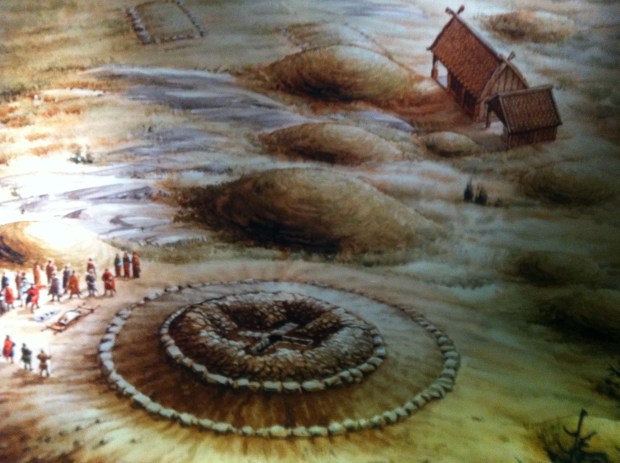
Viking burial mounds as shown at the Viking exhibit at the Museum Of History.

Viking burial mounds in Scandanavia as shown at the Viking exhibit at the Museum Of History.

Wallbridge concludes his report by saying “Whatever be the origin of these remains, it is clear that the Massassaga Indians were not the builders of the works which they are entombed, since this tribe, it is well known, buried their dead in wrapped birch bark, and laid them at full length a few inches beneath the surface of the soil,” Wallbridge is perplexed at the whole series of mounds, and insists “the skeletons found in the sitting posture belong to some other and far earlier race.”
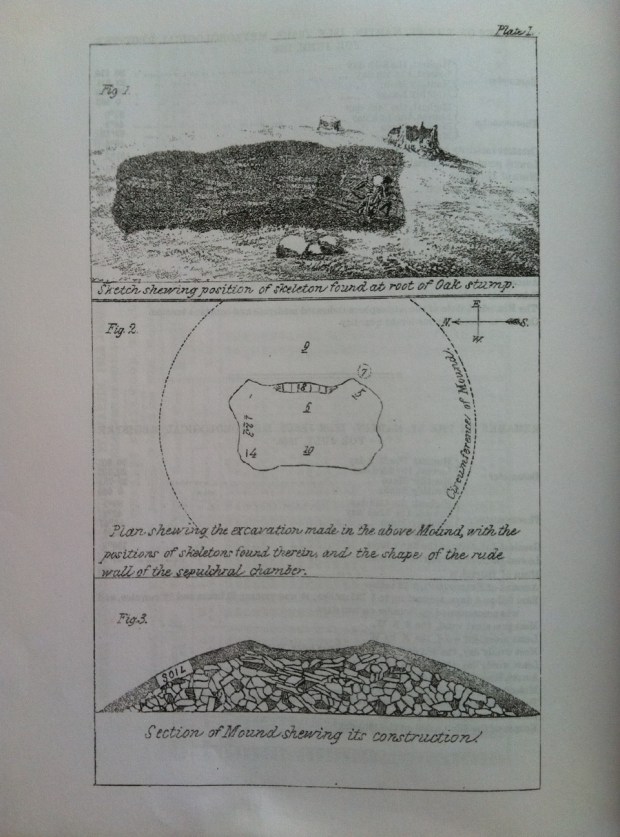
Wall bridge's sketches of his examination of the ancient mounds in Prince Edward County.

Wallbridge’s sketches of his examination of the ancient mounds in Prince Edward County.

Curious to view these mounds that lie within a short distance of my family’s home, I visited the Prince Edward County site to see for myself what characteristics they may have to give up some possible clues as to their purpose. The Ontario Archeology Report, 2001, Number 72, Page 38  has a thorough analysis of the mounds and striking similarities between those in PEC and mounds in Europe are given along with a comprehensive look at their possible function. Mapping out where the mounds may be located, I indeed came across the unusual mounds and recorded my finds. They are situated in close proximity to the shore of Lake Ontario facing east in groups of two. The mounds are about 20-ft in diameter and are about 8ft in height. The pair of mounds with their centre points connected with a line align to the rising sun in the east. Without permission or proper tools to investigate the mounds further, no other evidence was uncovered but these fascinating ancient structures demand further investigation by the proper institutions of historical research.
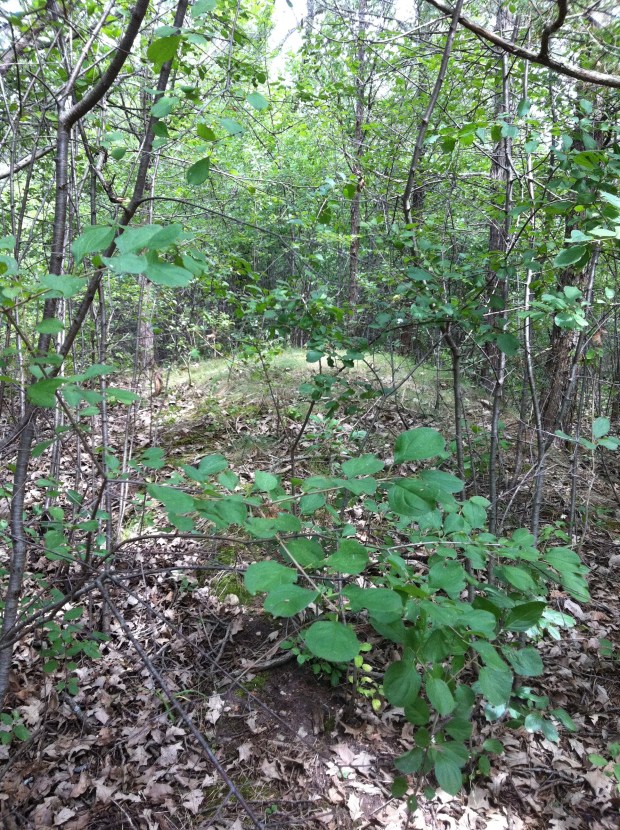
I explored the area Wallbridge described the mounds to be located in PEC and I came across the unusual mounds.

I explored the area Wallbridge described the mounds to be located in PEC and came across unusual mound shapes.

Kenyon then concludes his report on the mounds he found in an almost similar tone, noting most of the mounds were near water, the same situation in western Europe. Burial mounds in Europe were arranged around fjords or bays on high ground with views of the sea. The mounds found in Ontario share the same characteristics with Bronze Age burial mounds in Europe and those on the Orkney Islands off the United Kingdom. Is it pure coincidence that two entirely different cultures shared an almost identical mound building practice separated by the Atlantic Ocean? Perhaps they met and exchanged cultural practices that carried on for generations to come. It remains a curious mystery that the mounds generally contain another type of inner burial chamber with an outer indigenous intrusive burial on the top layer of the mound. One wonders if visitors of a different race at a different time as Wallbridge speculates first built the mounds and then they were later used for other burials practices by a future society. Again, without proper analysis that seems to be absent this can never be determined.

CURRENT DISCOVERIES

With most of the aforementioned Viking and related remnants having been discovered in the mid 20th century, it seems the whole Norse exploration mystery has remained on a simmering back burner for years. As our attention turns towards a more colonial French and Bristish occupation history of early Canada, these earlier visitations seem to go unnoticed and lack any further investigation. More recently the discovery of the butternut at LAM again opened the debate that Norse visitors ventured elsewhere in Canada and in 2012 the National Geographic published an article about the Norse in Canada after the curator of Arctic archeology at The Canadian Museum Of History (then called the Canadian Museum of Civilization) Patricia Sutherland discovered what is thought to be a Norse outpost on Baffin Island. Sutherland was abruptly fired for what was stated to be “harassment issues” in April 2012, (Ottawa Citizen article HERE) just months before her Arctic research was featured in National Geographic magazine, but her research is still available for viewing on the museum website HERE.

Another National Geographic Magazine article describes scientists found more than 80 living Icelanders with a genetic variation similar to one found mostly in Native Americans after analyzing a type of DNA passed only from mother to child. This would mean that a Native American joined someone from Iceland in North America, hopped aboard their ship and returned with them to procreate within Iceland. Brigitta Wallace who has written much about the Norse in Canada and is an archaeologist for Parks Canada has said that in the The Saga of Erik the Red four Skraeling boys (a Norse term for Native Americans) were captured by an Icelandic expedition and taken back to Greenland. This does not make it implausible a female was also brought back with the Vikings on their expeditions into Canada and has resulted in a DNA variation that combines Native American with Icelandic genes. It is interesting to note that no Inuit DNA shares any Norse DNA.

BUTTERNUTS AND BOOZE

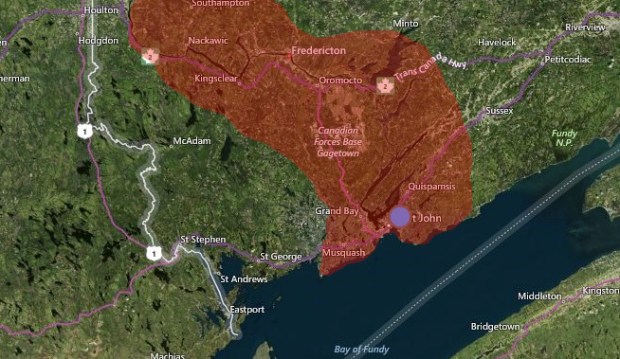
With evidence mounting that Norse explorers ventured elsewhere in Canada other than LAM, we can start to piece together a picture of what may have happened and the possible routes they may have taken. Compiling the locations of known relics (hoaxes or not) and the known areas where butternuts and wild grapes do indeed grow and have grown, we can create a map of possible exploration by our Norse visitors.
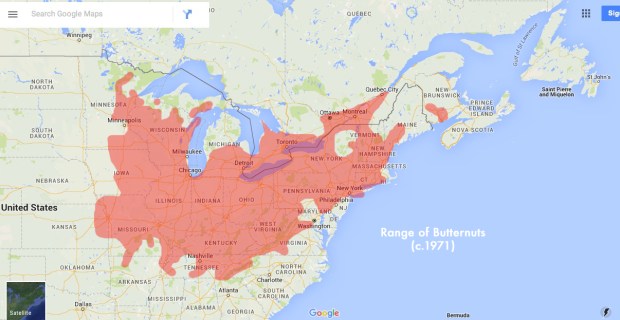
Range of butternuts.
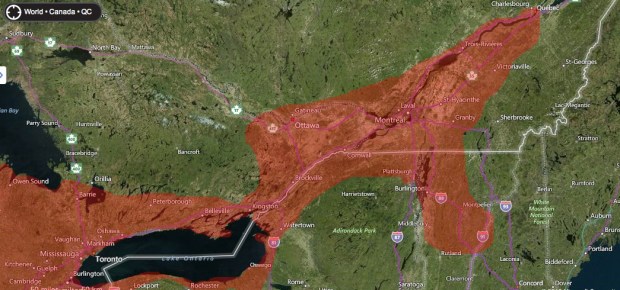
Range of butternuts.

Extent of butternuts along the St. Lawrence River and Lake Ontario.
Extent of butternuts along the St. Lawrence River and Lake Ontario.

Butternuts also occur along the St. John river in New Brunswick.

Butternuts also occur along the St. John river in New Brunswick.

With butternuts occurring along the southern part of the St. Lawrence River and into the shore regions of Lake Ontario as well as the interior of New Brunswick along the St. John River, and matching that with the area of wild grapes, a map of possibilities can be constructed. With projected exploration areas outlined, we can then “connect the dots” on certain routes and plot them out to determine where, if any, remains of Viking outposts or visitations may lie.
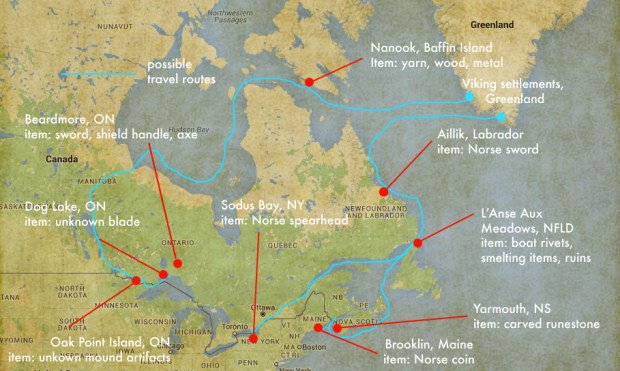
Possible Norse exploration routes.

Possible Norse exploration routes.

This narrows down the areas to either be in New Brusnwick or along the St. Lawrence River, areas where the Norse acquired the butternuts and grapes they took back to LAM. The existence of authentic Norse artifacts can not be denied, it is just figuring out how they got there that remains a mystery. trading with the indigenous tribes of the time is the accepted theory, but it seems odd these Norse items would make their way inland while none of these same items were ever found at LAM. It is not common practice for the Vikings to trade their weapon items with the native population, so how would they acquire them? Through conflict? Norse visitors may have come into Ontario further than we had thought possible. It is hard to request an investigation into these areas unknown without concrete evidence but if we look back on the speculation of the Ingstads in 1960 they proved to the world that legend can indeed be fact. Perhaps with the directed research and investigation into these projected areas we can prove once again an important part of Canadian, and ultimately, world history.
Vikings In Canada: A Mystery Revealed

vikingsSPLASHThis is a two part series that looks at the mystery of the Vikings lost settlements in Canada.

PART 1: Vikings Cometh

This week the Canadian Museum of History opened a special exhibit called “Vikings” described in the promotional material as “engaging interactive displays and 500 outstanding artifacts from The Swedish History Museum”. It only seems natural the Canadian Museum of History would host such an exhibit that explores the fabled Scandinavian culture since Vikings have now been proven to be the first Europeans to land in Canada one thousand years ago. The exhibit displays artifacts and information that seeks to tell the truth about Viking lore and the various myths associated with them. (no they did not wear helmets with horns on them)

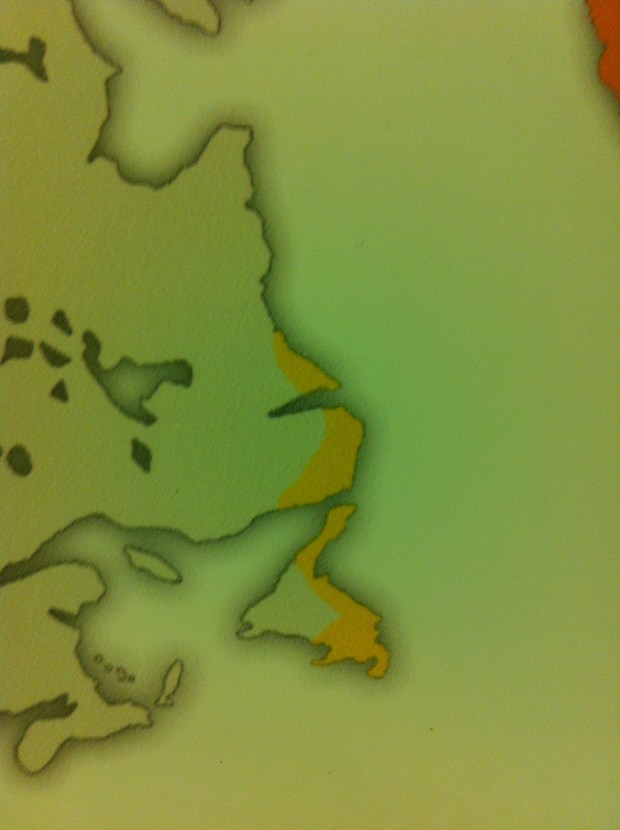
I was able to preview the exhibition before it opened and study the details of the exhibit to see if this collaboration between the Swedish History Museum in Sweden and MuseumsPartner in Austria would touch on the mystery surrounding Norse settlement in Canada. Many are skeptical about the Norse exploration of North America and I had hoped this exhibit would shed some light on the subject, but alas the only mention was a world map showing parts of Newfoundland where the only verified Viking settlement was unearthed in the 1960s.

The only Viking-Canada connection is this small map detail showing where Vikings may have settled in Canada.

The only Viking-Canada connection is this small map detail showing where Vikings may have settled in Canada.

I asked to speak with Gunnar Andersson, Senior Curator of the Viking exhibition from the Swedish History Museum about the Canadian Viking connection and he too had hoped the Canadian Museum of History would have contributed some material to exhibit. Andersson emphasized there is a rich Viking heritage in Canada which could have been tied into the exhibit.

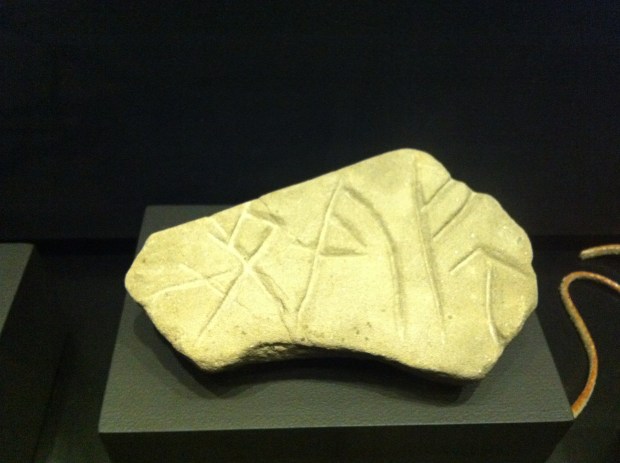
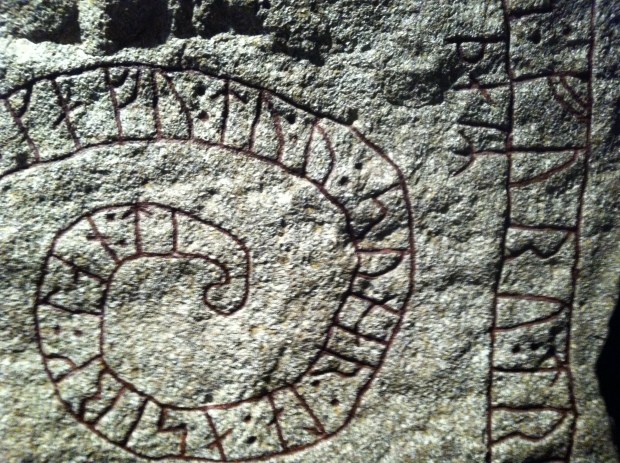
A stone with Viking rune carvings inscribed.

A stone with Viking rune carvings inscribed.

Contacting Stephanie Verner, Media Relations Officer for the Canadian Museum of History about the absence of a Canadian Viking connection, Verner responded “The exhibition does mention the Viking expansion westward to Iceland and Greenland, but does not significantly address activities in North America. As this was a borrowed exhibition intended to help debunk modern myths concerning the Vikings, the Canadian Museum of History did not add content from its own collections.” Verner did however state that in 2017 “The Viking/Norse presence in North America will be covered in the new Canadian History Hall which will open on July 1, 2017. The new Canadian History Hall will tell the story of Canada and its people from the dawn of human habitation to the present day.”

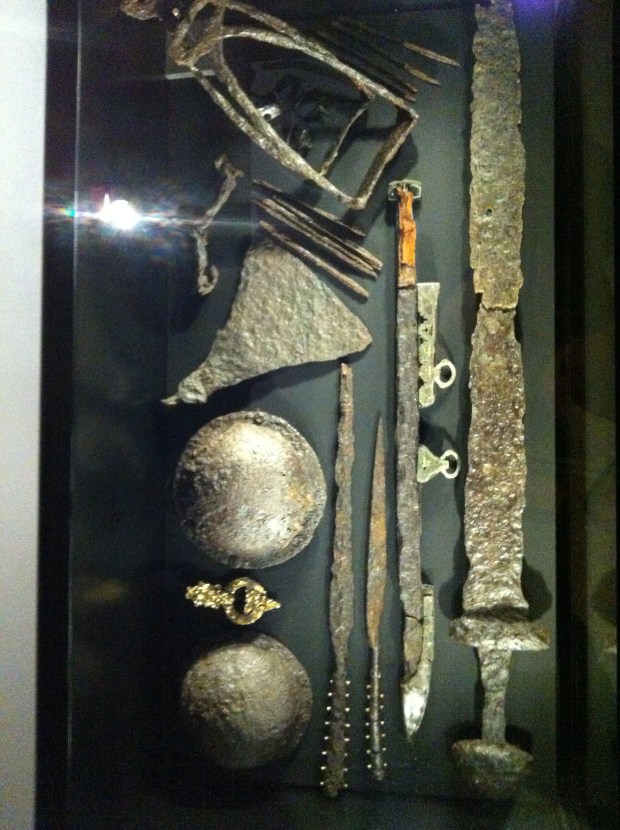
An assortment of unearthed Viking weaponry on display at the exhibit.

An assortment of unearthed Viking weaponry on display at the exhibit.

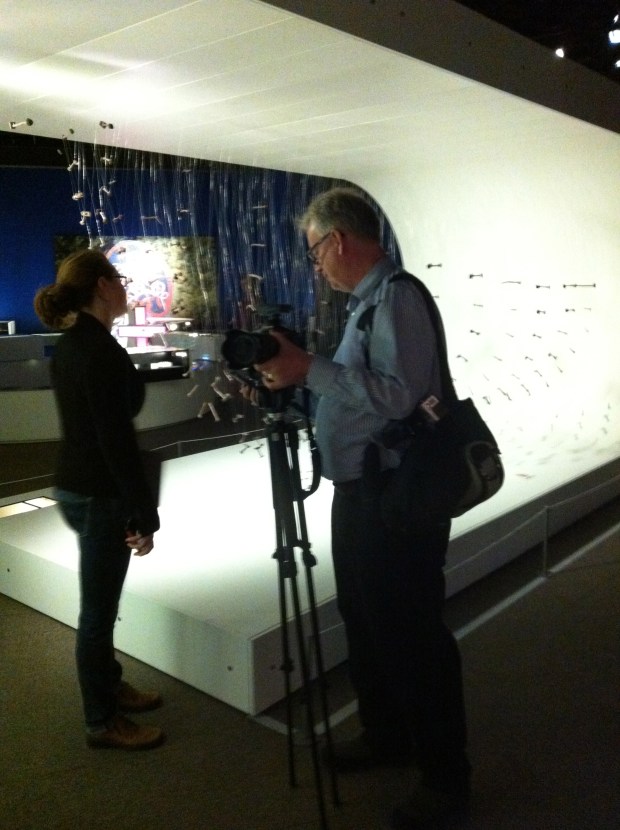
Regardless, the exhibit explores the lifestyle of the Vikings, a term they used to describe themselves during the Viking Age, an era between 750 and 1100AD. Fascinating artifacts are well displayed including weapons, household/cultural items and of course the Viking technological prowess in metallurgy and ship building. The most stunning part of the exhibit is a Viking “ghost ship” that exhibits hundreds of original iron rivets that would have held a ship’s long decomposed planks in place, suspended from the air by fishing line to form the shape of the ship’s hull.

Iron rivets that once held together the wooden planks of a Viking ship are suspended by fishing line to reveal a "Ghost Ship" hull shape.

Iron rivets that once held together the wooden planks of a Viking ship are suspended by fishing line to reveal a “Ghost Ship” hull shape.

Other noteworthy items are rune stones that show the cryptic carvings left by Vikings on rocks during their journeys across lands in Europe and the North Atlantic. After wandering the exhibit I felt like I was teleported back in time, completely immersed in the life and times of a Viking, which is an amazing feat for a temporary exhibit. I highly recommend checking it out and the IMAX film “Vikings” that runs until April 17 2016 at the Museum Of History.
Viking rune stone inscribed with Norse writing.
Viking rune stone inscribed with Norse writing on exhibit.

Leaving the exhibit one wonders if these daring adventurers from Scandanavia made it into Canada further than we have discovered. The idea of the Norse coming to Canada is nothing new, it was first the subject of legend, a tale of folklore in Scandanvia through the “Saga of Erik the Red” a tale preserved in two manuscripts; Hauksbók (14th century) and Skálholtsbók (15th century). In both there is a story describing the Norse exploration of North-America. This tale chronicled the events that led to Erik the Red’s banishment to Greenland as well as Leif Ericson’s discovery of a place called “Vinland” after his longship was blown off course and he journeyed to a distant land with trees, fish, grapes and riches beyond belief. It remained a fairytale for hundreds of years because how could anyone believe a bunch of barbaric warriors in wooden sailboats could ever cross the Atlantic ocean to another continent? Preposterous! The tales of Vinland and the journey made by the Viking explorers was long considered a myth.

The Norse traveling great distances was given credence when Viking settlements were found in Greenland. If they could make it to Greenland, then perhaps they could also make it to Canada. Ridiculous! said scholars of the time. Their wooden “Knarr” sailboats could never make the journey across the Atlantic to Canada! That was a task best left to explorers like Christopher Colombus, Jacques Cartier and Henry Hudson. Yet many did believe in the legend, and many tried to prove it true since most legends are usually based on a slice of fact.

In 1884 Dr. Lawson published an article in the Halifax Herald asking about Norwegians requesting information on the extent of wild grapes in Canada

In 1884 Dr. Lawson published an article in a Halifax newspaper about Norwegians requesting information on the extent of wild grapes in Canada. (Photo: google news)

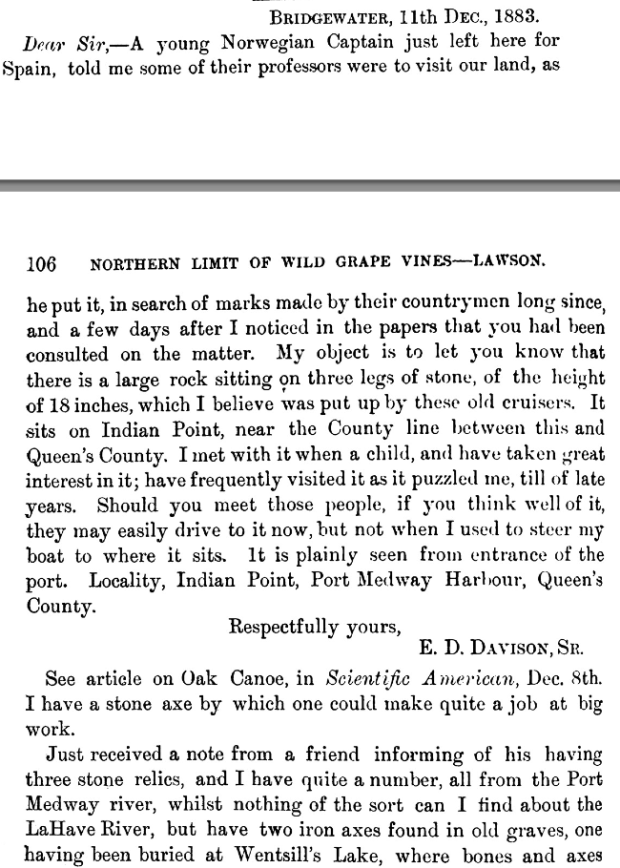
I managed to find some newspaper clippings that showed Norwegian scholars tried to prove the fable as fact in 1884 when a Dr. George Lawson of Halifax was asked by Norwegian professors on the extent of wild grapes in Canada, since that would reveal some information on where possible Norse explorers found the grapes needed to call their newly discovered land “Vinland”: land of the grape vine. The old saga described a land of wild grapes from which the Norse made wine, a very important ingredient to any rowdy Norse explorer meal plan. Dr. Lawson placed an article in the Halifax newspapers of the time, and was soon inundated with replies about odd ruins, stones with carvings in them, old axes and burial sites, that may reveal the existence of Norse explorers in the Nova Scotia region.

readers replied to Dr. Lawson about odd ruins, burial sites and artifacts in Nova Scotaia.

Many readers replied to Dr. Lawson about odd ruins, burial sites and artifacts in Nova Scotaia.

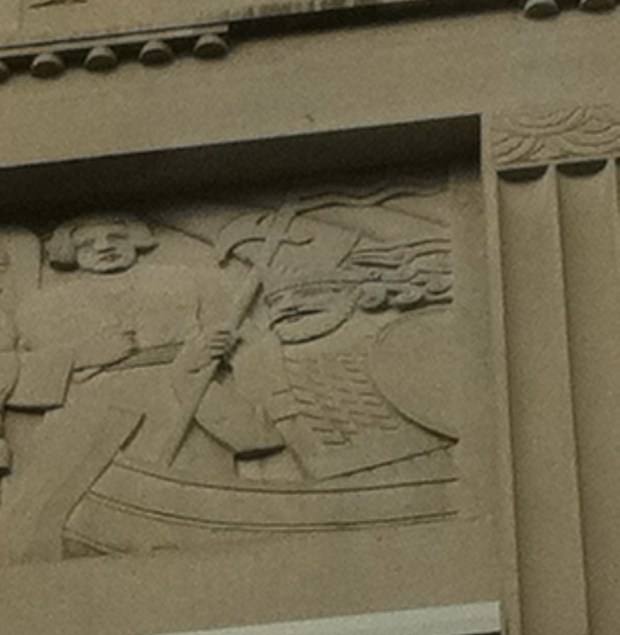
The idea of the Norse coming to Canada conjured up grand fantasies and “Viking Fever” swept the nation into the 1920s and 1930s, with many Viking artifacts being uncovered, their origin and provenance unknown. Viking relics in the Maritimes, Ontario, New York State, and the New England Coast started popping up and even a Bank Of Montreal building constructed here in Ottawa in 1930 on Sparks Street got in on the action with a relief sculpture depicting a Viking first discovering Canada.

A 1930 relief carving of a Viking first discovering Canada is depicted on the Bank Of Montreal on Sparks, St. Ottawa.

A 1930 relief carving of a Viking first discovering Canada is depicted on the Bank Of Montreal on Sparks, St. Ottawa.

The conjecture and speculation continued for almost another hundred years until the legend was finally proven to be fact. In 1960 the seemingly impossible became possible: archaeological remains of a Norse village were discovered in Newfoundland by two Norwegians, the explorer Helge Ingstad and the archaeologist Anne Stine Ingstad, a husband and wife team who once and for all proved the enduring legend was actually real.

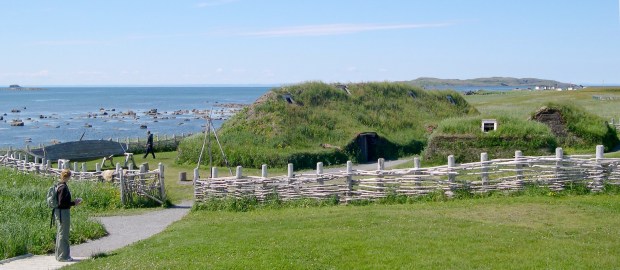
A site in northern Newfoundland was unearthed after the Ingstads asked local residents if there were any unusual ruins or features in the area. They had been studying old Norse maps that showed a peninsula labelled “Vinland” that seemed to match the shape of the upper peninsula of Newfoundland. The local residents pointed the Ingstad’s to some odd features that were once considered to be “old Indian ruins” but after excavation under the direction of Parks Canada in the 1970s a genuine Norse settlement at L’Anse aux Meadows was authentically dated to approximately 1,000 years ago, (carbon dating estimate 990 – 1050 CE). The Vikings were here.

The only verified Viking settlement discovered in Canada is in L'Anse Aux Meadows Newfoundland.

The only verified Viking settlement discovered in Canada is in L’Anse Aux Meadows Newfoundland. (photo: wikipedia)

Of particular interest in the excavation were many artifacts discovered that proved the Vikings had indeed landed, and stayed in Canada for about ten years. Iron smelting tools, household items, and dwellings were all found and verified to be those of the Vikings. Also found was an unusual nut, a butternut. Butternuts have not, and never did grow in Newfoundland. They exist only in regions much farther south than the LAM site. So how did a butternut get there?

A butter nut was found at the LAM site but they are, and have never been found in Newfoundland. Where did it come from?

A butternut was found at the LAM site but they are, and have never been found in Newfoundland. Where did it come from?

One would assume the Viking explorers ventured elsewhere and brought it back to the LAM site which was determined to be a temporary base camp for further explorations. LAM was not a permanent settlement, but rather a place to repair their boats and re-supply expeditions venturing elsewhere. But where was “elsewhere”? Why haven’t we found evidence that shows where the additional Norse adventures took them? Why haven’t we as a country looked more into this important piece of our history? Why have we stopped at LAM and not explored the possibilities Vikings carried onward to other places yet to be discovered? It seems like the one site was enough for our history books to handle and that is enough. Case closed.

However, this is what we are going to do now…look at possible explorations further inland that took our Norse visitors into North America and objects discovered that could show these explorations existed. So buckle up, we are heading to uncharted territory, a place filled with skepticism, hoaxes and of course a mystery that is long overdue to be solved. I must also note that I am not in anyway an expert on any form of archeology, but as an artist I am a curious thinker whose job it is to have a creative mind which I will utilize to provide my own analysis on what I think is a Great Canadian Viking Mystery. Using two years of collected research that includes overlooked artifacts sitting in small museums, old newspaper articles and current technological applications, let’s uncover more information and solve the great Viking mystery.

NEXT WEEK: Part 2 – Viking Evidence in Canada or an elaborate network of hoaxes?

Avro Arrow Test Negatives from 1958 Surface on Kijiji

The legend of the Avro Arrow endures after almost 60 years since it’s untimely demise in 1959. Images of the iconic Canadian designed and built advanced fighter jet being cut to pieces on the tarmac after cancellation of the Arrow program still leaves a bitter impression on many Canadians.

Not much survived that government ordered destruction of our beloved Arrow, a few pieces were whisked away by Avro employees before they were fired from the company, and the blow-torch scarred nose section and wings rest in the Aviation Museum in Ottawa.  These scraps are all that’s left to remind us of this unique part of Canadian history…until now…something new has arisen from the Avro ashes: Unpublished film negatives of a 1958 Avro Arrow test flight found for sale on Kijiji.

These are extremely rare, and the seller claims they are unpublished negatives from the June 11 1958 test run of the first Arrow prototype, “RL-201”.  The shots were taken by the seller’s father, who was a freelance photographer in 1958 and snapped these pics of the Arrow in Malton, On. The unpublished photos show the prototype Avro Arrow during a test flight, then sitting off a runway with its landing gear collapsed. Research shows that this particular incident occurred on June 11th 1958 when a malfunction resulted in main landing gear failure with the prototype Arrow skidding off the runway.

The Kijiji ad originates from Burlington, On, and after contacting the seller I was informed they are owned by the son of the original photographer, an inheritance after his father passed away. A direct link to the ad is HERE . Owning this rare piece of history comes with  $50,000 price tag for the 14 original film negatives. The ad photos show 6 of the 14 original negatives.  I used Photoshop to invert and flip them, providing us with the “positive” image as the Arrow test would have appeared on June 11th 1958 when this flight was captured on film.

The photos also capture the two Polish-Canadian test pilots who flew the Arrow, Janus Żurakowski and Wladyslaw “Spud” Potocki chatting in an office, positively identified in the photos negatives once I had inverted them. Zurakowski is from Barry’s Bay north-west of Ottawa where there is a town memorial commemorating his historic test flight in the Avro Arrow.

These remarkable photos speak for themselves but I have done my best to provide some explanatory captions below each negative and inversion image. I have contacted Canada Aviation and Space Museum who are now aware of the existence of these negatives..

Below are the original negatives and underneath each my reversal (positive) image and caption.

Enjoy this flight back in time.

NEGATIVE 1

NEGATIVE 1

NEGATIVE 1 INVERSION: This shows test pilot Janus kazolski in front of the first Arrow prototype RL 201

NEGATIVE 1 INVERSION: This shows test pilot Janus Zurakowski  in front of the first Arrow prototype RL 201

NEGATIVE 2

NEGATIVE 2

NEGATIVE 2 INVERSION: RL201 skidded off the runway after the landing gear collapsed.

NEGATIVE 2 INVERSION: RL201 skidded off the runway after the landing gear collapsed.

NEGATIVE 3

NEGATIVE 3

NEGATIVE 3 INVERSION: RL201, the first Avro Arrow prototype on take off.

NEGATIVE 3 INVERSION: RL201, the first Avro Arrow prototype on take off.

NEGATIVE 4

NEGATIVE 4

avro4A

NEGATIVE 4 INVERSION: Looks to be a scene from the Avro offices, with both Arrow test pilots, Zurakowski and Potocki. John Plant, President and GM of Avro is 3rd from left. Fred Smye, Avro Exec, Vice President is 2nd from right.

avro4Amarked

NEGATIVE 5

NEGATIVE 5

NEGATIVE 5 INVERSION: Arrow test pilot Zurakowski chatting with someone.

NEGATIVE 5 INVERSION: Arrow test pilot Zurakowski chatting with person unknown.

NEGATIVE 6

NEGATIVE 6

NEGATIVE 6 INVERSION: The prototype Arrow RL 201with landing gear collapsed on the Malton runway, June 11th, 1958.

NEGATIVE 6 INVERSION: The prototype Arrow RL 201with landing gear collapsed on the Malton runway, June 11th, 1958.

NEGATIVE 6

NEGATIVE 7

NEGATIVE 7 INVERSION: The two chase planes used by Avro to fly alongside the Arrow on its test flights, a Cf-100 Canuck and Cf-86 Sabre.

NEGATIVE 7 INVERSION: The two chase planes used by Avro to fly alongside the Arrow on its test flights, a Cf-100 Canuck and Cf-86 Sabre.